Section A - Governance

Accessibility Statement

We are committed to ensuring that our policy and procedure documents are accessible to all users. Please note that some appendices may contain images of sample forms or other visual examples. These images may not be fully accessible to individuals using screen readers or other assistive technologies.

If you require an accessible version of any appendix, need the information in an alternative format, or would like additional assistance, please contact us.

Board Code of Conduct

Date: 2003-11-25 / 2006-11-21 / 2013-03-05 / 2019-11-12 / 2024-10-29

Policy Statement

The St. Clair Catholic District School Board is committed to fostering Christ-centred, safe, caring and inclusive learning environments, supported by clear standards of behaviour is which are essential in developing an optimal learning environment.

This commitment is affirmed in Board policies, the Education Act, the Ontario Human Rights Code and Ministry of Education regulations and policy/program memoranda.

Policy Goals

The purpose of the Board’s Code of Conduct is to promote safe and caring schools founded on Catholic values and the Board’s mission; and to provide a framework for individual schools to develop a school-based Code of Conduct, which fosters a positive school climate and supports student achievement and well-being.

References

  • Education Act and Regulations
  • Ministry of Education Policy/Program Memorandum No. 128
  • Ontario Human Rights Code
  • Sec. B Policy – Responsible Use of Technology
  • Sec. C Policy – Dress Code for Elementary and Secondary Students
  • Sec. C Policy – Student Discipline
  • Sec. C Policy – Tobacco, Alcohol and Drug Abuse

Date: / / / /

Administrative Procedures

  1. Responsibilities

    The St. Clair Catholic District School Board Code of Conduct recognizes that all members of the school community, including principals, teachers and other staff members, students and parents have an obligation to comply with the standards of behaviour outlined in this policy. Each member of the school community has the following roles and responsibilities:

    1. The Board

      The Board will provide direction to its schools that ensure opportunity, excellence and accountability in the education system. It is the responsibility of the school board to:

      1. develop policies that set out how its schools will implement and enforce the Provincial Code of Conduct and all other rules that are related to the provincial standards that promote and support respect, civility, responsible citizenship, and safety (Student Discipline Policy);
      2. review these policies regularly with students, staff, parents/guardians, volunteers, and the community;
      3. seek input from school councils, Board Advisory Council, Special Education Advisory Committee, Indigenous Education Committee, parents/guardians, students, staff members, and the school community;
      4. establish a process that clearly communicates the Provincial Code of Conduct and local codes of conduct to all parents/guardians, students, staff members, and members of the school community in order to obtain their commitment and support;
      5. develop effective intervention strategies and respond to all infractions related to the standards for respect, civility, responsible citizenship, and safety; and
      6. provide opportunities for all staff to acquire the knowledge, skills, and attitudes necessary to develop and maintain academic excellence in a safe learning and teaching environment.
    2. Principals

      Under the direction of the Board, principals take a leadership role in the daily operation of a school. They provide this leadership by:

      1. exemplifying the principles of the Catholic faith with a demonstrated commitment to Catholic education, which fosters and guides the spiritual, intellectual, aesthetic, physical and social development of students in their formation as contributing, responsible Catholic citizens.
      2. demonstrating care for the school community and a commitment to academic excellence in a safe teaching and learning environment;
      3. holding everyone under their authority accountable for their behaviour and actions (Student Discipline Policy);
      4. empowering students to be positive leaders in their school and community; and
      5. communicating regularly and meaningfully with all members of their school community.

      Under the Education Act and regulations, principals have a duty to maintain proper order and discipline within the school. School codes of conduct are a key component of that duty. Principals shall develop school codes of conduct. A template is included as Appendix A.

    3. Teachers and Staff Members

      Under the leadership of their principals, teachers and other school staff members maintain order in the school and are expected to hold everyone to the highest standard of respectful and responsible behaviour. As role models, teachers and staff uphold these high standards when they:

      1. exemplify the principles of the Catholic faith with a demonstrated commitment to Catholic education, which fosters and guides the spiritual, intellectual, aesthetic, physical and social development of students in their formation as contributing, responsible Catholic citizens;
      2. help students work to their full potential and develop their sense of self-worth;
      3. empower students to be positive leaders in their classroom, school, and community;
      4. communicate regularly and meaningfully with parents/guardians;
      5. maintain consistent standards of behaviour for all students;
      6. demonstrate respect for all students, staff, parents/guardians, volunteers, and the members of the school board and school communities and relate to them in a Christian manner;
      7. prepare students for the full responsibility of citizenship, in particular of respectful communication, both in person and online;
      8. model the standards of respect, civility and responsible citizenship. This includes modeling appropriate use of personal mobile devices. Educators are not to use personal mobile devices during instructional time, unless explicitly for work related purposes; and
      9. inspire students to be active in the church and community.
    4. Students

      Students must demonstrate respect for themselves, for others, and for the responsibilities of citizenship through acceptable behaviour. Respect and responsibility are demonstrated when a student:

      1. comes to school prepared, on time, and ready to learn;
      2. shows respect for themselves, for others, and for those in authority;
      3. refrains from bringing anything to school that may compromise the safety of others;
      4. follows the established rules and takes responsibility for their own actions;
      5. elementary students will be required to keep personal mobile devices on silent and out of sight for the duration of the instructional day, from the time of arrival at school until the time of departure from the school, except under the following circumstances:
        1. for educational purposes, as directed by an educator;
        2. for health and medical purposes; or
        3. to support education needs.

        *Elementary students must hand in and store their device, as designated by the principal, should the educator see a personal device that is not stored out of view during instructional period.

      6. secondary students will store personal mobile devices out of view and powered off or set to silent mode during instructional time, except when their use is strictly permitted by the educator under the following circumstances:
        1. educational purposes, as directed by an educator;
        2. health and medical purposes; or
        3. to support education needs.

        *Secondary students must hand and store their device, as designated by the educator, should the educator see a personal device that is not stored out of view during instructional period. Students who refuse to do so will be sent to the principal’s office.

      7. if directed by the principal or vice-principal, display the contents of clothing, backpacks, etc. that are worn or carried on school property. Desks and lockers are school property, and a search is permissible by school administration;
      8. be dressed in a neat and well-groomed manner, according to the St. Clair Catholic District School Board’s Dress Code for Students.
    5. Parents/Guardians

      Parents/Guardians play an important role in the education of their children and have a responsibility to support the efforts of school staff in maintaining a safe and respectful Christ-centred learning environment for all students. Parents/guardians fulfill their role when they:

      1. show an active interest in their child’s school work and progress;
      2. communicate regularly with the school;
      3. help their child be neat, appropriately dressed and prepared for school;
      4. ensure that their child attends school regularly and on time;
      5. promptly report to the school their child’s absence or late arrival;
      6. show that they are familiar with the School’s Code of Conduct and school rules;
      7. encourage and assist their child in following the rules of behaviour; and
      8. assist school staff in dealing with disciplinary issues involving their child.
  2. Expectations

    Standards of Behaviour: respect, civility and responsible citizenship

    1. Members of the school board and school communities shall:
      1. respect and comply with all applicable federal, provincial, and municipal laws;
      2. comply with all Ministry of Education, school board and school policies;
      3. demonstrate honesty and integrity;
      4. respect differences in people, their ideas, and their opinions;
      5. treat one another with dignity and respect at all times, and especially when there is disagreement, both in person and on-line;
      6. respect and treat others fairly, regardless of, for example, race, ancestry, place of origin, colour, ethnic origin, citizenship, creed, gender identity, gender expression, sex, sexual orientation, age, marital status, family status or disability;
      7. respect the rights of others;
      8. show proper care and regard for school property and the property of others;
      9. take appropriate measures to help those in need;
      10. seek assistance from a member of the school staff, if necessary, to resolve conflict peacefully;
      11. refrain from using abusive language or swearing at another person;
      12. respect all members of the school community, especially persons in positions of authority; and
      13. respect the need of others to work in an environment that is conducive to learning and teaching.
    2. Members of the school board and school communities shall not:
      1. engage in bullying behaviours, including cyberbullying;
      2. commit sexual assault;
      3. traffic weapons or restricted drugs;
      4. give alcohol to a minor;
      5. commit robbery or theft;
      6. be in possession of any weapon, including firearms;
      7. threaten or intimidate another person;
      8. cause injury to any person with an object;
      9. be in possession of, or be under the influence of, or provide others with alcohol, cannabis, tobacco, electronic cigarettes, cannabis and related products or illegal and/or restricted drugs;
      10. for students, be in possession of electronic cigarettes, illegal drugs, or related products;
      11. inflict or encourage others to inflict bodily harm on another person;
      12. engage in hate propaganda and other forms of behaviour motivated by hate or bias;
      13. commit an act of vandalism that causes extensive damage to Board or school property or to property located on the premises of the school;
      14. swear at a teacher or at another person in a position of authority; and/or
      15. record, take, or share non-consensual recordings or photos of members of the school community.
  3. Application of the Standards of Behaviour

    The Board standards of behaviour apply to all members of the school board and school communities, including students, parents/guardians, teachers or staff members, volunteers and visitors.

    1. The standards of behaviour apply:

      1. on school board property;
      2. while travelling on a school bus that is owned by the Board or that is under contract to the Board;
      3. in-school sports activities;
      4. in off-site school and/or board-sponsored activities;
      5. in a virtual learning environment; and
      6. in circumstances where engaging in an activity could have a negative impact on the school board and/or school climate.
  4. Progressive Discipline

    1. In order to promote positive pupil behaviours that contribute to safe learning environments, the Board supports the use of positive practices for prevention and behaviour management. Progressive discipline is a non-punitive, whole school approach that uses a continuum of corrective and supportive interventions, supports and consequences to address inappropriate behaviour. When addressing inappropriate behaviour, school staff will consider the particular pupil and circumstances, including mitigating and other factors.
    2. Early and ongoing intervention strategies may include:
      1. Contact with the pupil’s parent(s)/guardian(s)
      2. Oral reminders & Review of expectations
      3. Written work assignment with a learning component
      4. Volunteer services to the school community
      5. Referral to counselling
      6. Conflict mediation and resolution
      7. Consultation
    3. When inappropriate behaviour has occurred, progressive discipline may also include a range of interventions, supports and consequences such as:
      1. Meeting with the pupil’s parent(s)/guardian(s), pupil and principal, teachers, school and related personnel
      2. Referral to a community agency for anger management or substance abuse counselling /intervention
      3. Detentions
      4. Withdrawal of privileges
      5. Withdrawal from class
      6. Restitution for damages
      7. Restorative practices
      8. Transfer to another class within the school
      9. Transfer to another school within the board
      10. Suspension or Expulsion
    4. Suspensions

      A principal shall consider whether to suspend a pupil if the principal believes that the pupil has engaged in any of the following activities while at school, at a school-related activity or in other circumstances where engaging in the activity will have an impact on the school climate:

      1. uttering a threat to inflict serious bodily harm on another person;
      2. possessing alcohol, illegal drugs or, unless the pupil is a medical cannabis user, cannabis;
      3. being under the influence of alcohol or, unless the pupil is a medical cannabis user, cannabis;
      4. swearing at a teacher or at another person in a position of authority;
      5. committing an act of vandalism that causes extensive damage to school property at the pupil’s school or to property located on the premises of the pupil’s school;
      6. bullying; and/or
      7. any other activity that is an activity for which a principal may suspend a pupil under a policy of the Board.
    5. Expulsions

      The infractions for which a principal may consider recommending to the Board that a pupil be expelled from the pupil’s school or from all schools of the Board include:

      1. possessing a weapon, including possessing a firearm;
      2. using a weapon to cause or to threaten bodily harm to another person;
      3. committing physical assault on another person that causes bodily harm requiring treatment by a medical practitioner;
      4. committing sexual assault;
      5. trafficking in weapons or in illegal drugs;
      6. committing robbery;
      7. giving alcohol or cannabis to a minor;
      8. bullying, if:
        1. The pupil has previously been suspended for engaging in bullying, and
        2. The pupil’s continuing presence in the school creates an unacceptable risk to the safety of another person.
      9. any activity listed that is motivated by bias, prejudice or hate based on race, national or ethnic origin, language, colour, religion, sex, age, mental or physical disability, sexual orientation, gender identity, gender expression, or any other similar factor; and/or
      10. any other activity that, under a policy of the Board, is an activity for which a principal must suspend a pupil and, therefore in accordance with this section, conduct an investigation to determine whether to recommend to the Board that the pupil be expelled.
    6. Further details, including the appeal process for suspensions and expulsions, are outlined in the St. Clair Catholic District School Board’s Sec. C Policy – Student Discipline.

  5. Board and School Codes of Conduct

    1. The purposes of the Board Code of Conduct are:
      1. to ensure that all members of the school community are treated with respect and dignity in accordance with our Catholic beliefs;
      2. to promote responsible citizenship by encouraging appropriate participation in the civic life of the school community;
      3. to maintain an environment where conflict and difference can be addressed in a manner characterized by respect and civility;
      4. to encourage the use of non-violent means to resolve conflict;
      5. to promote the safety of people in schools; and
      6. to discourage the use of alcohol and illegal and/or restricted drugs.
    2. A school code of conduct will:
      1. nurture the development of students’ self-worth, social responsibility, self-discipline and respect for others through a safe learning environment;
      2. outline a clear set of board, principal, staff, student and parent/guardian behaviour standards;
      3. provide a continuum of interventions based on a progressive discipline approach;
      4. apply to all activities taking place within the school and school grounds, on a school bus, or any other school related activity;
      5. be communicated to students, staff, and the parents/guardians of the school community; and
      6. be reviewed with students, parents and staff annually and with the School Council every three years;
  6. Community Partners and the Police

    1. Police and community members are essential partners in making our schools and communities safer. Community-based service providers are resources that the Board uses to deliver prevention or intervention programs. Protocols are effective ways of establishing linkages between the Board and community-based service providers and of formalizing the relationship between them. Community partners need to support and respect the rules of their local schools. Police will investigate and respond to incidents in accordance with the Police/School Board Protocol.
  7. Additional Information

    1. The St. Clair Catholic District School Board is committed to the principles of equity and inclusive education, consistent with our Catholic teachings, which value and promote human rights and social justice in all Board policies, programs, guidelines, operations and practices.
Board of Trustees Role

Date: 2003 11 25 / 2006 11 21 / 2013 03 05 / 2019 11 12

Policy Statement

The work of the Board is to serve as elected Trustees for the Catholic Community in ensuring effective governance.

Policy Goals

To distinguish the work of Trustees from the work of staff, the Board of Trustees will concentrate its efforts on the following:

  1. Providing the link between the organization and supporters of Catholic education in the St. Clair district, who have ownership of the publicly funded Catholic education system.
  2. Ensuring clarity of values and vision in Board policy which, at the broadest levels, addresses:
    1. Governance Process: This describes how the Board conceives, carries out and monitors its own task (Accountability: Board of Trustees).
    2. Board: Director Relationship: This describes how authority is delegated, and its proper use monitored; and outlines the authority and accountability of the Director of Education. (Accountability: Board of Trustees).
    3. Strategic Directions / Annual System Goals: This sets out the objectives for the year. (Accountability: Director of Education).
    4. Executive Limitations: These place constraints on executive authority (e.g. needing to adhere to policies and to maintain a balanced budget). (Accountability: Director of Education).

Catholic Director of Education Performance Appraisal

Date: 2003-11-25 / 2006-11-21 / 2013-03-05 / 2019-11-12 / 2024-10-29

Policy Statement

The Director of Education is accountable to the Board of Trustees for the operation and performance of the organization. All authority and accountability for staff rest with the Director of Education.

Policy Goals

  1. The Director of Education’s contributions should be annually stated as performance in two areas:
    1. Organizational accomplishment of the Multi-Year Strategic Plan
    2. Organizational operation within the boundaries of prudence and ethics established in Board policy and Ontario Acts, Statutes and Regulations

References

  • Education Act and Regulations

Date: 2022 05 31 / 2024 10 29

Administrative Procedures

The St. Clair CDSB adheres to the strategic priorities as set out in the Board’s Strategic Plan 2022-2026, and the Vision, Mission, Priorities and Values of the Board. The successful performance of the Director of Education is critical to ensuring organizational success and provides demonstrated evidence of progress towards the achievement of Board goals and priorities. The Board recognizes that success for the system is achieved through collaboration, consultation, and cooperation between the Board of Trustees and the Director of Education and that the success of the Director of Education Performance Appraisal (DPA) process is dependent upon good faith, clear communication, and adherence to shared Catholic system values. The DPA policy and procedure will support student success and foster ethical Catholic leadership and confidence in Catholic education by ensuring that regular and cyclical performance appraisals of the Director of Education are completed.

While feedback is an ongoing process, the DPA is conducted annually in alignment with O. Reg. 83/24. It is an opportunity each year to clarify expectations, set goals and priorities, and engage in constructive and strategic dialogue.

The Board of Trustees: Accountability, Transparency and Confidentiality

The Board will ensure that an accountable, transparent and effective Director of Education Performance Review process will:

  1. Identify a clear rationale and objectives for the process;
  2. Clearly outline a process and timelines;
  3. Identify mutually agreed upon assessment criteria and goals that are measurable, based on the Multi-Year Strategic Plan, the Director’s Annual Report, legislative requirements and Board policy;
  4. Collect objective evidence to support assessment criteria and goals;
  5. Outline overall performance based on agreed upon assessment criteria and goals;
  6. Identify a process for addressing situations where performance is unsatisfactory;
  7. Include a written report for approval by the Board of Trustees; and
  8. Comply with all expectations set forth in O. Reg. 83/24.

The Board will maintain and respect confidentiality throughout the DPA process by ensuring that:

  1. The DPA is confidential and will be conducted in private. In accordance with the Education Act, Section 207(2)(b), Closing of certain committee meetings, which states the disclosure of intimate, personal, or financial information in respect of a member of the Board or committee, an employee or prospective employee of the board or a pupil or his or her parents or guardians, specific details and materials related to the performance review will remain confidential; and
  2. Discussion shall be limited to the process and the identification of goals and performance indicators.

Responsibilities

Trustees shall:

  1. Be aware of their individual and collective responsibilities as the Board of Trustees related to the DPA process;
  2. Participate in and complete the DPA process, when required;
  3. Maintain confidentiality;
  4. Review the DPA policy in accordance with the priorities in the Multi-Year Strategic Plan and the approved policy review cycle;
  5. Develop and implement the DPA and provide constructive feedback with a focus on effective strategies and leadership practices that demonstrate progress on agreed upon goals and performance indicators; and
  6. Approve any revisions to the DPA procedure.

The Director of Education is responsible for:

  1. Actively participating in the performance review process;
  2. Collaborating with the Chair and Vice Chair of the Board and DPA committee to determine the goals and performance indicators that are aligned with the Director’s Annual Growth Plan, the Multi-Year Strategic Plan, and any other mutually determined goals;
  3. Allocating staff and resources to support the implementation of the DPA;
  4. Knowing their responsibilities and the individual and collective responsibilities of trustees related to the DPA;
  5. Discussing the evaluation process and developing a work plan with the Chair of the Board;
  6. Working with the Chair of the DPA committee to achieve consensus on final goals;
  7. Completing the appropriate tools identified in this procedure;
  8. Reflecting on shared learning and implementing goals, priorities, and areas of improvement; and
  9. Maintaining confidentiality.

Dispute Resolution

If the Director of Education, Chair and Vice Chair of the Board do not agree on the final evaluation, the following process will be followed.

A three-member panel composed of the following individuals will be established:

  1. One member will be selected by the Director of Education in consultation with the English Council of Catholic Directors of Education (ECCODE) and CODE;
  2. A second member will be selected by the Chair or Vice Chair in consultation with the Ontario Catholic School Boards Association (OCSTA); and
  3. A third member will be an external consultant, with expertise in mediation, agreed upon by ECCODE and OCSTA.

This three-member panel will consider all information presented by the Chair or Vice Chair of the Board, the Director of Education, and the external consultant and make recommendation(s) to the Board for consideration. The external consultant will facilitate this process.

Timelines

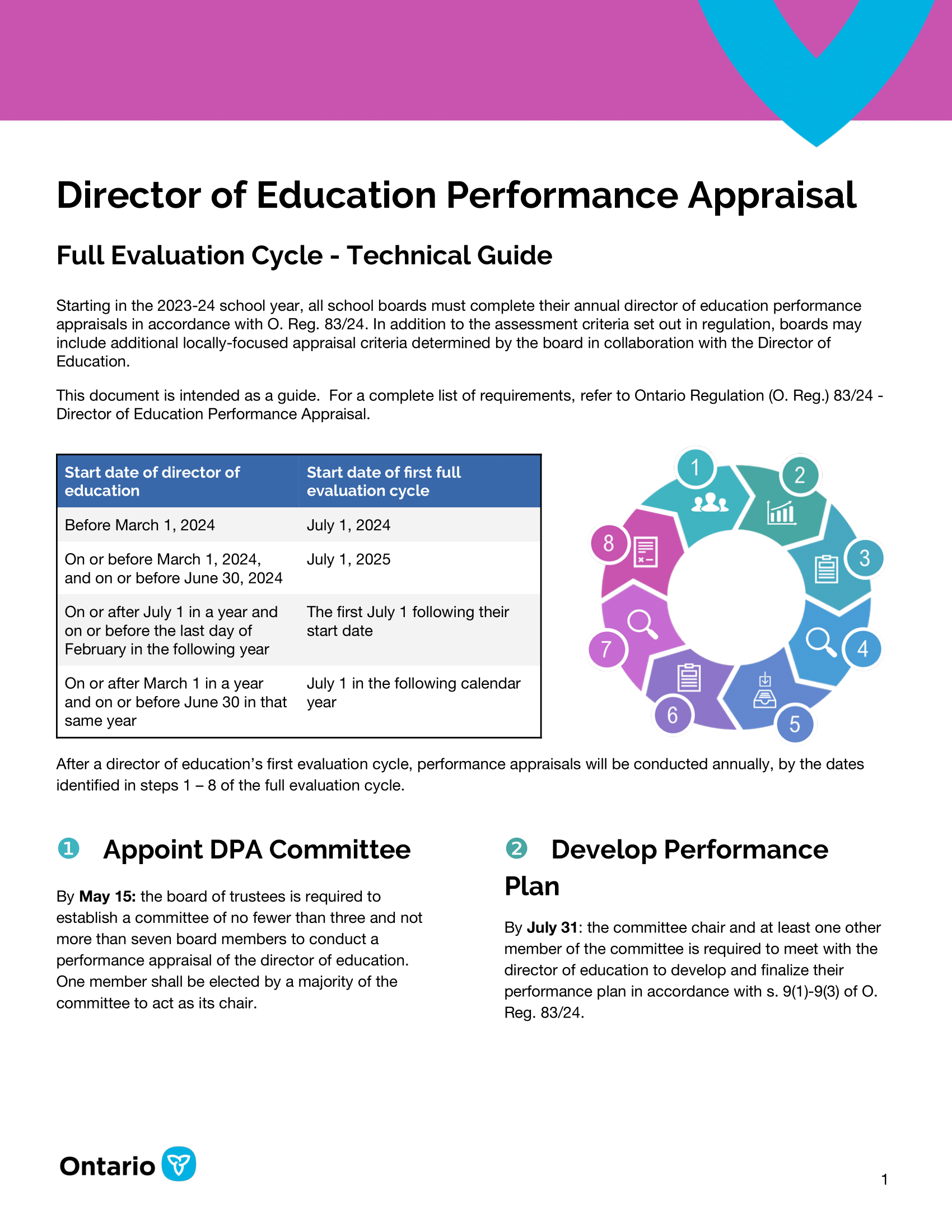
Starting in the 2023-2024 school year, the Board must complete the annual DPA in accordance with O. Reg. 83/24. In addition to the assessment criteria set out in regulation, the Board may include additional locally focused appraisal criteria determined by the Board in collaboration with the Director of Education.

An incoming Director of Education will undergo their first DPA based on their start date in accordance with the following schedule:

Start date of the Director of Education Start date of first full evaluation cycle
On or after July 1 in a year and on or before the last day of February in the following year The first July 1 following their start date
On or after March 1 in a year and on or before June 30 in that same year The July 1 in the following calendar year

A Director of Education whose start date falls on or after March 1 will complete their first DPA according to the Interim Evaluation Cycle section below. After the Director of Education’s first evaluation cycle, the DPA will be conducted annually by the dates identified in O. Reg. 83/24 as is outlined in the Full Evaluation Cycle section below.

Interim Evaluation Cycle

Step 1: Appoint DPA Committee

On or before May 15, the Board will establish a committee of no fewer than three and not more than seven Board members to conduct the DPA. One member shall be elected by a majority of the committee to act as Chair of the DPA committee.

Step 2: Develop Performance Plan

Within 30 days of the Director of Education’s start date, the Chair and at least one other member of the DPA committee will meet with the Director of Education to develop and finalize their performance plan in accordance with s. 9(1)-9(3) of O. Reg. 83/24.

Step 3: Notice of Performance Plan

Within 45 days of the Director of Education’s start date, the Chair of the DPA committee will provide a copy of the Director of Education’s performance plan to every member of the Board.

The Chair of the DPA committee will also provide written notice to the Minister which includes:

  1. The date that the Director of Education began their role; and
  2. Confirmation that the Director of Education’s performance plan has been put in place for the current evaluation cycle.

In addition, the Chair of the DPA committee must post a copy of the confirmation to the Board’s website.

Step 4: Mid-year Review

At least 20 days before the Chair and at least one other member of the DPA committee are due to meet with the Director of Education to discuss progress on the performance plan, the Chair of the DPA committee will request feedback from every member of the Board on the Director of Education’s progress towards implementing and achieving the goals in the performance plan.

At least 10 days before the Chair and at least one other member of the DPA committee are due to meet with the Director of Education to discuss progress on the performance plan, each member of the Board will have the opportunity to provide feedback to the Chair of the DPA committee.

On or before the closest weekday to a date that is midway between the date that notice is provided to the Minister and the final day of the interim evaluation period, the Chair and at least one other member of the DPA committee shall meet with the Director of Education to review progress towards implementing and achieving goals in the performance plan.

Step 5: Draft DPA Report

On or before June 10, the Director of Education shall update the performance plan in accordance with s. 9(4) of O. Reg. 83/24.

On or before June 20, the Chair of the DPA committee will provide a copy of the draft DPA report, prepared in accordance with s. 10 of O. Reg. 83/24 to every member of the Board.

On or before June 30, each member of the Board will give any feedback they might have in response to the request for feedback.

Step 6: Review DPA Report

On or before July 7, the Chair of the DPA committee will provide the draft DPA report to the Director of Education.

On or before July 31, the Chair and at least one other member of the DPA committee will meet the Director of Education to review actions to achieve a performance plan, update the performance plan for the following evaluation cycle, discuss the draft of the DPA report, and provide opportunity for response.

Step 7: Final DPA Report

On or before August 10, the DPA committee will finalize the DPA report and provide the final report to the Director of Education.

On or before August 15, the Board will provide written confirmation to the Minister that the DPA has been conducted and adopted by Board resolution. On that same date, the Board will post a copy of the written confirmation to the Board’s website.

Full Evaluation Cycle

Step 1: Appoint DPA Committee

On or before May 15, the Board will establish a committee of no fewer than three and not more than seven board members to conduct the DPA. One member shall be elected by a majority of the committee to act as Chair of the DPA committee.

Step 2: Develop Performance Plan

On or before July 31, the Chair and at least one other member of the DPA committee will meet with the Director of Education to develop and finalize their performance plan in accordance with s. 9(1)-9(3) of O. Reg. 83/24.

Step 3: Notice of Performance Plan

On or before August 15, the Chair of the DPA committee will provide a copy of the Director of Education’s performance plan to every member of the Board.

On or before August 15, the Chair of the DPA committee will also provide written notice to the Minister of Education which includes:

  1. The date that the Director of Education began their role;
  2. Confirmation as to whether bi-annual feedback (as stated in s. 8(1) of O. Reg. 83/24) is required during the current evaluation cycle; and
  3. Confirmation that the Director of Education’s performance plan has been put in place for the current evaluation cycle.

In addition, the Chair of the DPA committee must post a copy of the confirmation to the Board’s website.

Step 4: Mid-year review

In a full evaluation cycle in which bi-annual feedback is required, by December 1 the Minister will provide written notice to the Board and the Director of Education on whether the Minister intends to provide feedback under s. 8.

On or before January 11, the Chair of the DPA committee shall request feedback from every member of the Board on the Director of Education’s progress toward implementing and achieving the goals in the performance plan.

On or before January 21, each member of the Board will provide feedback to the Chair of the DPA committee.

On or before January 31, the Chair of the DPA committee and at least one other committee member shall meet with the Director of Education to review progress towards implementing and achieving goals in the performance plan.

Step 5: Bi-annual feedback

The Board shall procure an entity to conduct the bi-annual feedback that has at least five years of experience conducting multi-source executive performance assessments.

On or before April 30, starting in the first full evaluation cycle and every second full cycle year thereafter, the entity selected to conduct the bi-annual feedback will request feedback from the following individuals (as listed in s. 8(2) of O. Reg. 83/24 in respect to the Director of Education’s performance):

  1. Each member of the Board.
  2. Each student trustee of the Board.
  3. Each member of every statutory, ad hoc, or other committee of the Board.
  4. Each staff member of the Board who reports directly to the Director of Education.
  5. Each parent member of the school council at each school of the Board.
  6. A representative nominated by each local employee association representing employees of the Board.
  7. A representative sample of community partners and stakeholders, as identified by the DPA committee with input from the Director of Education.
  8. If the Minister has provided notice to the Board and Director of Education of their intention to provide feedback, the Minister is to be involved in providing feedback.

Step 6: Draft DPA report

On or before May 15, the entity selected to conduct the bi-annual feedback will prepare a written report that summarizes and analyzes feedback and will submit the report to the DPA committee and the Director of Education.

On or before June 10, the Director of Education shall update their performance plan in accordance with s. 9(4) of O. Reg. 83/24.

On or before June 20, the Chair of the DPA committee will provide a copy of the draft DPA report, prepared in accordance with s. 10 of O. Reg. 83/24, to every member of the Board.

On or before June 30, each member of the Board will provide any feedback on the draft DPA report to the DPA committee.

Step 7: Review draft DPA report

On or before July 7, the Chair of the DPA committee will provide the draft DPA report to the Director of Education.

On or before July 31, the Chair and at least one other member of the DPA committee will meet with the Director of Education to review actions implemented to achieve goals in the performance plan, update the plan for the following evaluation cycle, discuss the draft of the report, and provide opportunity for response.

Step 8: Final DPA report

On or before August 10, the DPA committee will finalize the DPA report and provide the final report to the Board and the Director of Education.

On or before August 15, the Board shall provide the following items to the Minister:

  1. Written confirmation that the DPA has been conducted and adopted by Board resolution; and
  2. A list of community partners and stakeholders that participated in the bi-annual feedback.

On that same date, the Board shall post a copy of both above listed items to the Board’s website.

Performance Appraisals and Ratings

Based on the results of the DPA, the DPA committee shall assign one of the following performance ratings to the Director of Education:

  1. Meets all expectations.
  2. Meets most expectations.
  3. Meets some expectations.
  4. Does not meet expectations.

When determining which performance rating to assign to the Director of Education for the Board, the DPA committee shall consider the following factors:

  1. The extent to which the Director of Education worked diligently and consistently toward the implementation of the actions identified in the performance plan.
  2. The efforts made by the Director of Education to engage staff, community partners and stakeholders, and others in the development of the goals and implementation of the actions identified in the performance plan.
  3. The degree of success the Director of Education had in achieving the goals set out in the performance plan, as informed by data available to the Board including:
    1. The feedback set out in the report required by executive performance consulting firm if applicable, and
    2. The information collected by the school climate surveys required by subsection 169.1 (2.1) of the Act in respect of the evaluation cycle, if applicable.
  4. The rationale provided by the Director of Education for the actions that were not implemented and the goals that were not achieved.
  5. The effectiveness of efforts made to overcome challenges faced by the Director of Education in implementing the actions identified in the performance plan.
  6. The demonstrated ability and willingness of the Director of Education to address, in the future, the actions that were not implemented and the goals that were not achieved.

The DPA committee shall summarize their evaluation in the draft DPA report, setting out the performance rating and providing an explanation for the rating.

Additional Information

The St. Clair Catholic District School Board is committed to the principles of equity and inclusive education, consistent with our Catholic teachings, which value and promote human rights and social justice in all Board policies, programs, guidelines, operations and practices.

List of Appendices

Appendix Description
Appendix A Director of Education Performance Appraisal: Full Evaluation Cycle – Technical Guide
Appendix B Director of Education Performance Appraisal: Interim Evaluation Cycle – Technical Guide
Appendix C Catholic Director of Education Appraisal Report
Appendix D Catholic Director of Education Appraisal Report Instruction Guide
Appendix E Sample Template - Director of Education Performance Appraisal Written Confirmation of Performance Plan
Appendix F Sample Template – Director of Education Performance Appraisal Written Confirmation of Completion
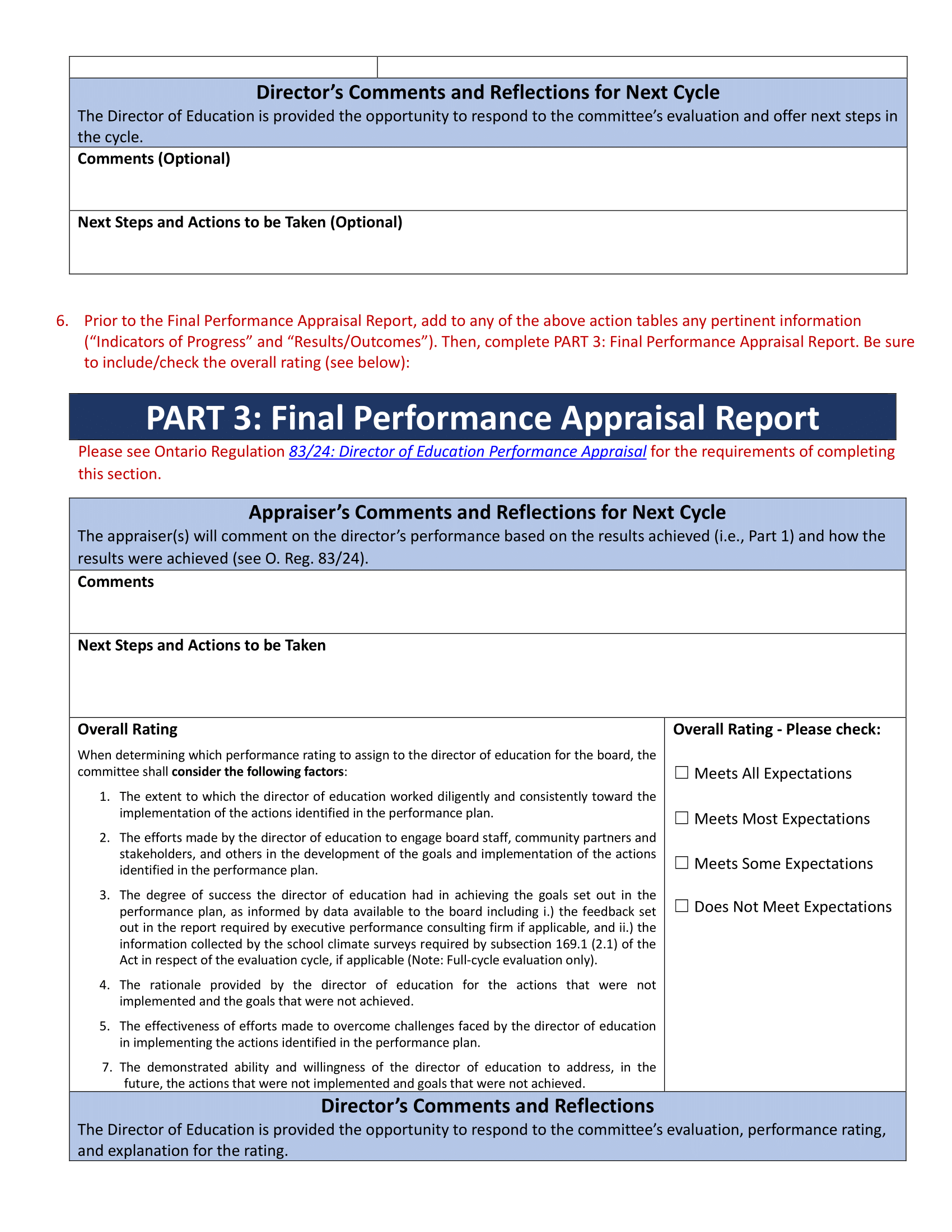
Page 1 of Director of Education Performance Appraisal, Full Evaluation Cycle - Technical Guide Page 2 of Director of Education Performance Appraisal, Full Evaluation Cycle - Technical Guide Page 3 of Director of Education Performance Appraisal, Full Evaluation Cycle - Technical Guide
Page 1 of Director of Education Performance Appraisal, Interim Evaluation Cycle - Technical Guide

Catholic Director of Education Appraisal Report

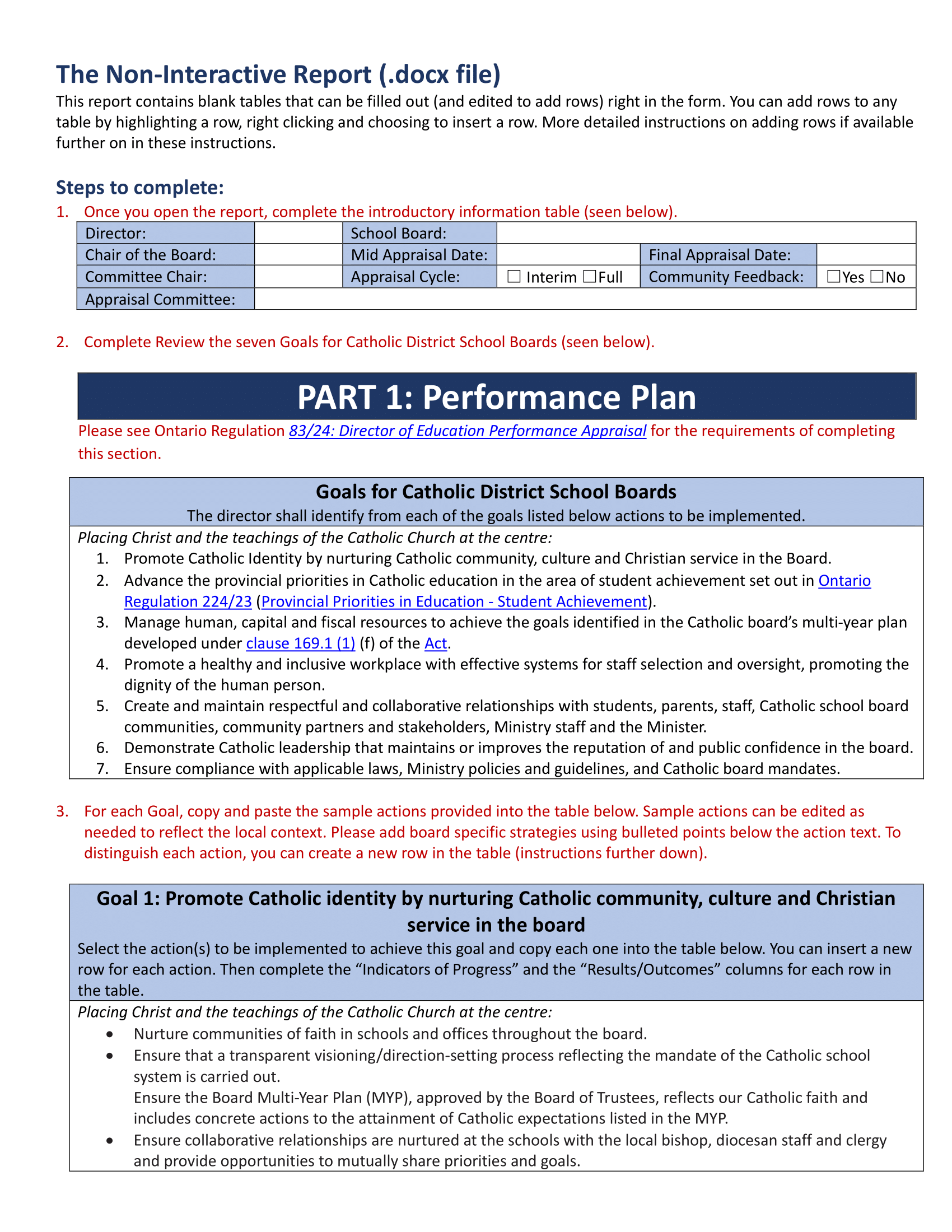
Appraisal Details

Appraisal Cycle:
Community Feedback:

Ministry Priorities

For the purposes of subsection 11.2 (1) of the Act , the following are the provincial priorities in education in the area of student achievement:

  1. Achievement of learning outcomes in core academic skills.
  2. Preparation of students for future success.
  3. Student engagement and well-being.

Resources

  1. Pastoral Letters for Catholic Education (e.g., This Moment of Promise, Fulfilling the Promise, Renewing the Promise)
  2. The Congregation for Catholic Education
  3. Education Act and Related Regulations
  4. Good Governance: A Guide for Trustees, School Boards, Directors of Education, and Communities
  5. Ontario Leadership Framework: Catholic System-Level Leadership
  6. PPM 159: Collaborative Professionalism
  7. Ontario’s Education Equity Action Plan
  8. Ontario First Nation, Metis and Inuit Education Policy Framework

PART 1: Performance Plan

Goals for Catholic District School Boards

The director shall identify from each of the goals listed below actions to be implemented.

Placing Christ and the teachings of the Catholic Church at the centre:

  1. Promote Catholic Identity by nurturing Catholic community, culture and Christian service in the Board.
  2. Advance the provincial priorities in Catholic education in the area of student achievement set out in Ontario Regulation 224/23 (Provincial Priorities in Education - Student Achievement).
  3. Manage human, capital and fiscal resources to achieve the goals identified in the Catholic board’s multi-year plan developed under clause 169.1 (1) (f) of the Act.
  4. Promote a healthy and inclusive workplace with effective systems for staff selection and oversight, promoting the dignity of the human person.
  5. Create and maintain respectful and collaborative relationships with students, parents, staff, Catholic school board communities, community partners and stakeholders, Ministry staff and the Minister.
  6. Demonstrate Catholic leadership that maintains or improves the reputation of and public confidence in the board.
  7. Ensure compliance with applicable laws, Ministry policies and guidelines, and Catholic board mandates.

Goal 1: Promote Catholic identity by nurturing Catholic community, culture and Christian service in the Board

Select the action(s) to be implemented to achieve this goal:

Placing Christ and the teachings of the Catholic Church at the centre:

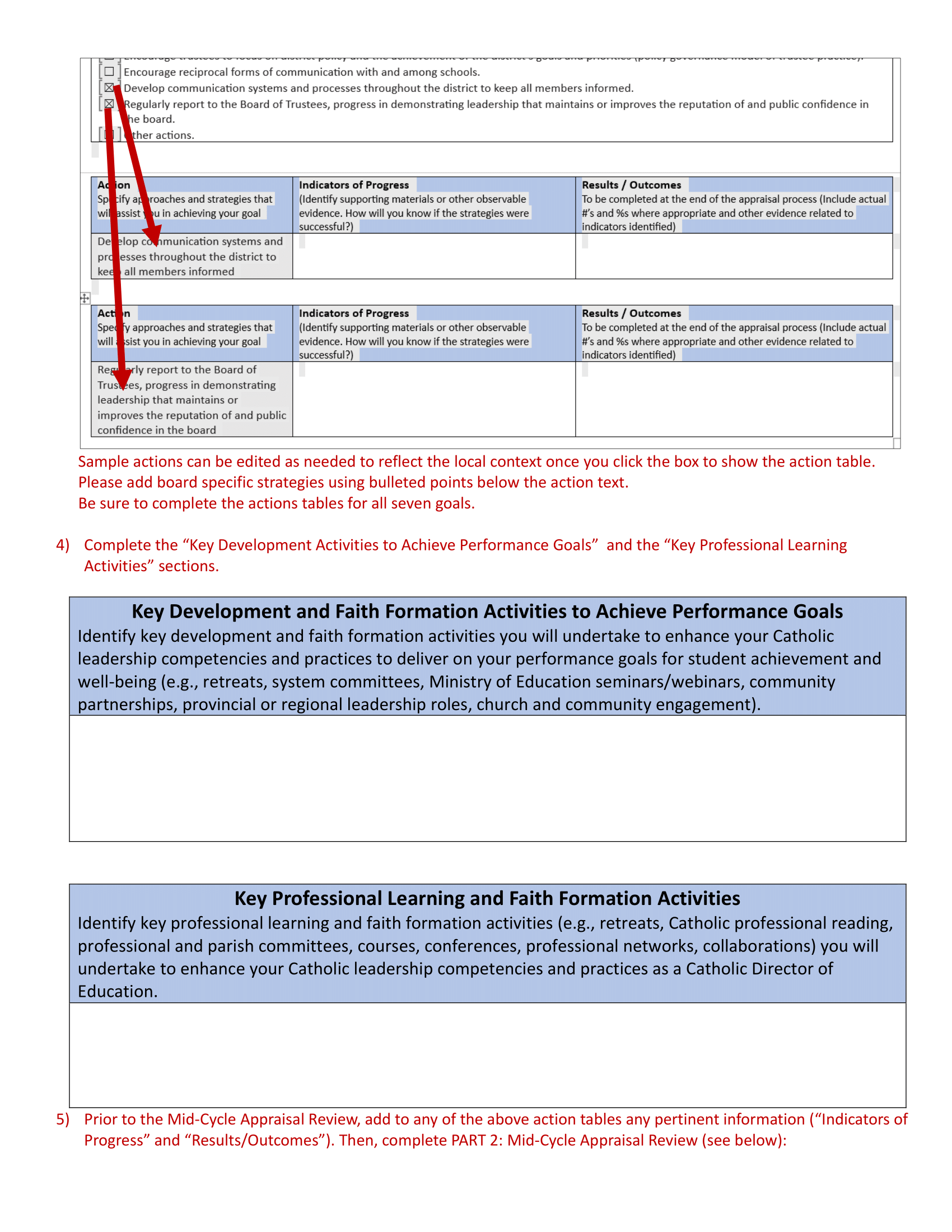
Action Indicators of Progress
(Identify supporting materials or other observable evidence. How will you know if the strategies were successful?)
Results / Outcomes
To be completed at the end of the appraisal process (Include actual numbers and percentages where appropriate and other evidence related to indicators identified)

Key Development and Faith Formation Activities to Achieve Performance Goals

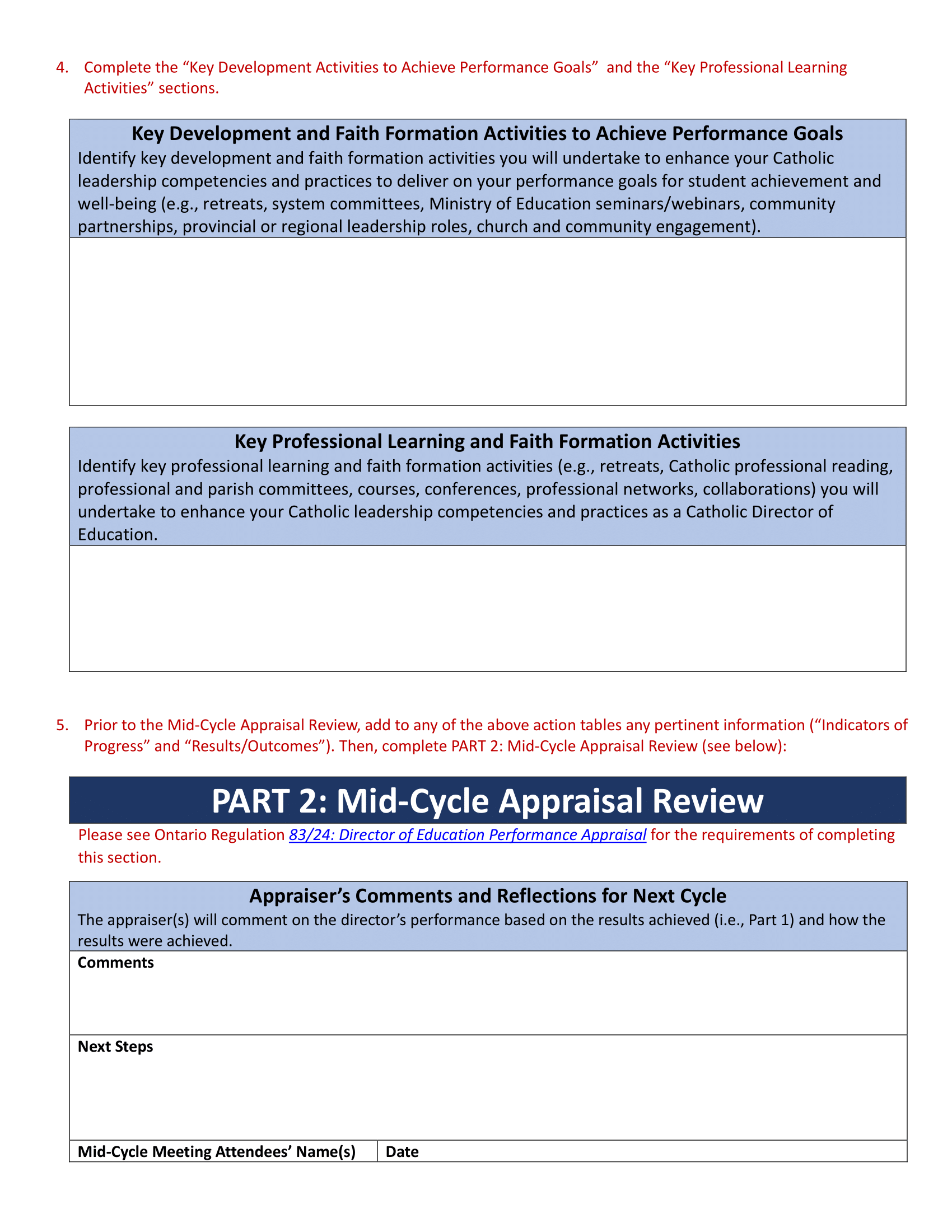
Identify key development and faith formation activities you will undertake to enhance your Catholic leadership competencies and practices to deliver on your performance goals for student achievement and well-being (e.g., retreats, system committees, Ministry of Education seminars/webinars, community partnerships, provincial or regional leadership roles, church and community engagement).

Key Professional Learning and Faith Formation Activities

Identify key professional learning and faith formation activities (e.g., retreats, Catholic professional reading, professional and parish committees, courses, conferences, professional networks, collaborations) you will undertake to enhance your Catholic leadership competencies and practices as a Catholic Director of Education.

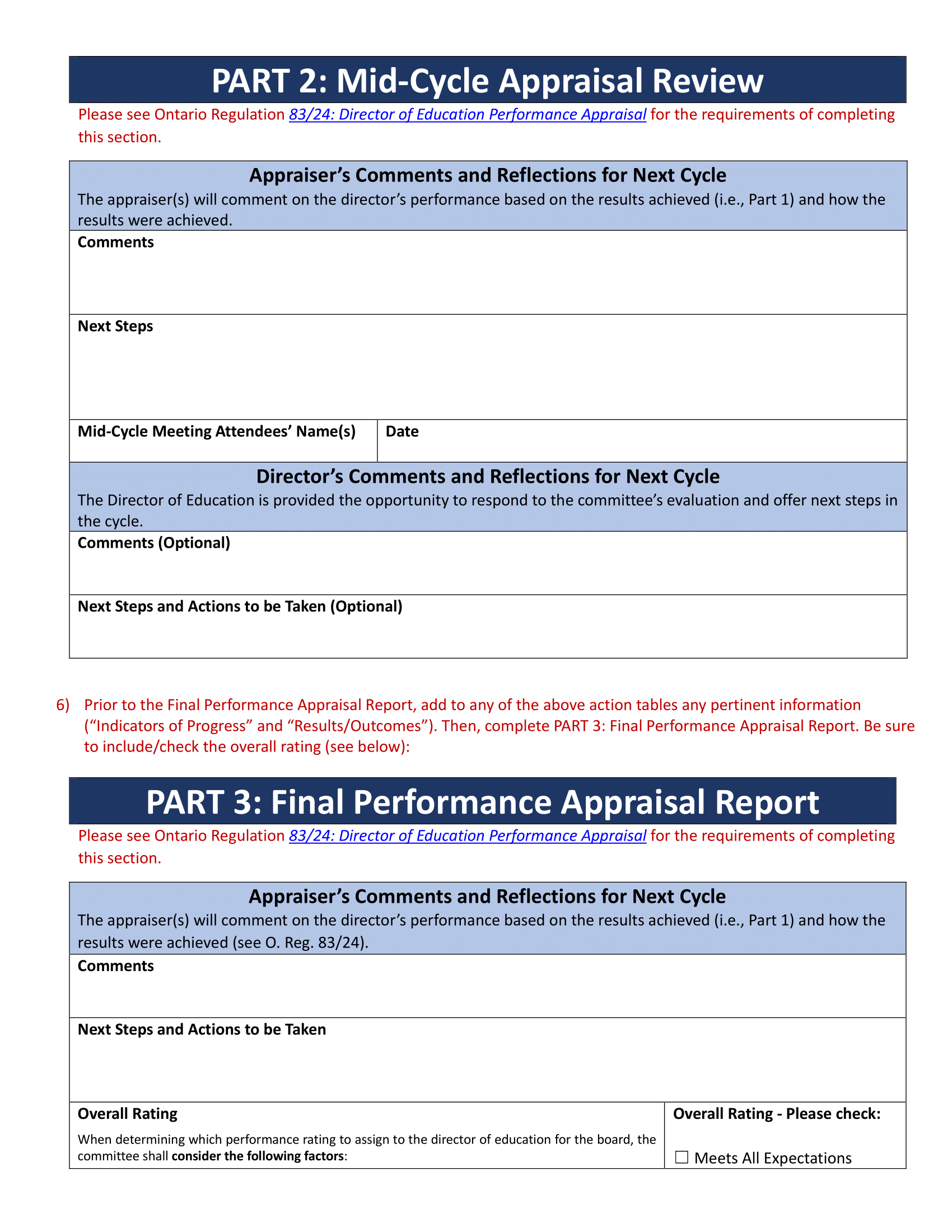
PART 2: Mid-Cycle Appraisal Review

Appraiser’s Comments and Reflections for Next Cycle

The appraiser(s) will comment on the director’s performance based on the results achieved (i.e., Part 1) and how the results were achieved.

Comments

Next Steps

PART 3: Final Performance Appraisal Report

Appraiser’s Comments and Reflections for Next Cycle

The appraiser(s) will comment on the director’s performance based on the results achieved (i.e., Part 1) and how the results were achieved (see O. Reg. 83/24).

Comments

Next Steps and Actions to be Taken

Overall Rating

When determining which performance rating to assign to the director of education for the board, the committee shall consider the following factors:

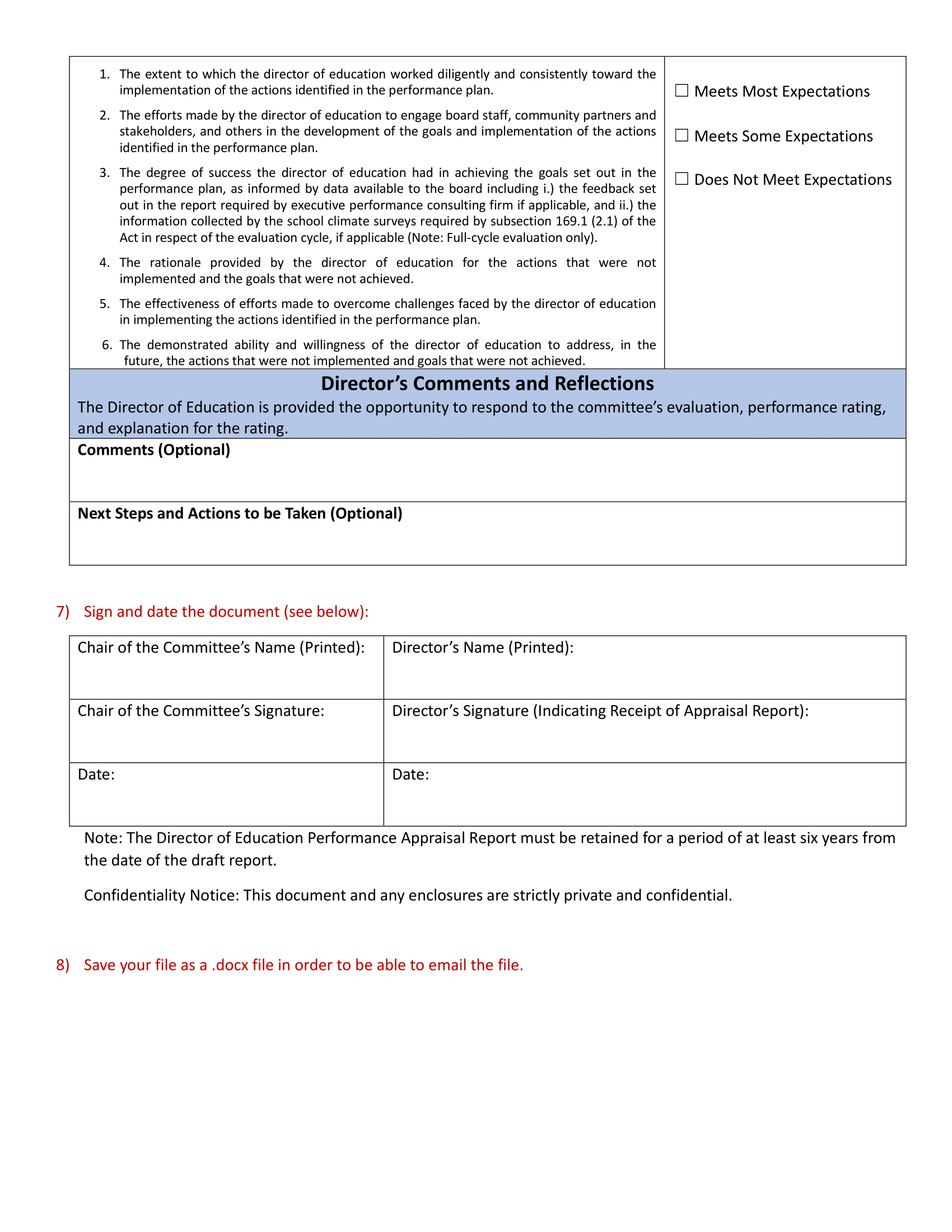
  1. The extent to which the director of education worked diligently and consistently toward the implementation of the actions identified in the performance plan.
  2. The efforts made by the director of education to engage board staff, community partners and stakeholders, and others in the development of the goals and implementation of the actions identified in the performance plan.
  3. The degree of success the director of education had in achieving the goals set out in the performance plan, as informed by data available to the board including:
    1. the feedback set out in the report required by executive performance consulting firm if applicable, and
    2. the information collected by the school climate surveys required by subsection 169.1 (2.1) of the Act in respect of the evaluation cycle, if applicable (Note: Full-cycle evaluation only).
  4. The rationale provided by the director of education for the actions that were not implemented and the goals that were not achieved.
  5. The effectiveness of efforts made to overcome challenges faced by the director of education in implementing the actions identified in the performance plan.
  6. The demonstrated ability and willingness of the director of education to address, in the future, the actions that were not implemented and goals that were not achieved.

Overall Rating - Please check:

Director’s Comments and Reflections

The Director of Education is provided the opportunity to respond to the committee’s evaluation, performance rating, and explanation for the rating.

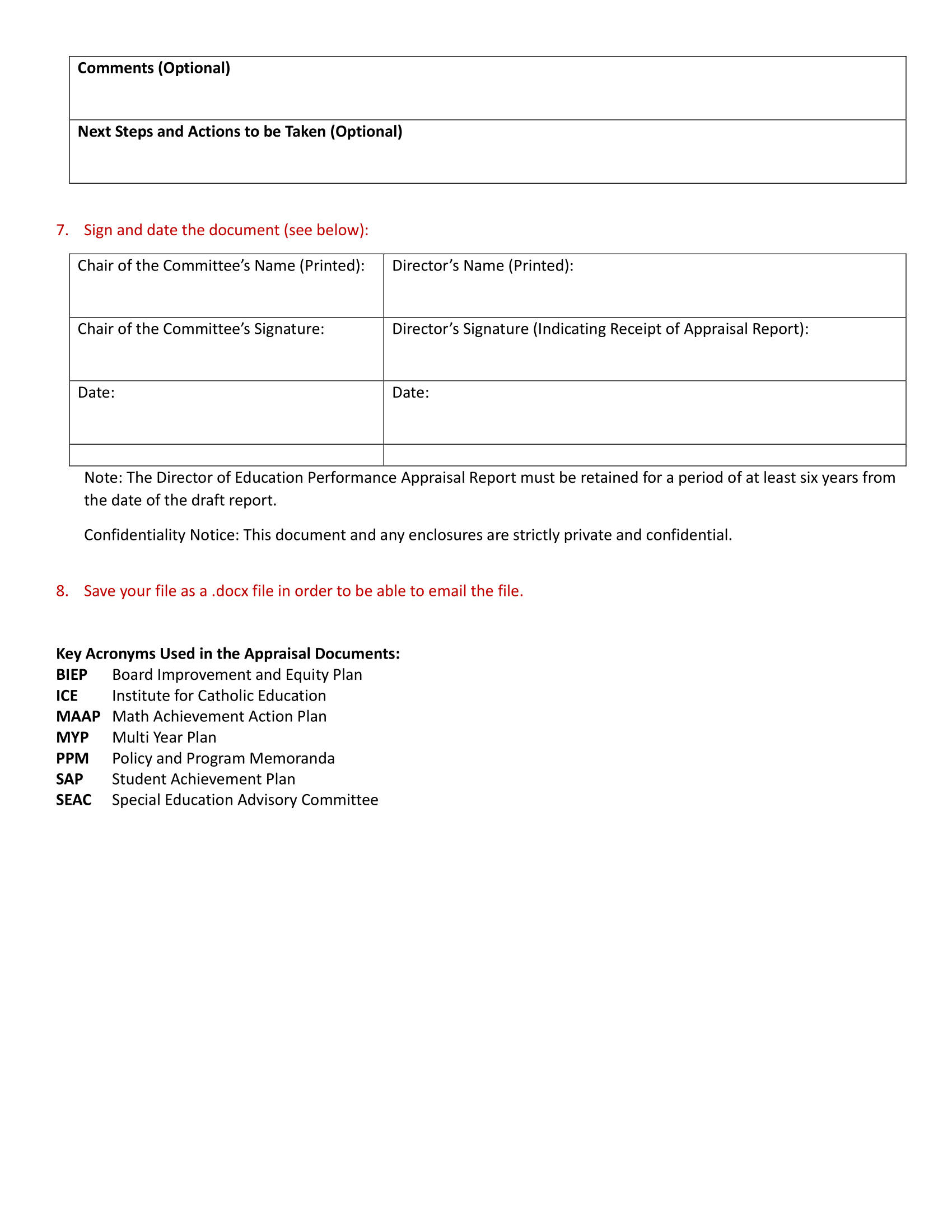
Comments (Optional)

Next Steps and Actions to be Taken (Optional)

Chair of the Committee’s Name (Printed): Director’s Name (Printed):
Chair of the Committee’s Signature: Director’s Signature (Indicating Receipt of Appraisal Report):
Date: Date:

Note: The Director of Education Performance Appraisal Report must be retained for a period of at least six years from the date of the draft report.

Confidentiality Notice: This document and any enclosures are strictly private and confidential.

Page 1 of Catholic Director of Education Appraisal Report Instruction Guide
Page 2 of Catholic Director of Education Appraisal Report Instruction Guide
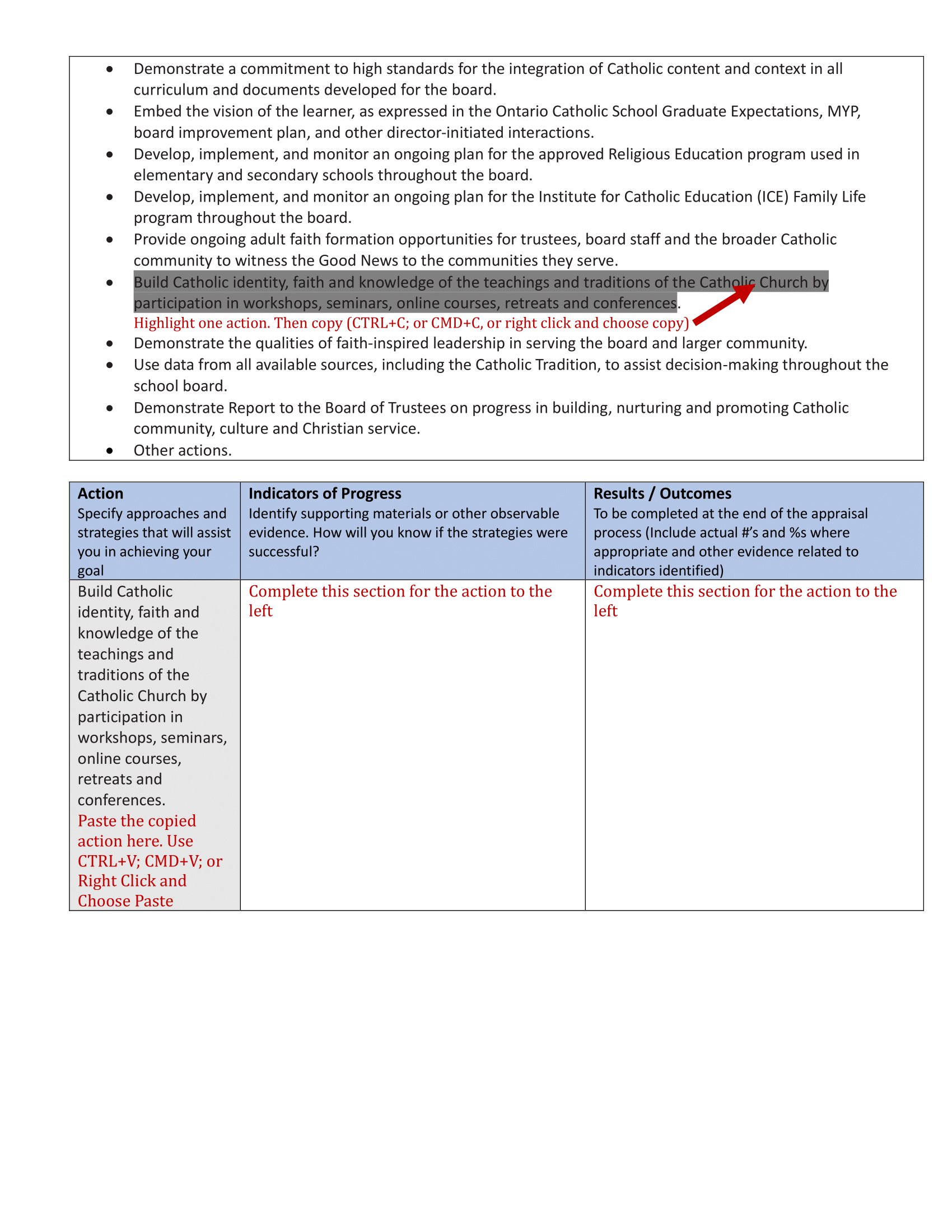
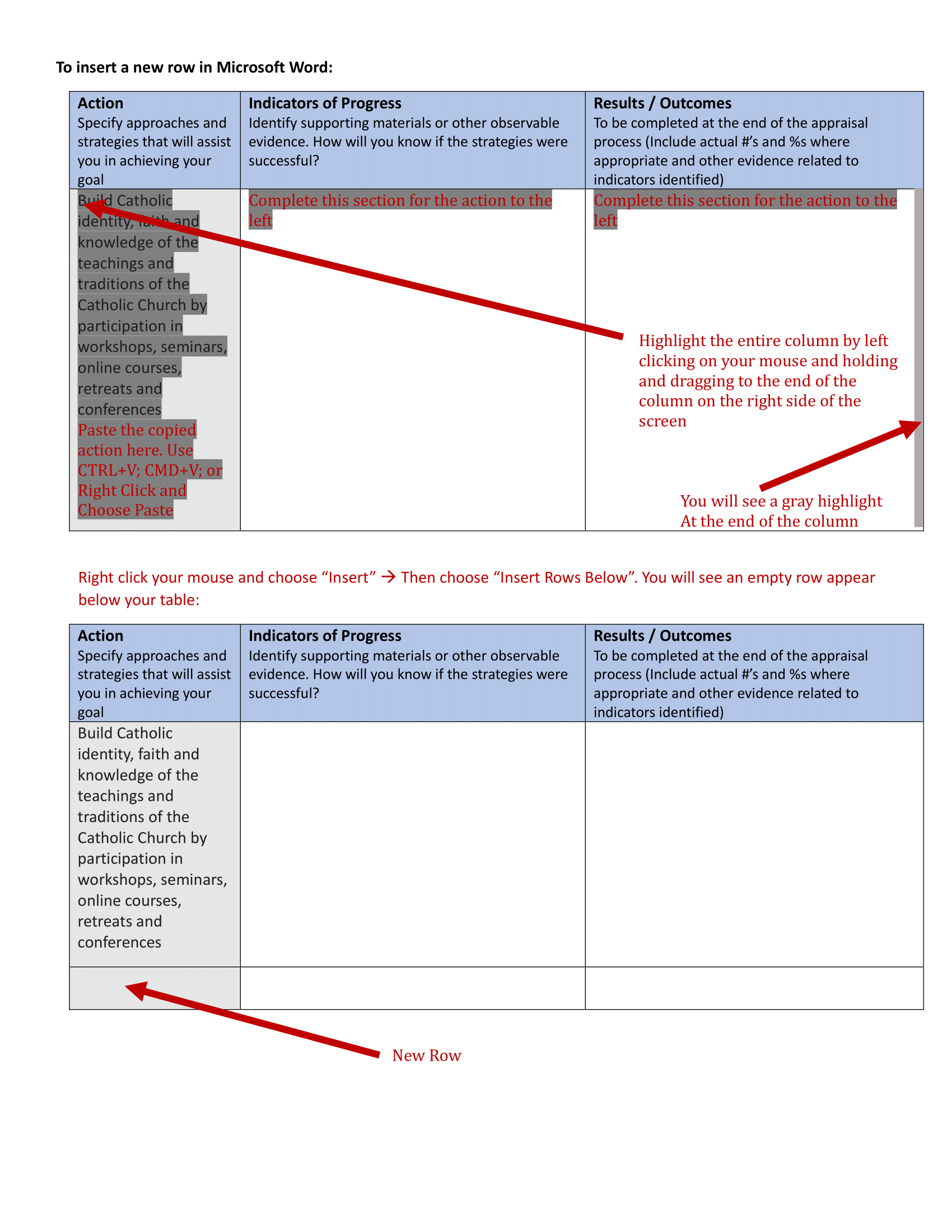
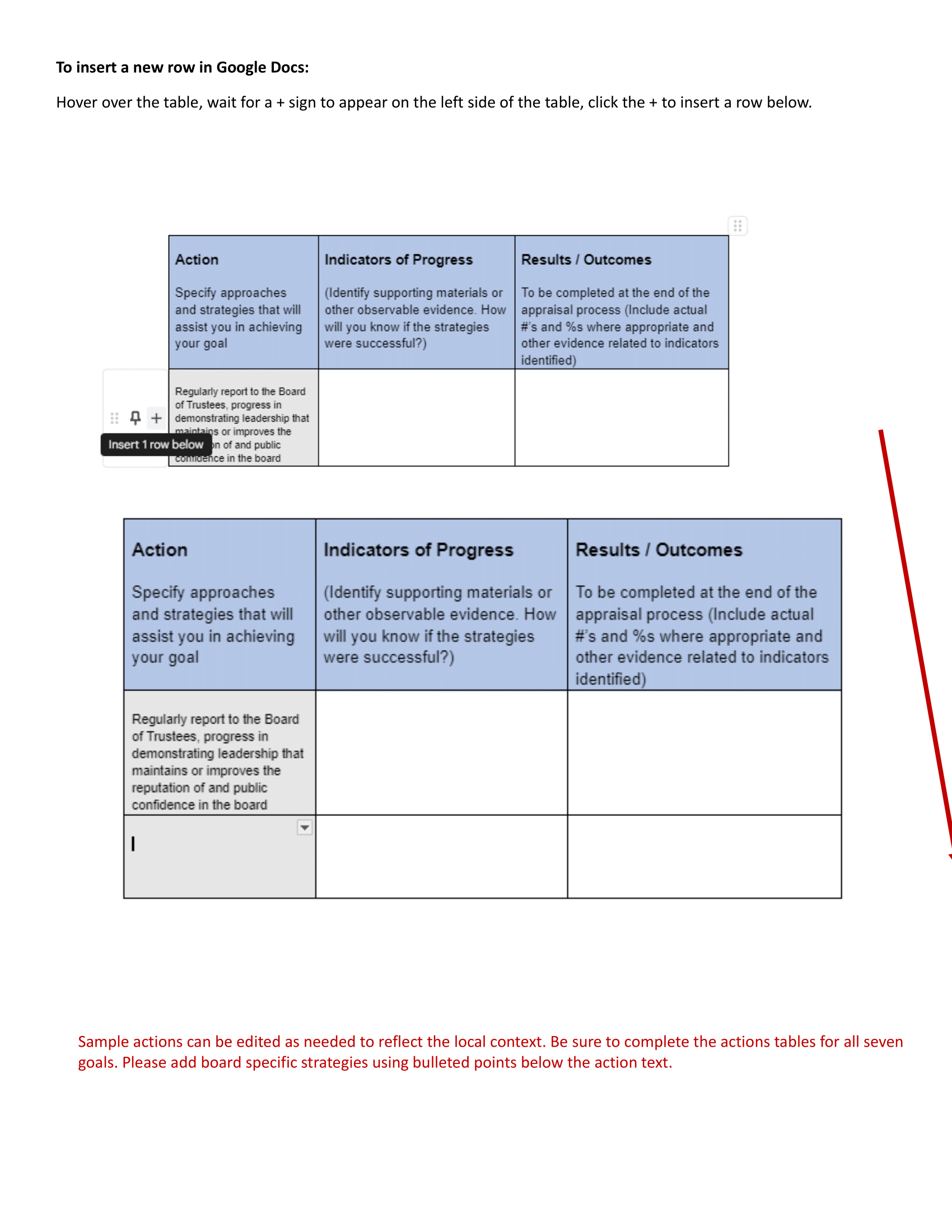
Page 3 of Catholic Director of Education Appraisal Report Instruction Guide
Page 4 of Catholic Director of Education Appraisal Report Instruction Guide
Page 6 of Catholic Director of Education Appraisal Report Instruction Guide
Page 7 of Catholic Director of Education Appraisal Report Instruction Guide
Page 8 of Catholic Director of Education Appraisal Report Instruction Guide
Page 9 of Catholic Director of Education Appraisal Report Instruction Guide
Page 10 of Catholic Director of Education Appraisal Report Instruction Guide
Page 11 of Catholic Director of Education Appraisal Report Instruction Guide
Page 12 of Catholic Director of Education Appraisal Report Instruction Guide
Page 13 of Catholic Director of Education Appraisal Report Instruction Guide

The Honourable _______________________________ Minister of Education

c/o 13th Floor, 315 Front St. W.
Toronto, ON M7A 0B8
educationequitysecretariat@ontario.ca

Date: Enter a date.

This is to confirm that Name of Director of Education began their role as Director of Education for the Name of school board on Date.

Performance Plan

Date of Performance Plan Completion: Enter a date.

_________________________________
Signature of the Chair of the Board

_________________________________
Printed Name of the Chair of the Board

The Honourable ___________________Minister of Education

c/o 13th Floor, 315 Front St. W.
Toronto, ON M7A 0B8
educationequitysecretariat@ontario.ca

Date: Enter a date.

This is to attest that Name of School Board has completed the interim or full performance appraisal of their Director of Education Director of Education in accordance with the Ontario Regulation __/2024 – Director of Education Performance Appraisal.

Bi-annual feedback:

Bi-annual community partner/stakeholder feedback inclusion
    • Community partners and stakeholders
    • ______________________________
    • ______________________________
    • ______________________________

Date of Performance Appraisal Completion: Enter a date.

_________________________________
Signature of the Chair of the Board

_________________________________
Printed Name of the Chair of the Board

Chair of the Board Role

Date: 2003 11 25 / 2006 11 21 / 2013 03 05 / 2019 11 12

Policy Statement

The Chair of the Board safeguards the integrity of the Board’s process and represents the Board of Trustees to outside parties.

Policy Goals

The authority of the Chair is found in legislation and is delineated accordingly:

  1. The Chair’s role is to assure that the Board is in compliance with its own rules and those legitimately imposed upon it through Ontario Acts, Statutes and Regulations.
    1. Meeting discussion content will be only those matters which, according to Board policy, Ontario Acts, Statutes and Regulations are within the purview of the Board of Trustees, not the Director of Education.
    2. Deliberation will be fair, open and thorough but also timely, orderly and kept to the point.
  2. The Chair has authority to make decisions that fall within Board policies on Governance Process and Board: Director Relationship, except where the Board specifically delegates portions of this authority to another individual or committee(s). The Chair is authorized to use any reasonable interpretation of the provisions in these policies.
    1. The Chair is empowered to chair Board meetings, with all the commonly accepted responsibility of that position, and in accordance with the Procedural By-laws of St. Clair Catholic District School Board.
    2. The Chair has no individual authority to make decisions about policies created by the Board within policy areas.
    3. The Chair, as well as the Director, are the designated spokespersons and shall represent the Board to all outside parties, including the media, in announcing Board-stated positions.
    4. The Chair may delegate this authority but remains accountable for its use.
    5. The Chair and/or Vice Chair, in consultation with the Director of Education, shall be responsible for the preparation of the meeting agendas, and may include other items identified by the Board.
    6. The Chair will provide leadership to the Board in maintaining the Board’s focus on its mission and vision; and assume such other responsibilities as may be specified by the Board.

Equity and Inclusive Education

Date: 2010 09 01 / 2016 05 24 / 2023 06 20

Policy Statement

The St. Clair Catholic District School Board (the "Board") recognizes that all people are created equal, in the image of God, each with unique characteristics deserving of dignity (Genesis: 1:27). In accordance with the Church's teachings, it is the policy of the Board to provide in all its operations an educational environment that supports and enables diversity within its Catholic community.

The Board recognizes that any form of social or cultural discrimination is incompatible with Catholic moral principles and is in violation of the Ontario Human Rights Code. The Board recognizes that the school system gives pre-eminence to the tenets of the Catholic faith, congruent with the protection afforded in the Ontario Human Rights Code, the Constitution Act, 1982 and confirmed in the Canadian Charter of Rights and Freedoms.

The Board and its staff are committed to the elimination of discrimination as outlined in Ontario’s Equity and Inclusive Education Strategy and the Ontario Ministry of Education (the “Ministry”) Policy/Program Memorandum No. 119, in a manner which is consistent with the exercise of the Board’s denominational rights under section 93 of the Constitution Act, 1982 and as recognized in section 19 of the Ontario Human Rights Code.

Policy Goals

  1. Embed the principles of equity and inclusive education through cyclical policy reviews in all Board policies, programs, curriculum, guidelines, operations, practices, and Board Improvement Plans.
  2. Provide leadership that is committed to identifying and removing discriminatory biases and systemic barriers to learning and promote the development of collaborative environments in which participants share a commitment to equity and inclusive education principles and practices.
  3. Build capacity with the active engagement of parents and school community partners to create and sustain a positive school climate that supports student achievement and well-being.
  4. Use inclusive curriculum, assessment practices, and effective instructional strategies that reflect the diverse needs of all students and their learning pathways that they are taking.
  5. Include a religious accommodation guideline which prohibits discrimination on the grounds of creed (e.g., religion) and impose a duty to accommodate, in accordance with the Ontario Human Rights Code and the requirements stated in Policy/Program Memorandum No. 108 and Regulation 298.
  6. Support a positive and inclusive school climate where all members of the school community feel safe, included, welcomed, and accepted.
  7. Investigate in a thorough and timely manner any claims of discrimination and/or racism and take appropriate action consistent with the principles of the Code.
  8. Engage in regular school and Board monitoring of school climate through school climate surveys, as outlined in Policy/Program Memorandum No. 144, "Bullying Prevention and Intervention", to help identify inappropriate behaviours, barriers, or issues that should be addressed.
  9. Provide opportunities for students, administrators, teachers, support staff, and trustees to participate in equity and inclusive education initiatives.
  10. Engage in ongoing and open communication to keep all stakeholders informed of the Board's goals and progress through the yearly monitoring and reporting on the Board's Multi-Year Strategic Plan and by posting the Equity and Inclusive Education Policy on its website.
  11. Provide opportunities for the diverse Catholic school community, including students, staff, parents, trustees, and community members, to provide input into Board policies on an ongoing basis.

Definitions

Equity:
A condition or state of fair, inclusive and respectful treatment of all people. Equity does not mean treating all people the same without regard for individual differences.
Inclusive Education:
Education that is based on the principles of acceptance and inclusion of all students. Students see themselves reflected in their curriculum, their physical surroundings, and the broader environment in which diversity is honoured and all individuals are respected.
Ontario Human Rights Code (“the Code”):
A provincial law that gives everyone equal rights and opportunities, without discrimination, in specific areas such as education, jobs, housing, and services. The goal of the Code is to address and ultimately prevent discrimination and harassment (available at www.ohrc.on.ca).
```

Date: 2010 09 01 / 2016 05 24 / 2023 06 20

Administrative Procedures

BOARD POLICIES, PROGRAMS, PROCEDURES AND PRACTICES

Expectations

The Board recognizes the importance of anti-racism and anti-harassment policies in promoting and maintaining a Catholic educational and working environment which fosters racial and ethnocultural understanding.

The Board’s policy review cycle will result in the alignment and integration of the requirements of Policy/Program No. 119 and the Strategy with all Board policies, programs, procedures, and practices. The perspectives of the entire diverse Catholic school community will be reflected in all areas of the teaching, learning and administrative culture. Every effort will be made to identify and remove discriminatory biases and systemic barriers that may limit access to and opportunity for effective employment procedures for individuals from diverse communities and underrepresented peoples within the context of the denominational rights of Catholic school boards.

The Board is committed to serving staff, students, and families in its diverse Catholic community by incorporating the principles of equity and inclusive education into all aspects of its policies, programs, procedures, and practices that are consistent with Catholic denominational right.

Responsibilities

The Director will:

  1. Establish the foundational framework that will inform their review and/or development and implementation of a comprehensive equity and inclusive education policy that recognizes and eliminates biases related to race, class, ethnicity, gender, sexual orientation, disability, family status, religion, and linguistic differences as well as socioeconomic factors.
  2. Review existing equity and inclusive education policies and/or extend or develop such policies to fulfill the requirements of existing regulations, the Strategy, Policy/Program Memorandum No. 119, and the Code, in accordance with the denominational rights afforded to the Catholic school system.
  3. Ensure the principles of equity and inclusive education are explicitly stated in all Board policies, programs, guidelines, operations, practices, and Board improvement plans.
  4. Draft and implement all future policies, guidelines and practices in accordance with the Board’s Equity and Inclusive Education Policy.
  5. Collect information needed to monitor the effects of the implementation of the Equity and Inclusion Education Policy by the Board.
  6. Accommodate all persons with disabilities appropriately and in a manner consistent with the Code.
  7. Provide training for school and system leaders to facilitate equitable recruitment and hiring to reflect Ontario’s diverse society.
  8. Provide opportunities for the diverse school community, including students, staff, parents, trustees, and community members, to provide active input into Board policies and improvement plans on an ongoing basis.
  9. Investigate in a thorough and timely manner any claims of discrimination and/or racism and take appropriate action consistent with the principles of the Code.

Our Schools will:

  1. Review existing school policies, for example, codes of conduct, to determine that they reflect the principles of equity and inclusive education.
  2. Extend, develop, and implement strategies to actively engage students, parents, families, and the wider community in the review, development, and implementation of initiatives to support and promote equity and inclusive education.
  3. Implement Board equity and inclusive education policies, programs, and school improvement plans, consistent with the Code and that reflect the needs of their diverse Catholic school community.

SHARED AND COMMITTED LEADERSHIP

Expectations

The Board subscribes to an informed leadership philosophy that inspires, empowers, and supports all stakeholders in our Catholic community to join together to implement institutional practices and behaviours that cultivate equity and inclusion.

The Board is committed to providing informed shared leadership to improve student achievement and to close achievement gaps for students by identifying, addressing, and removing all barriers and forms of discrimination.

The Board recognizes the critical connection between student leadership and improved student achievement and will strive to include student voice in the implementation of equity and inclusive education.

Board and school leaders will encourage and promote a collaborative approach to all dimensions of equity and inclusive education, which ensures the participation of students, parents, staff, parish, and community partners.

Responsibilities

The Board will:

  1. Provide extensive and ongoing education and training for students, administrators, teachers (including guidance counsellors), support staff and trustees in implementing equity and inclusive education and leadership initiatives.
  2. Establish selection criteria for leadership positions that prioritize demonstrated commitment, knowledge and skills related to equity and inclusive education implementation and inclusive leadership, and consistent with proactive Code compliance.
  3. Provide ongoing training for all staff that reflects comprehensive attention to the principles of human rights and their fundamental role in an equitable and inclusive environment.
  4. Strive to ensure that members of communities that are underserved and/or marginalized are included in the shared leadership.

Our Schools will:

  1. Establish a collaborative culture where the collective capabilities and voices of all stakeholders are used to develop and implement equity and inclusive education goals.
  2. Promote equity minded student leadership related to issues of social justice.
  3. Demonstrate leadership in implementing practices that nurture a caring, safe, and inclusive culture.

SCHOOL – COMMUNITY RELATIONSHIPS

Expectations

Establish and maintain partnerships with all members of our diverse Catholic community so that the perspectives and experiences of all students, families, and employees are recognized.

Responsibilities

The Board will:

  1. Review and/or initiate tools, for example, school climate surveys, to determine stakeholders’ views on school environment and act upon relevant next steps.
  2. Take proactive steps to ensure that existing committees represent the diversity of the wider community.
  3. Deepen existing community partnerships to ensure that they reflect the principles of equity and inclusive education.
  4. Expand community efforts to foster new partnerships that engage a cross-section of diverse students, parents, staff, community members and various community organizations, including business groups, to ensure inclusion.
  5. Establish processes to identify and address systemic barriers that limit or prevent all sectors of the school community from benefiting from enhanced opportunities for Board representation and greater access to Board initiatives.
  6. Identify under-represented communities and facilitate their participation and involvement in Board activities.
  7. Gather and use the knowledge, skills, and experience of Board community partners to enrich educational and career experiences of staff, students, and volunteers.

Our Schools will:

  1. Invite and support representation of diverse groups on school committees, including school improvement planning.

INCLUSIVE CURRICULUM AND ASSESSMENT PRACTICES

Expectations

The Board is committed to supporting the spiritual growth of students and the achievement of the distinctive Ontario Catholic Graduate Expectations.

Assessing and evaluating students requires Catholic educators to integrate fundamental principles which best reflect our Gospel values and respect the uniqueness of each student. Fairness in assessment and evaluation is grounded in the belief that all students should be able to demonstrate their learning regardless of their socio-economic status, ethnicity, gender, geographic location, learning style, and/or need for special services.

Responsibilities

The Board will:

  1. Review student assessment and evaluation policies and practices to identify and address systemic bias that may exist in the way students’ work is assessed and evaluated in order to reduce the achievement gap. The principles of such a review will be consistent with the Code.
  2. Support the schools’ review of classroom strategies that promote school-wide equity and inclusive education policies and practices specifically addressing areas of discrimination (e.g., race, gender, disability).

Our Schools will:

  1. Review student assessment and evaluation policies and practices to identify and address systemic bias that may exist in the way students’ work is assessed and evaluated; the principles of such a review will be consistent with the Code.
  2. Promote grade team planning and include teacher moderated marking to ensure a collaborative approach to student assessment.
  3. Support growth and learning with the belief that each and every student can achieve and be successful, given the appropriate time and support through assessment and evaluation.
  4. Provide education and training based on the belief that all students can learn and ensure that it is reflected in expectations of students’ assessment and evaluation practices, counselling about available program options, and other counselling practices.
  5. Use a variety of assessment strategies and instruments to inform short and long-term planning to reduce gaps in student achievement and improve student learning.
  6. Support the schools’ review of classroom strategies that promote school-wide equity and inclusive education policies and practices.
  7. Provide multiple opportunities for assessment (self, peer, teacher, student led conferencing and/or parent/student and teacher interviews).
  8. Adjust instruction based on the results of formative assessment. Feedback to students must be specific, timely and promote further learning.
  9. Recognize the variety of learning styles and multiple intelligences through collaborative learning structures.
  10. Consistently monitor the growth of students who are on Individual Education Plans and/or are English Language Learners to ensure that the specific needs of students are addressed through the accuracy of programming based on best practices in assessment; all needed accommodations and modifications must be in place to assist the student in accessing the curriculum.
  11. Enable all students who have English language learning needs to receive equity of access to the curriculum.
  12. Actively involve parents (and students where appropriate) in identification and placement decisions, including those required by the Identification, Placement and Review Committee.
  13. Provide access and use of assistive technologies for students who require accommodations to support achievement and success.
  14. Improve student learning and achievement through the use of differentiated product (e.g., an oral response for a reading comprehension task or a mind map in lieu of an essay or a dramatic performance that demonstrates the student’s learning).
  15. Engage students as active participants in their learning (e.g., students seeing and hearing themselves in the curriculum; gender specific teaching practices; culturally relevant and responsive pedagogy; research-based practices in assessment and evaluation).
  16. Review and reflect upon classroom practices and revise them as needed to help ensure that they are aligned with school-wide equity and inclusive education policies.
  17. Make certain that resources and instructional strategies are in accordance with Catholic teachings and values; are in compliance with the Code, and promote school-wide equity and inclusive education policies and practices specifically addressing areas of social and cultural discrimination.

RELIGIOUS ACCOMMODATION

Expectations

Within the framework of gospel values, traditions, and the Board’s denominational rights, in recognition of this diversity, the Board will attempt to provide reasonable accommodation for religious beliefs and practices of students and staff, while also protecting its denominational rights.

The Board is committed to the values of freedom of religion and freedom from discriminatory or harassing behaviour based on religion and will take all reasonable steps to provide religious accommodations within the legal rights afforded to the Catholic school system.

Responsibilities

The Board will:

  1. Provide information to students and their parents/guardians and staff of their right to request accommodation for religious beliefs and practices.
  2. Prepare a religious accommodation guideline in keeping with the Code, and consistent with its denominational rights, which prohibits discrimination on the grounds of creed, and other Code protected grounds, and provides a duty to accommodate. (Appendix A)
  3. Provide religious accommodation for students and staff, where reasonable and consistent with the Code.

Our Schools will:

  1. Refer to Appendix A – Religious Accommodation Guideline and Appendix B – Guideline to Address Requests for Religious Exemptions.

SCHOOL CLIMATE THE PREVENTION OF DISCRIMINATION AND HARASSMENT

Expectations

The Board acknowledges that a Christ-centered, positive school climate is one where all members of the school community feel safe, welcomed, and accepted. The principles of equity and inclusive education support positive student behaviour.

Responsibilities

The Board will:

  1. Implement strategies to identify and remove discriminatory barriers that limit engagement by students, parents, and the community, so that diverse groups and the broader community have better Board-level representation and greater access to Board initiatives.
  2. Put procedures in place that will enable students and staff to report incidents of discrimination and harassment safely and that will also enable Boards to respond in a timely manner.
  3. Initiate or expand proactive programs to decrease the number of suspensions and expulsions and alleviate the negative impact of suspensions and exclusions on students.
  4. Create a caring, safe and inclusive climate for all.
  5. Communicate that administrators are expected to use progressive discipline and professional discretion, and to understand the duty to accommodate students with disabilities.

Our Schools will:

  1. Revise codes of conduct to address all forms of racism, discrimination, and harassment.
  2. Use progressive discipline, including peer mediation and restorative justice.
  3. Welcome, respect and validate the contributions of all students, parents, and other members of the school community.
  4. Support every student, as outlined in Student Success strategies, Learning for All, Reach Every Student, and other applicable legislation, and inspire them to succeed in a culture of high expectations.
  5. Develop school codes of conduct with the active consultation and involvement of students, staff, parents, and a representative cross-section of community members, to reflect the needs of the diverse Catholic community served by the school.
  6. Review or develop guidelines and procedures to address the prohibited grounds of discrimination under the Code as they may apply to students, staff, and others in the Catholic community.

PROFESSIONAL LEARNING

Expectations

The Staff of the Board is its most important asset and is the vehicle by which Catholicity and equity are taught in the classroom and throughout the system. The Board, therefore, recognizes the importance of ongoing professional learning to create a foundation for Catholic values, ecclesial and cultural identity, human rights education, and effective teaching practices.

Responsibilities

The Board will:

  1. Support the schools’ review of classroom strategies that promote school-wide equity and inclusive education policies and practices.
  2. Allocate adequate resources to provide ongoing opportunities for staff and trustees to participate in equity and inclusive education training and leadership initiatives.
  3. Provide anti-racism and anti-discrimination training that promotes respect.
  4. Provide training that promotes a deeper understanding of exceptionalities and how to mitigate discipline, in light of its effect on students with disabilities.
  5. Ensure that the principles of equity and inclusive education are modeled and incorporated in professional learning programs.

Our Schools will:

  1. Review classroom strategies and revise them as needed to help ensure that they are aligned with and reflect school-wide equity and inclusive education policies and culturally relevant pedagogy.
  2. Promote collaborative teams that learn together through job embedded learning, implement their learnings, and reflect together on best practices.
  3. Build staff capacity through ongoing needs based professional learning determined through data analysis and based on results.
  4. Encourage and support students in their efforts to promote social justice, equity, antiracism, and antidiscrimination in schools and classrooms.

ACCOUNTABILITY AND TRANSPARENCY

The Board is committed to assessing and monitoring the principles of Equity and Inclusive Education into all Board policies, programs, guidelines, and practices; and to communicating these results to the community.

Responsibilities

The Board will:

  1. Embed the principles of equity and inclusive education into all Board policies, programs, guidelines, and practices.
  2. Actively communicate the equity and inclusive education policy to students, teachers, parents, staff, school councils, community partners, and volunteers and post it on the Board’s website.
  3. Seek and use feedback to improve the Equity and Inclusive Education policy, in the spirit of continuous improvement.
  4. Engage Board and school teams in school improvement planning with particular emphasis on using data to identify and remove barriers to student achievement, to raise awareness about discriminatory practices and to encourage conversations and collaborative actions about racism and other equity issues.
  5. Establish processes to monitor progress and assess effectiveness of policies, programs, and procedures.
  6. Report on student achievement using specific criteria.
  7. Maintain the transparency of the Identification Placement and Review Committee (IPRC) process, inform, and support parents through this process.

Our Schools will:

  1. Monitor student achievement data. Develop, review, communicate, and reflect on the effectiveness of school improvement plans with attention to equity and inclusive education.

Definitions

Bias: Prejudice in favour of or against one thing, person, or group compared with another, usually in a way considered to be unfair.

Implicit Bias: Bias as a product of associations learned through past experiences.

Explicit Stereotypes: Consciously endorsed, intentional, and sometimes controllable thoughts and beliefs.

Equity: A condition or state of fair, inclusive and respectful treatment of all people. Equity does not mean treating all people the same without regard for individual differences.

Inclusive Education: Education that is based on the principles of acceptance and inclusion of all students. Students see themselves reflected in their curriculum, their physical surroundings, and the broader environment in which diversity is honoured and all individuals are respected.

Ontario Human Rights Code (“the Code”): A provincial law that gives everyone equal rights and opportunities, without discrimination, in specific areas such as education, jobs, housing, and services. The goal of the Code is to address and ultimately prevent discrimination and harassment (available at www.ohrc.on.ca).

Religious Accommodation: An obligation under the Ontario Human Rights Code to provide reasonable accommodation for students and employees who wish to observe the tenets or practices of their faith, as well as for those who wish not to participate in any form of religious observance.

Culturally Relevant Pedagogy: In an inclusive education system, students should see themselves reflected in the curriculum, their physical surroundings, and the broader environment so that they can feel engaged and empowered by their learning.

References

Religious Accommodation Guideline

Mission Statement

Learning Together Today, Transforming Tomorrow.

Introduction

The St. Clair Catholic District School Board (the Board) believes in the dignity of all people and their equality as children of God. The Board recognizes the importance of freedom of religion and strives to recognize, value, and honour the many customs, traditions and beliefs that make up the Catholic community.

Freedom of religion is an individual right and a collective responsibility. The Board commits to work with the community it serves to foster an inclusive learning environment that promotes acceptance and protects individuals from discrimination and harassment on the basis of their religion.

In accordance with the Catholic Church’s teachings, it is the policy of the Board to provide, in all its operations, an educational environment which promotes and supports diversity within its Catholic community as well as the equal attainment of life opportunities for all students, staff, parents and other members of that community.

Legislative and Policy Context

All school boards exist within a broader context of law and public policy that protect and defend human rights. At the Board, a number of policy statements have been developed that reinforce both federal and provincial legislation, and also help ensure that the freedoms they set out are protected within the school system.

The Canadian Charter of Rights and Freedoms (Section 15) guarantees freedom of religion. The Ontario Human Rights Code (The Code) protects an individual’s freedom from discriminatory or harassing behaviours based on prohibited grounds. Consistent with this legislation is The Education Act, its Regulations and policies governing Equity and Inclusion in Schools:

  • PPM No 108, “Opening or Closing Exercises in Public Elementary and Secondary Schools”
  • R.R.O. 1990, Regulation 298, “Operation of School-General” s 27-29, under the heading “Religion in Schools”
  • PPM No. 119, “Developing and Implementing Equity and Inclusive Education Policies in Ontario Schools”

The Board and its staff are committed to the elimination of discrimination as outlined in this Federal and Provincial legislation in a manner which is consistent with the exercise of its denominational rights under section 93 of the Constitution Act, 1982 and as recognized in section 19 of the Ontario Human Rights Code (“the Code”).

The Board recognizes, and is committed to, the values of freedom of religion and freedom from discriminatory or harassing behaviour based on prohibited grounds through its human rights policy, equity and inclusive education policy, the safe schools policy and curriculum documents. All of these will be informed by, and interpreted in accordance with, the principles of the Code.

This Policy reflects the Board’s fidelity to Canadian law protecting freedom of religion in accordance with the Catholic Church’s teachings.

Definitions

Accommodation

The Ontario Human Rights Commission’s Policy on Creed and the Accommodation of Religious Observances defines “accommodation” as a duty corresponding to the right to be free from discrimination:

The Code provides the right to be free from discrimination, and there is a general corresponding duty to protect the right: the “duty to accommodate.” The duty arises when a person’s religious beliefs conflict with a requirement, qualification, or practice. The Code imposes a duty to accommodate based on the needs of the group of which the person making the request is a member. Accommodation may modify a rule or make an exception to all or part of it for the person requesting accommodation.
(Policy on Creed and the Accommodation of Religious Observances, Ontario Human Rights Commission, October 20, 1996, pg. 5)

The duty to accommodate is an obligation that arises when requirements, factors, or qualifications, which are imposed in good faith, have an adverse impact on, or provide an unfair preference for, a group of persons based on a protected ground under the Code. The duty to accommodate must be provided to the point of undue hardship. In determining whether there is undue hardship, section 24(2) of the Code provides that reference should be made to the cost of accommodation, outside sources of funding, if any, and health and safety requirements.

Creed

Creed is interpreted by the Ontario Human Rights Commission’s 1996 Policy on Creed and the Accommodation of Religious Observances as “religious creed” or “religion.” It is defined as a professed system and confession of faith, including both beliefs and observances of worship.

The existence of religious beliefs and practices are both necessary and sufficient to the meaning of creed if the beliefs and practices are sincerely held and/or observed.

This policy does not extend to religions that incite hatred or violence against other individuals or groups, or to practices and observances that purport to have a religious basis, but which contravene international human rights standards or criminal law (Policy on Creed and the Accommodation of Religious Observances, Ontario Human Rights Commission, October 20, 1996, pg. 2).

Undue Hardship

Accommodation will be provided to the point of undue hardship, as defined by the OHRC (for example in the Policy and Guidelines on Disability and the Duty to Accommodate). A determination regarding undue hardship will be based on an assessment of costs, outside sources of funding, and health and safety. It will be based on objective evidence. For more information about the evidence needed to prove undue hardship, see Human Rights at Work, p. 133-134 and Appendix E.

A determination that an accommodation will create undue hardship carries with it significant liability for the Board. It should be made only with the approval of the appropriate Supervisory Officer or where appropriate the Board of Trustees.

Where a determination is made that an accommodation would create undue hardship, the person requesting accommodation will be given written notice, including the reasons for the decision and the objective evidence relied upon. The accommodation seeker shall be informed of his or her recourse under the Board’s Equity and Inclusive Education Policy and Anti-Discrimination Policy and Procedure, and under the Ontario Human Rights Code.

Where a determination has been made that an accommodation would cause undue hardship, the Board will proceed to implement the next best accommodation short of undue hardship or will consider phasing in the requested accommodation.

Accommodation Guidelines

The purpose of this guideline is to inform all Board staff, students, parents, and other members of the school community that they have access to information about their rights and responsibilities under the Code with respect to religious accommodation. It also sets out the Board’s procedures for accommodation and the responsibilities of each of the parties to the accommodation process. In accordance with the Equity Strategy, the Code and OHRC’s Guidelines on Developing Human Rights Policies and Procedures, it is intended that the accommodation process, as well as the accommodation itself, be effective and respectful of the dignity of accommodation seekers.

The Board is committed to providing an environment that is inclusive and that is free of barriers based on prohibited grounds. Accommodation will be provided in accordance with the principles of dignity, and inclusion. The Board will work cooperatively, and in a spirit of respect, with all partners in the accommodation process.

Accommodation Based on Request

The Board will take all reasonable steps to provide accommodation to individual members of a religious group to facilitate their religious beliefs and practices. All accommodation requests will be taken seriously. No person will be penalized for making an accommodation request.

The Board will base its decision to accommodate by applying the Code’s criteria of undue hardship, the Board’s ability to fulfill its duties under Board policies and the Education Act.

When concerns related to beliefs and practices arise in schools, collaboration among school, student, family, and religious community is needed in order to develop appropriate accommodation. It is the role of the Board and its staff to ensure equity and respect for the diverse religious beliefs and practices of students and their families and other staff in the school system. However, school administrators should not be placed in the position of monitoring a child’s compliance with a religious obligation, and enforcing such practices, e.g., wearing a head covering is not the responsibility of the school or the Board.

General Procedures for Religious Accommodation

Staff

  1. The person requesting accommodation should advise the administration at the beginning of the school year, to the extent possible. If September notice is not feasible, the person should make the request as early as possible.
  2. The absence of employees due to religious observances should be granted as determined by this policy and the appropriate collective agreement.

Students

  1. Students must present verbal or written notice from their parents/guardians specifying their accommodation needs relating to religious observances, including holy days on which they will be absent from school. This notice should be made enough in advance (preferably at the beginning of each school year) to ensure that scheduling of major evaluations, such as tests, assignments, or examinations, takes the religious observances into consideration.
  2. Student handbooks and parent newsletters should include information about the procedure to follow to request an accommodation for religious observances and/or holy days. Such procedures shall be easy for staff, students, and parents to understand.

Unresolved Requests

Despite the Board’s commitment to accommodate, an individual may feel that discrimination based on religion has occurred. The Board will take reasonable and timely steps to address the unresolved issues raised by the affected person which could include dispute resolution mechanism.

Areas of Accommodation

For many students and staff of the Board, there are a number of areas where the practice of their religion will result in a request for accommodation on the part of the school and/or the Board. These areas include, but are not limited to the following:

  1. School opening and closing exercises
  2. Leave of Absence for Religious Holy days
  3. Prayer
  4. Dietary requirements
  5. Fasting
  6. Religious dress
  7. Modesty requirements in physical education
  8. Participation in daily activities and curriculum

General Guidelines and Procedures

This policy will consider each (of the above stated) area of accommodation in turn.

School Opening and Closing Ceremonies

Pursuant to the Ontario Ministry of Education Policy/Program Memorandum No. 108 (“Memorandum No. 108”), if a student or parent/guardian objects to all or part of the opening or closing exercises due to religious beliefs, the student will be exempted and given the option not to participate and to remain in class or in an agreed upon location through the duration of the exercise.

Memorandum No. 108 states the following:

  1. All public elementary and secondary schools in Ontario must be opened or closed each day with the national anthem. “God Save the King” may be included.
  2. The inclusion of any content beyond “O Canada” in opening or closing exercises is to be optional for public school boards.
  3. Where public school boards resolve to include, in the opening or closing exercises in their schools, anything in addition to the content set out in item 1 above, it must be composed of either or both of the following:
    1. One or more readings that impart social, moral, or spiritual values and that are representative of our multicultural society. Readings may be chosen from both scriptural writings, including prayers, and secular writings;
    2. A period of silence.
  4. Parents who object to part or all of the exercises may apply to the Principal to have their children exempted. Students who are adults may also exercise such a right.

These requirements will be interpreted in accordance with the Code and the Board will consider other requests for accommodation as may be made.

Absence for Religious Holy Days

The Board affirms and values the faith diversity in our Catholic secondary schools. Section 21(2) (g) of the Education Act provides that a person is excused from school attendance in observance of a “holy day by the Church or religious denomination to which he/she belongs.”

All staff and students who observe religious holidays in accordance with section 21(2) (g) of the Education Act may be excused from attendance, subject to the particular request for religious leave process.

The Board will encourage members of diverse groups to identify their religious holy days at the beginning of each school year. The Board will make reasonable efforts to acknowledge the different observances of their Catholic community when planning programs and events, such as Board-wide tests and examinations. To the extent possible, conferences, meetings, workshops, co-curricular activities, and exams/tests, will not be scheduled on these significant faith days:

Examples of Significant Holy Days
Baha’j Ridvan
Buddhist Lunar New Year/Chinese
Western Christian Good Friday
Eastern Christian Christmas Holy Friday
Hindu Diwali
Jewish Rosh Hashanah (2 days), Yom Kippur
Passover (first day)
Muslim Eid-ul-Fitr, Eid-ul-Adha
Sikh Baisakhi

Guidelines for Administrators

  • All staff and students who request to observe a religious holy day should be allowed this right without having to undergo any unnecessary hardship.
  • Staff requesting a leave should advise the school administration at, or as close as possible to, the beginning of the school year and leave should be granted in accordance with the terms of the appropriate collective agreement.
  • Students requesting a leave should give verbal or written notice from their parent/guardian to the school at, or as close as possible to, the beginning of the school year. Such procedures should be easy to understand and follow.
  • Student agendas, school newsletters and announcements should include information about the procedures for requesting leaves.
  • All staff members acting on behalf of/representing the Board on other organizations, which in partnership with the Board are planning events or activities that involve students and/or staff of Board schools, have the responsibility to bring this procedure to the attention of these organizations.
  • For consultation or further clarification of questions, administrators and managers should contact Board Chaplaincy Leader.

Unresolved Requests

Employee

In the event that, after an employee’s consultation with the Superintendent of Education, unresolved issues remain, then the matter will be referred to the Superintendent of Human Resources.

Students

In the event that a student maintains that his or her rights under the Board’s religious accommodation policy have been compromised, then the matter will be referred to the appropriate Superintendent of Education.

Prayer

The Board recognizes the significance of prayer in religious practice. Board schools will make reasonable efforts to accommodate individuals’ requirement for daily prayer by providing an appropriate location within the building for students and staff to participate in prayer. This may mean a quiet space in the library, an empty room, or wherever it is mutually satisfactory for the school and the student or staff member requesting the accommodation. Adult presence should be for supervision purposes only.

Dietary Restrictions

The Board is sensitive to the different dietary restrictions of various religious groups. Such sensitivity includes attending to issues related to the menus provided by catering companies, snacks in elementary schools, and food provided within schools, at school-sponsored activities and community events.

Breakfast and lunch programs in both secondary and elementary schools will consider relevant dietary restrictions in their menu planning. Availability of vegetarian options is recommended as a form of inclusive design.

Special attention needs to be given to overnight outdoor education activities, as well as field trips that extend over a mealtime period.

Fasting

The Board is sensitive to religious periods of fasting. Schools will endeavour to provide appropriate space, other than cafeterias or lunchrooms, for individuals who are fasting in religious observance. The Board recognizes that students who are fasting may need exemptions from certain physical education classes and Board schools should make reasonable efforts to provide appropriate accommodations.

Religious Dress

“Dress Code” is the appropriate dress policy established by a school and may include a school uniform.

The Board recognizes that there are certain religious communities that require specific items of ceremonial dress. The Board understands that some religious attire, which is a requirement of religious observance, may not conform to a school’s Dress Code. Board schools will reasonably accommodate students with regard to religious attire. Religious attire is not cultural dress; it is a requirement of religious observation.

Religious attire that should be reasonably accommodated in Board schools includes, but is not limited to:

  1. Head covers: Yarmulkes, turbans, Rastafarian headdress, hijabs
  2. Crucifixes, Stars of David, etc.
  3. Items of ceremonial dress

Where uniforms are worn, administrators may ask the student to wear religious attire in the same colour as the uniform (e.g., the head scarves for females); however, there may be religious requirements of colour that cannot be modified.

Special attention must be given to accommodations necessary for a student to participate in physical education and school organized sports. Where possible, these should be incorporated into Board policies as part of an inclusive design process.

The Board seeks to foster an atmosphere of cultural understanding in order to be proactive in addressing potential harassment about religious attire. Schools should be aware that harassment about religious attire is one of the most common types of harassment and bullying. The Board and its schools will not tolerate any teasing directed at, or inappropriate actions taken against, an individual’s religious attire and there will be appropriate consequences for individuals who violate this rule.

There are religious communities that require specific items of ceremonial dress which may be commonly perceived as contravening Board policies, for example the use of the Kirpan by Khalsa Sikh students. For specific guidelines on the accommodation of Khalsa Sikh students wishing to carry a Kirpan, please see Appendix “A.”

Modesty Requirements for Dress in Physical Education Classes

The Board recognizes that some religious communities observe strict modesty attire in respect of their religion. This can become a matter of concern when students are asked to wear the clothing used in physical education activities. Such policies should be designed inclusively, taking into account common religious needs that may exist.

If a family has concerns that cannot be addressed through inclusive design, the school should discuss the modesty requirements with them, and, taking into consideration the Ministry of Education’s mandated expectations in the physical education curriculum, provide reasonable accommodation. The curriculum requirements should be explained to the family so that it has sufficient information to understand the physical education curriculum and to select available curriculum alternatives.

Participation in Daily Activities and Curriculum

The Board will seek to reasonably accommodate students where there is a demonstrated conflict between a specific class or curriculum and a religious requirement or observance. Where academic accommodation is requested, the school should have an informed discussion with the student’s parents/guardians to understand the nature and extent of the conflict.

The school should make it clear during the discussion that its role is to protect students and staff from harassment and discrimination because of their religion and cultural practices. Where these conflict with the school routines, activities or curriculum, the school should consider accommodation. It cannot, however, accommodate religious values and beliefs that clearly conflict with mandated Ministry of Education and Board policies.

It is important to note that when an individual requests an accommodation related to the curriculum, the accommodation applies to the individual in question and not to the whole class or to classroom practices in general.

Refer to “Secondary Religious Education Expectation and Exemptions, Fall 2014.”

The Ministry of Education recommends substitutions when there are exemptions requested related to specific curriculum (Ontario Secondary Schools, Grades 9-12, Program and Diploma Requirements).

In general, the Board recommends an informed, common-sense approach to questions of religion and curriculum. Hopefully, these questions can be solved by an open discussion between the teacher, the student and his/her family.

Limitations to Religious Accommodation

The Board supports freedom of religion and an individual’s right to manifest his/her religious beliefs and observances. The right to freedom of religion, however, is not absolute and religious accommodation in the Board is carried out in the larger context of the Catholic education system and denominational rights of Catholic schools.

The Board, at all times, will seek to accommodate an individual’s right to freedom of religion in a manner that not only respects the individual’s beliefs but the principles of the Catholic Church.

Concerning the sharing of worship space in Catholic schools, a distinction needs to be made between baptized non-Catholics, and non-baptized members of other faith traditions.

In the first instance, the Directory for the Application of principles and Norms on Ecumenism (published in 1993 by the Pontifical Council for the Promotions of Christian Unity) and addresses the issue of Catholic schools and accommodation of baptized non-Catholic students and staff in paragraph #141:

“In Catholic schools and institutions, every effort should be made to respect the faith and conscience of students or teachers who belong to other Churches or ecclesial Communities. In accordance with their own approved statues, the authorities of these schools and institutions should take care that clergy of other Communities have every facility for giving spiritual and sacramental ministration to their own faithful who attend such schools or institutions. As far as circumstances allow, with the permission of the diocesan Bishop these facilities can be offered on the Catholic premises, including the church or chapel.”

In the second instance, non-baptized members of other faith traditions should NOT be using the chapel as their own place of prayer. In which case, the Catholic school should provide another space for them. The suggestion of a meeting room in the school library or an unused classroom seems to be appropriate.

Guideline for Kirpan Accommodation

A Kirpan is a ceremonial sword that must be worn by all baptised Khalsa Sikhs. The Board seeks to accommodate Khalsa Sikhs who wear a kirpan under the following conditions as follows:

  1. At the beginning of the school year or upon registration, the student and parents/guardians must report to their respective school administration that they are Khalsa Sikhs and wear the five articles of faith, including a Kirpan.

The principal, in consultation with the student and his/her parents/guardians, will develop appropriate accommodations to allow the student to wear the Kirpan while ensuring the safety of others. These may include the following conditions:

  1. The Kirpan is six inches or less.
  2. The Kirpan will be sufficiently secured with a stitched flap, so it is not easily removed from its sheath.
  3. The Kirpan will not be worn visibly, but under the wearer’s clothing.
  4. There is notification in writing to the principal by the parents/guardians and student and, where possible, from the Guardwara (place of worship), confirming that the student requesting accommodation is a Khalsa Sikh.
  5. Students under the age of eighteen must be accompanied by parents/guardians when discussing the rules regarding the wearing of a Kirpan.

Religious Exemptions

  1. Resident pupils of the Public Board may request an exemption from secondary Religious Education courses by applying in writing to the school Principal and providing an explanation of the reason for the request, along with a copy of the Municipal Property Assessment Corporation (MPAC) designation.
  2. A request for a secondary course exemption must be made a minimum of 8 weeks prior to the start of each semester. Due to staffing and scheduling requirements, exemption requests made at other times of the year will only be considered for the following academic year.
  3. An appeal of a Principal’s denial of an exemption from Religious Education for a resident pupil of the public Board should be made in writing to the Associate Director of Education. An appeal should include the reason for the exemption request, along with a copy of the Municipal Property Assessment Corporation (MPAC) statement.

Foundation Statements re: Policies

Date: 2000-12-01 / 2006-09-26 / 2013-10-22 / 2019-11-12

Policy Statement

Policies of the St. Clair Catholic District School Board shall reflect the belief that Catholic education is the shared responsibility of parents/guardians; the Church, through its parishes and diocese; the St. Clair Catholic District School Board and its schools; and the community, through its government ministries, agencies and organizations.

  1. The Catholic Church believes that parents/guardians are the primary educators of their children and, as such, the policies of the St. Clair Catholic District School Board shall reflect this belief.
  2. St. Clair Catholic District School Board policies shall reflect the commitment that the student will be the focus of all deliberations and decision-making.
  3. St. Clair Catholic District School Board policies shall be consistent with the Mission and Vision Statements of the Board.
  4. St. Clair Catholic District School Board policy shall be applied consistently and fairly throughout the education system.
  5. The St. Clair Catholic District School Board is committed to providing equitable access to resources for all students.

Policy Goals

It shall be the goal of this policy that through the application of these foundational statements, their spirit and intent will be at the forefront as Trustees turn their minds to the development and approval of policy; and that, in turn, staff will heed the significance of these tenets, through the implementation and enforcement of policy.

Governance Commitment

Date: 2003 11 25 / 2006 11 21 / 2013 03 05 / 2019 11 12

Policy Statement

On behalf of the Catholic Community, the St. Clair Catholic District School Board will govern with a faith-filled strategic perspective, which is an expression of Catholic values and the Board’s Vision and Mission.

Policy Goals

The St. Clair Catholic District School Board intends that the actions and decisions of the staff and administration are guided by the Board’s Mission and Vision and, as such, believes:

  1. In the vitality, uniqueness and importance of our Catholic values and in the need to live our faith each day.
  2. In the infusion of the teachings of Jesus Christ in all curricula.
  3. In the fundamental dignity of each person as one of God's children and that each one is to be treated with respect and equity in all that we do.
  4. In being learner-centred in all our programs, services, relations and decisions.
  5. That parents/guardians are the first and foremost educators of their children.
  6. That every person has the potential, the right and the need to learn.
  7. In valuing all our people through affirming their achievements, recognizing their contributions and supporting their efforts.
  8. In effectively communicating with and facilitating the participation of all stakeholders as the basis for supporting an effective home-school-parish partnership built on faith, trust, meaningful engagement and community cohesion.
  9. In creating an organizational culture that gives voice and witness to social justice, enables responsible risk taking, responds to changing needs and is built upon striving for academic excellence.
  10. In being accountable for our programs, services, decisions and for the effective stewardship and use of resources.

Our Vision

Catholic Education ┼ Future Ready

Our Mission

Learning together today, transforming tomorrow

Governing Style

Date: 2003 11 25 / 2006 11 2 / 2013 03 05 / 2019 11 12

Policy Statement

The Board of Trustees will govern its affairs by means which emphasize:

  1. Outward vision
  2. Strategic leadership
  3. A clear distinction of Board of Trustees and Director of Education roles
  4. Collaborative decision-making
  5. A focus on the future
  6. The Golden Rule

Policy Goals

More specifically, the Board will:

  1. Approve policy
  2. Be responsible for excellence in governing
  3. Cultivate a sense of group responsibility by deliberating in many voices, but governing in one
  4. Operate in all ways mindful of the above policy statement
  5. Enforce upon itself whatever discipline is needed to govern with excellence. Discipline will apply to matters such as attendance, adherence to its policies, respect of roles, speaking with one voice and ensuring the continual improvement of Board processes
  6. Provide orientation to new members about the Board’s governance process
  7. Provide opportunities for periodic Board discussion of process improvement
  8. Direct and inspire the organization with thoughtful establishment of the broadest organizational policies, reflecting the Board’s values and vision. The Board’s major focus will be on the strategic directions, rather than on the administrative means of attaining those aims/ends
  9. Be mindful of the Policy Statement, with respect to the Board’s process and performance at each meeting

Policy Development and Review

Date: 2000 12 01 / 2006 11 21 / 2011 04 13 / 2016 01 26 / 2023 05 30

Policy Statement

Policy statements reflect the mission and strategic goals of the St. Clair Catholic District School Board and constitute basic principles for decision-making and action by administrative personnel.

Policy Goals

  1. Board policies will provide direction and set the framework for the operation of the school system.
  2. Through its policy-making function, the Board of Trustees directs and empowers administration to implement effective operational procedures for the school system. Board policies are formulated to articulate values, establish terms of reference and parameters and set direction for the governance of students, staff and volunteers to the school system.
  3. Through statements of policy, the Board of Trustees exercises its legislative authority to establish limits for administrative action.
  4. Board policy shall be in keeping with Ontario statutes and regulations, as they apply to the operations of both the Board of Trustees and the Corporate Board.
  5. All policies and procedures of the Board will uphold and promote the Board’s commitment to the principles of equity and inclusive education, consistent with our Catholic teachings, which value and support human rights and social justice in all Board policies, program, guidelines, operations and practices.
  6. The Director of Education shall oversee a process of cyclical review of Board policies and procedures.

Definitions

Policy Statement
The policy statement is an articulation of the philosophy and the broad goals of the Board and its mission, with respect to the policy.
Policy Goals
The policy goals set a standard to guide future action by the Board, administration and staff. Effective policies clearly establish the intent of the Board, relate to a goal of the Board, are future oriented, free from ambiguities and are sufficiently broad in scope to guide administrative decision-making.

Date: 2000 12 01 / 2006 11 21 / 2011 04 13 / 2016 01 26 / 2023 05 30

Administrative Procedures

Policy Development

Responsibilities (Required)

  1. The responsibility section clarifies who is responsible for the implementation of the policy.
  2. Responsibility could include, but is not limited to, the orientation of staff to the policy, the communication of the policy to school communities and the general public, or the responsibility to implement and supervise the operation of the policy.
  3. The Supervisory Officer responsible for the policy and procedure development process will consider input and feedback received from stakeholder groups and determine whether any additional consultation is necessary.
  4. The Supervisory Officer responsible for the policy and procedure development will ensure that it is compliant with legislation, Ministry of Education guidelines and regulations, other Board policies and the Vision and Mission of the Board.
  5. The Secretary of the Board, on behalf of the Board of Trustees, will be responsible for ensuring that all policies and procedures approved by the Board are posted to the website and that the policy section of the website remains updated.
  6. All policies are drafts until approved by the Board of Trustees.

Expectations (Required)

  1. This section is a refinement of the Policy Goals and spells out clearly what behaviour, skill or knowledge the implementation of the policy will effect.
  2. The Expectations section also sets out how compliance to the policy is to be achieved; outlining specific actions that will be undertaken to assure that the Board’s policy direction is carried out.

Additional Headings (Optional)

  1. There may be, depending on the length and complexity of the procedures, as many additional headings as may be required to outline the policy in a clear and logical format.
  2. Additional headings and the accompanying text should follow the Expectations section and precede the Additional Information section.

Additional Information (Required)

  1. Included in all procedures, in the Additional Information section, will be the following statement: “The St. Clair Catholic District School Board is committed to the principles of equity and inclusive education, consistent with our Catholic teachings, which value and promote human rights and social justice in all Board policies, programs, guidelines, operations and practices.”
  2. Board policy stands alone. Having been enacted by the elected Board of Trustees, policy, on its face, carries the necessary weight to demand compliance. However, on occasion, policy writers may wish to add the extra credence of the authority of the Ontario legislature. All such references to the Education Act, provincial regulation or Ministry guidelines shall appear in the Additional Information section of the procedures.

Definitions (As Required)

    The Definitions Section of the procedure is intended to clarify for the reader the meaning of particular terms or acronyms that are used in the procedure. Definitions which appear in this section will reference words or terms found in the procedure section only.

References (As Required)

    References to applicable legislation, Acts, Ontario regulation or other Board policies should be listed with both the policy and the procedures.

Policy Review

Responsibilities

  1. The Director of Education shall oversee a process of cyclical review of board policies and procedures. The policies of the Board will be reviewed on a five-year cycle at a minimum, with due consideration to staff workload demands.

    The process of developing policies and the cyclical review of all policies will include timely consultation with individuals and groups as deemed appropriate to the policy under review.

  2. When a policy is being recommended to the Board for revision, its accompanying procedures shall be presented to the Board for information.
  3. The policy revision cycle consists of the following sequence:
    1. Annually in June, the Director of Education will bring forward to the Policy Vetting Committee a schedule of policies that are to be considered for review during the next school year. In addition to those policies that have reached their five year review cycle, Director of Education will consider additional policies for review based on feedback and input received from stakeholders and the Policy Vetting Committee.
    2. At the beginning of each school year, the Director of Education assigns responsibility for policy review to members of Executive Council. A list of policies scheduled for review during the school year will be posted on the Board website, with an invitation for stakeholders to offer input.
    3. The assigned member of Executive Council (EC) shall review the policy and procedure documents at a meeting of EC and may prepare revisions to the policy and/or procedure. Amendments may include considerations prompted by feedback from stakeholder groups or individuals. Proposed revisions may include a recommendation to rescind policy, which is no longer current or relevant.
    4. Once revisions have been presented and discussed at EC, the draft revised policy is placed on the agenda of the Policy Vetting Committee. The report to the Policy Vetting Committee will include any feedback and suggestions received from stakeholder groups or individuals.
    5. The member of Executive Council responsible for the policy and procedures shall present the revised documents, with changes tracked, at a meeting of the Policy Vetting Committee. Additional changes may be required, based on feedback from the Committee. When the draft is finalized, the Committee will recommend approval by the Whole Board at the next Regular Meeting of the Board of Trustees.
    6. The member of Executive Council responsible for the policy and procedures shall present the final draft documents, with changes tracked, at the next Regular Meeting of the Board. The Board report will highlight important changes and indicate that the Policy Vetting Committee has reviewed the documents and recommends approval of the policies.

Procedural ByLaws

Date: 2000 12 01 / 2002 06 11 / 2002 12 01 / 2003 10 28 / 2004 05 25 / 2005 05 24 / 2006 02 01 / 2011 09 13 / 2013 03 05 / 2020 02 25 / 2023 03 28

Preamble

  1. In any school system, the final authority rests with the elected body of officials, the Board of Trustees, which is answerable to its electorate and the Government of Ontario for the management and business operation of all Board affairs.
  2. The St. Clair Catholic District School Board, in recognition of significant responsibilities to its Catholic students and ratepayers, will, in conducting the business of the Board, abide by its Procedural By-Laws and all relevant Acts, Statutes and Regulations.
  3. The Procedural By-Laws of the St. Clair Catholic District School Board shall be observed for the order and dispatch of business at meetings of the Board.
  4. The Procedural By-Laws of the St. Clair Catholic District School Board shall regulate the duties and powers of its Chair, Vice Chair, committees and senior administration, subject to the Act and Regulation of the Ministry of Education and Province of Ontario.

Definitions

Board
In the context of ‘the corporate Board’ refers to the St. Clair Catholic District School Board, including Trustees and senior administration. In the context of ‘the Board of Trustees’ refers only to voting members, who are the appointed or elected Trustees of the Board.
Committee
Includes all ad hoc, legislative, or special committees duly constituted by the Board in accordance with this by-law.
Chair
Refers to the Chair of the Board or of a meeting (whichever the context implies).
Vice Chair
Refers to the Vice Chair of the Board or of a committee (whichever the context implies).
Member
Refers to a voting member of the Board (elected or appointed trustees) or a member of a committee (whichever the context implies).
Ex-officio Member
Refers to a member of a committee, who is permitted, but not required, to act as a member of a committee. The ex-officio member is permitted to vote but is not counted in determining quorum.
Committee Chair
Refers to the Chair of a standing, ad hoc or special committee of the Board.
Director
Refers to the Director of Education and Secretary of the Board.
Treasurer
Refers to the Associate Director and Treasurer of the Board.
Inaugural Meeting
The first Board meeting held following a Municipal Election.
Initial Meeting
The first annual Board meeting in December held between elections.
In-camera Meeting
Meetings held in closed or private session. Such meetings are restricted by legislation to legal, personnel or property matters only.
Vote
The indicated preference of a Trustee in favour of, in opposition to, or abstaining from the question.
Abstain
Any trustee who chooses not to vote on a motion or resolution is said to ‘abstain from voting.’ Abstentions do not affect quorum. Quorum refers to the number of trustees who must be present in order to conduct normal business. Whether they abstain from voting on a particular motion or resolution makes no difference in establishing quorum.
Resolution
  1. A motion having been duly passed by Trustees becomes a resolution of the Board;
  2. As a matter of formality, a motion may be made in the form of a resolution, which is always submitted in writing. Such a resolution is usually a public statement of the Board, which calls for some type of action, recognition or censure.
Conflict of Interest
The Municipal Conflict of Interest Act sets out three types of financial interest which must be declared by trustees. A conflict of interest arises where a trustee has a direct, indirect or deemed pecuniary interest that is before the Board of Trustees and that interest is not remote.
  1. Direct Interest – a trustee would have a direct interest, where the trustee himself or herself stands to benefit or suffer financially by a decision of the Board;
  2. Indirect Interest – a trustee would have an indirect interest if the trustee is a shareholder, director or senior officer of a share or non-share corporation that has a pecuniary interest, or the member of a body that has a pecuniary interest, or is a partner or employee of a body that has a pecuniary interest;
  3. Deemed Interest – a trustee would have deemed interest when the parent, spouse or child of the trustee, including daughter-in-law and/or son-in-law, has a direct or indirect pecuniary interest that is known to the trustee.
Pecuniary Interest
An interest in a matter that could monetarily affect the trustee, and includes direct, indirect or deemed pecuniary interest.

References

  • Education Act
  • Municipal Conflict of Interest Act
  • Municipal Elections Modernization Act
  • Robert’s Rules of Order

Date: 2000 12 01 / 2002 06 11 / 2002 12 01 / 2003 10 28 / 2004 05 25 / 2005 05 24 / 2006 02 01 / 2011 09 13 / 2013 03 05 / 2016 02 23 / 2020 02 25 / 2022 04 19 / 2023 03 28

Administrative Procedures

1. Responsibility (Required)

  1. The Director of Education in cooperation with the Chair of the Board, shall ensure that the Procedural By-Laws of the Board are followed.

2. Expectations

  1. The Procedural By-Laws will ensure that the business of the St. Clair Catholic District School Board at all Board and committee meetings will be conducted with order and efficiency.
  2. Through the Procedural By-Laws, which are compliant with the Act and Regulation of the Ministry of Education and the Province of Ontario, the Board will be accountable to the electorate.

3. Rules of Order

  1. The rules and regulations contained in this By-Law shall be observed in all proceedings of the Board and shall be the rules and regulations for the order and dispatch of the business of the Board and its Committees, except where any statute or legislative regulation otherwise provides.
  2. In any instance or instances not provided in statute or in this By-Law, Robert’s Rules of Order shall govern insofar as they are applicable.
  3. Procedural By-Laws of the St. Clair Catholic District School Board shall be reviewed as soon as possible following each Inaugural Meeting.
  4. Whenever an adjournment takes place due to lack of quorum, the time of the adjournment and the names of the members present shall be entered into the Board minutes. The Chair or other Presiding Officer shall preserve order and decorum and decide upon all questions of order.
  5. In the absence of the Chair and Vice Chair for any cause, the Board may, from the members present, appoint a Presiding Officer who, during such absence, shall have the powers of the Chair of the Board.
  6. The Chair or person presiding may vote on all questions and any questions on which there is an equality of votes shall be deemed to be negative.
  7. The yeas and nays shall not be recorded upon any question unless requested by at least one member.
  8. Should the Chair elect to vacate the Chair to take part in any debate or discussion or for any other reason, he/she shall call upon the Vice Chair or in his/her absence one of the other members to fill his/her place until he/she resumes the Chair.
  9. No member shall speak for more than five minutes on the same question without the permission of the Chair.
  10. Any trustee may request a recorded Roll Call vote.

4. Motions

    1. The purpose of a motion is to place before the meeting a defined subject for orderly consideration and the collective decision of the Board.
    2. Except where otherwise specified, a motion must be moved by one member and seconded by another. It then may be adopted, amended, defeated or withdrawn.
    3. After a motion has been duly moved, seconded and read from the Chair, it shall be deemed to be in the possession of the meeting, shall be open to debate and shall be disposed of by vote, but it may be withdrawn at any time before the vote is taken only with the consent of the mover and provided no one objects.
    4. After the Chair has put any question to a vote, there shall be no further debate.
    5. Any member may, of right, require the question or motion under discussion to be read for his/her information at any period of the debate, but not so as to interrupt a member speaking.
    6. Any motion approved at committee level must be approved by the Board before implementation.
    7. Any member can introduce a notice of motion. Written notice shall be given to all motions for introducing a new matter, other than matters of privilege or petitions, at a meeting previous to that at which it comes up for discussion, unless such notice be dispensed with by a majority vote of the members present.
    8. Any question, when decided by the Board, shall not be re-introduced in the same calendar year, except by a majority vote of the entire Board.
    9. After a resolution has been duly written, it shall be deemed to be in possession of the Board. It may be withdrawn at any time with the sanction of the Board, or it may in like manner, be allowed to stand over.
    10. All ordinary votes at meetings shall be taken by a show of hands and the result declared by the Chair; or if his/her declaration were questioned, the members voting shall rise and stand until they have been counted. When any resolution is under consideration, no motion shall be received, unless to adjourn the previous question, to lay on the table, to postpone, to refer, or to amend, which shall have precedence in the order named, the first and second of which shall be without debate.
    11. A motion to adjourn shall always be in order.
    12. All amendments shall be put in the reverse order in which they are moved and shall be decided upon or withdrawn before the main question is put to a vote.
    13. When the question under consideration contains distinct propositions the vote upon each proposition shall be taken separately upon the question of any member.
    14. No member shall speak to the question after it is finally put by the Chair, nor shall any other motion be made until after the result is declared; and the decision of the Chair, as to whether the question has been finally put shall be conclusive.
    15. Whenever the Chair is of the opinion that a motion offered to the Board is contrary to the rules and privileges, he/she shall inform the members immediately before putting the question thereon and quote the rule applicable to the case without argument or comment.
    16. Every member who introduces a petition, or motion, upon any subject, which may be referred to a Committee, shall have the option of being named to the Committee by the Board.
    17. Conflict of Interest
      1. The Municipal Conflict of Interest Act sets out three types of financial interest which must be declared by trustees. A conflict of interest arises where a trustee has a direct, indirect or deemed pecuniary interest that is before the Board of Trustees and that interest is not remote.
      1. Direct Interest – a trustee would have a direct interest, where the trustee himself or herself stands to benefit or suffer financially by a decision of the Board;
      2. Indirect Interest – a trustee would have an indirect interest if the trustee is a shareholder, director or senior officer of a share or non-share corporation that has a pecuniary interest, or the member of a body that has a pecuniary interest, or is a partner or employee of a body that has a pecuniary interest;
      3. Deemed Interest – a trustee would have deemed interest when the parent, spouse or child of the trustee, including daughter-in-law and/or son-in-law, has a direct or indirect pecuniary interest that is known to the trustee.
        1. When a trustee identifies a direct, indirect or deemed conflict of interest in a matter and is present for a meeting of the Board or Committee of the Board at which the matter is being discussed, he or she must declare a conflict before any discussion of the matter begins. The trustee is required to take the following measures to recuse himself/herself:
        1. Publicly declare the conflict of interest, state the general nature of the interest and have the declaration recorded in the minutes of the meeting;
        2. File a written statement of the interest and its general nature with the Secretary of the Board or Committee;
        3. The trustee will not vote on any question in respect to the matter;
        4. The trustee will not take part in any discussion of the matter;
        5. The trustee will not attempt to influence the voting on any question related to the matter;
        6. In a closed session of a Committee or Board meeting, the trustee declaring the conflict should leave the meeting room for as long as the matter is discussed and the absence will be recorded in the minutes.
          1. A registry will be kept on file in the Office of the Secretary of the Board containing the following information:
          1. A copy of each conflict of interest declaration and each conflict of interest statement by a trustee;
          2. An excerpt from the minutes of the meeting where the declaration is made;
          3. The registry will be organized by date and will include all documents filed by each trustee who declares a conflict of interest;
          4. The registry will be kept in a publicly accessible file in the Office of the Secretary of the Board and can be accessed by any member of the public by visiting the Catholic Education Centre during regular office hours.

          5. Voting Procedures

          1. Only the appointed or elected Trustees present at Board meetings, when a question is put, are entitled to vote thereon, unless they personally have a conflict of interest. Members participating electronically are considered present.
          2. The procedure for taking the vote shall be by show of hands, or in the case of members attending electronically, by a verbal response. Each member present and voting shall indicate his/her vote upon the question by raising his/her hand, or in the case of members attending electronically, indicating by verbal response, at the appropriate time in response to the Chair’s call for votes in favour of, in opposition to, or abstaining from the question, and the Chair shall announce the results thereof.
          3. Each member’s vote shall not be recorded upon any motion unless requested by a member before the Chair calls upon the members to vote on the question. Provided a request is made prior to the Chair calling the question, the names of those who vote in favour of the question, those who vote in opposition and those who abstain, shall be entered in the minutes. Any member may request that their individual vote be recorded either before or after the Chair calls the question.
          4. A member may abstain from voting.
          5. No member shall speak to the question after it is finally put by the Chair, nor shall any other motion be made until after the result is declared; and the decision of the Chair as to whether the question has been finally put shall be conclusive.
          6. On every question, the Chair of a meeting, who is at the same time a member in full standing, may vote on any question and any question on which there is equality of votes shall be deemed to be lost.
          7. Where a simple majority vote is required for the passage of a motion, such shall mean any number greater than one-half of the votes cast where a quorum is present.

          6. Inaugural and Initial Meetings of the Board

          1. Time of Meeting
          2. The Inaugural Meeting of the Board shall be held on November 15 in the year of a Municipal election; or if November 15 is not a Tuesday, the first Tuesday following November 15 not later than November 21. Initial Meetings shall be held on the first Tuesday of December. Should any such Tuesday be a statutory or civic holiday, the Board will meet on the following day at an agreed upon hour unless otherwise decided by the Board.

          3. Declaration of Office
          4. At the Inaugural Meeting, the Chief Executive Officer or another appointed officer of the Board shall call the Board to order and shall read the results from the Returning Officer, certifying the election of new members and the resolutions and certificates of appointment of the newly appointed members and receive the Declaration of Office.

          5. Election of the Chair of the Board
          6. At the Inaugural Meeting of the Board, the whole Board will elect a Chair and Vice Chair to a term of one year. Moving by consensus, the Members shall select one of their number to preside during the election of the Chair. At Initial Meetings of the Board, the Secretary of the Board shall be the presiding official during the election of the Chair. Only members of the Board shall be considered as candidates for nominations. In the event no candidate receives a majority, the person receiving the fewest votes shall drop out and so continue until a Chair is elected. In the case of an equality of votes at the election of the final two candidates, the presiding official shall provide for drawing lots. The Chair shall then take the Chair.

          7. Appointment of Scrutineers
          8. Two people shall be appointed to act as scrutineers from among the Director of Education & Secretary of the Board; the Associate Director & Treasurer; and the Executive Manager – Human Resource Services; with the most senior of the two to act as Chief Scrutineer. The scrutineers shall distribute, collect and count the ballots. The Chief Scrutineer shall be responsible for reporting the election results to the presiding official.

          9. Election of Vice Chair of the Board
          10. Upon the election of the Chair, the Board shall proceed to the election of the Vice-Chair, conducted by the Chair. In the event no candidate receives a majority, the person receiving the fewest votes shall drop out and so continue until a Vice Chair is elected. In case of an equality of votes, at the election of the final two candidates, the Chair shall provide for drawing lots.

          11. The Chair and Vice Chair shall serve for a term of one year.

          7. Committees of the Board

          1. General

            The Board may establish committees composed of members of the Board to make recommendations to the Board in respect of education, finance, personnel and property.

          2. The Board may establish committees that may include persons who are not members of the Board in respect of matters other than those referred to above. The Board may establish the following types of committees:

          • Ad Hoc Committees
          • Negotiating Committees
          • Committee of the Whole Board
          1. The Board shall establish the following legislated committees to advise the Board:
          • Special Education Advisory Committee
          • Health and Safety Committee(s)
          • Parent Involvement Committee
          • Audit Committee
          • Discipline Committee
          • Supervised Alternative Learning Program Committee
          1. Appointment or Election of Legislated Committees

          The Board shall appoint the following number of Trustees to the following Legislated Committees to serve a term, the length of which shall be determined by the Board:

          • Special Education Advisory Committee (4 year term) – 2 Trustees (Trustee to Chair the Committee)
          • Health and Safety Committee (1 year term) – 1 Trustee
          • Parent Involvement Committee (1 year term) – 1 Trustee (Parent to Chair the Committee)
          • Audit Committee (4-year term) – 2 Trustees (Trustee to Chair the Committee)
          • Discipline Committee (1 year term) – 3 Trustees (Trustee to Chair the Committee)
          • Supervised Alternative Learning Program Committee (1 year term) – 2 Trustees (Trustee to Chair the Committee)
          1. Establishment of Ad Hoc Committees

          The Board may establish Ad Hoc Committees to deal with specific matters. The resolution establishing such a committee shall clearly specify the purpose and terms of reference of the Ad Hoc Committee. At the time when the Ad Hoc Committee completes its work and has reported to the Board, it is assumed that the Ad Hoc Committee is dissolved.

          1. No matter, which has been referred to an Ad Hoc Committee, shall be considered by the Board until the Board has received the Committee’s report. This provision may be suspended by the vote of a majority of all members of the Board.
          2. Composition of Ad Hoc Committees shall be comprised of a minimum of two Trustees and Chair ex-officio.
          1. Committee of the Whole Board In-Camera (Private Session)
            1. By formal motion and by majority vote, the Board may resolve itself into a Committee of the Whole, In-Camera (Private Session) for the purpose of:
              1. The security of the property of the Board
              2. The disclosure of intimate, personal or financial information in respect of a member of the Board or Committee, an employee or prospective employee of the Board or a pupil or his/her parent or guardian
              3. The acquisition or disposal of a school site
              4. Decisions in respect of negotiations with employees of the Board, or
              5. Litigation affecting the Board
                1. Regularly scheduled meetings of the Committee of the Whole, In-Camera (Private Session) shall be held prior to each regularly scheduled Regular Board meeting.
                2. Committee of the Whole, In-Camera (Private Session) meetings include all Trustees, Director of Education, Board Chaplain, Supervisory Officers, Supervisor of Communications and the recording secretary only. All others must be admitted by Board motion. Trustees may caucus privately at the call of the Chair.
                3. The primary purpose of a Committee of the Whole, In-Camera (Private Session) meeting is to discuss private and confidential matters. Minutes of such discussion will not be kept.
                4. The following matters shall not be raised at open meetings of the Board and in open committee meetings, but shall be considered in Committee of the Whole, In-Camera (Private Sessions) meetings:
              6. The liability of the board, which in the opinion of the Chair and the Director of Education and Secretary, may involve legal implication, personnel matters, such as efficiency, discipline, termination or retirement of employees, medical reports or examination(s) and staff changes.
              7. Reports by the Director of Education or Superintendent of Education regarding evaluation of teaching staff and any report having reference to the general educational program, which in the opinion of the Chair of the Board and the Director of Education and Secretary, might be prejudicial to the operation of a school.
              8. Lease, sale or purchase of property.
              9. Negotiations of salary and wage schedules of employees.
              10. Suspension, expulsion and readmission of students, confidential record of which shall be kept in the office of the Director of Education and Secretary.
              11. Matters involving litigation that affects the Board.
            2. The Rules of the Board governing debate, i.e., Roberts Rules of Order (Bantam Books, 1979 Edition) shall be observed in Committee of the Whole, In-Camera (Private Session).
            3. A motion made in Committee to rise and report shall be decided without debate. Rise and report items will be grouped for motion purposes. Specific item(s) shall be voted on separately at the request of a Trustee.
            4. A report of the Committee of the Whole, In-Camera (Private Session) may be amended, before being adopted, by a majority of the Board without being referred back to the Committee of the Whole, In-Camera (Private Session).
            5. A report of the Committee of the Whole, In-Camera (Private Session), or a report of the Committee of the Whole, In-Camera (Private Session) as amended, may be accepted or referred back to the committee, but it may not be accepted or rejected in part only.
            6. Any consensus reached in a Committee of the Whole, In-Camera (Private Session) must be approved by formal motion of the Board at a regularly convened public meeting before it can be considered to be a Board decision.
          2. Committee of the Whole (Public Session)
            1. The Board may call meetings of the Committee of the Whole (Public Session) for the purpose of hearing presentations, discussing issues and planning Board direction.
            2. The Rules of the Board governing debate, i.e., Robert’s Rules of Order (Bantam Books, 1979 Edition) shall be observed in Committee of the Whole (Public Session).
            3. A motion made in Committee to rise and report shall be decided without debate. Rise and report items will be grouped for motion purposes. Specific item(s) shall be voted on separately at the request of a Trustee.
            4. A report of the Committee of the Whole (Public Session) may be amended, before being adopted, by a majority of the Board without being referred back to the Committee of the Whole (Public Session).
            5. A report of the Committee of the Whole (Public Session), or a report of the Committee of the Whole (Public Session) as amended, may be accepted or referred back to the committee, but it may not be accepted or rejected in part only.
            6. Any consensus reached in a Committee of the Whole (Public Session) meeting must be approved by formal motion of the Board at a regularly convened public meeting before it can be considered to be a Board decision.
          3. Chair, Ex-Officio Member of All Committees

            The Chair of the Board may be an ex-officio member of all committees. The Chair shall be a voting member.

          4. Vice Chair

            The Vice Chair, when delegated by, or in the absence of the Chair, shall have all powers of the Chair. When the Board meets as Committee of the Whole, the Chair shall relinquish the Chair and shall call the Vice Chair, or, in his/her absence, the Chair or another Trustee, to act as presiding officer.

          8. Meetings of the Board

          1. Meeting Schedules

            To be determined by the Board

          2. The Members of the Board of Trustees shall not on any occasion meet as a whole Board without the Director of Education/Secretary of the Board being present, except:

            1. When meeting for the purpose of hiring a new Director of Education;
            2. To consider the performance review of the Director of Education/Secretary of the Board, as set out in Sec. A Policy & Procedures – Director of Education Role and Accountability; Director of Education Performance Review;
            3. To consider disciplinary action related to the Director of Education/Secretary of the Board, as set out in Sec. A Policy & Procedures – Director of Education Role and Accountability; Director of Education Performance Review.
          3. Quorum

            A quorum of the Board shall consist of a majority of the trustees. If the Trustees present do not constitute a quorum within thirty minutes after the time appointed for the meeting, the Secretary of the Board shall record the names of the Trustees then present, or present electronically, and the Board shall stand adjourned until the next Regular Meeting, unless a Special Meeting is called.

            Where the number of Trustees present and able to participate in the meeting is reduced due to conflict of interest declarations such that the remaining Trustees are not of sufficient number to constitute a quorum, the remaining number of Trustees shall be deemed to constitute a quorum, provided such number is not less than two.

            Where the remaining number of Trustees is less than two, the question will be set aside and the Secretary of the Board will seek legal advice.

          4. Notice of Meeting
            1. Written notices of all meetings of the Board and Legislated Committees shall be transmitted along with the Agenda of the Meeting, and notice of correspondence to the email address of each member, at least forty-eight hours before the time of the meeting.
            2. A Trustee who cannot attend a Board meeting shall inform the Secretary of the Board on or before noon of the day of the meeting. A Trustee who is unable to attend in person, but who wishes to be present electronically, will give reasonable notice thereof.
            3. If a Trustee is absent without being authorized by resolution entered in the minutes from three consecutive meetings of the Board, he/she thereby vacates his/her seat and the provisions of the Education Act, with respect to the filling of vacancies, will apply.
          5. Regular Board Meetings
            1. The Secretary of the Board shall prepare the minutes from the previous Board Meeting and any subsequent Special Meetings. The minutes shall be delivered to the Board members 48 hours before the next Regular Meeting of the Board.
            1. The Order of Business shall be as follows:
            • A. CALL TO ORDER
              • Prayer
              • Recording of Attendance
              • Confirmation of Agenda and Addendum
              • Declaration of Conflict of Interest
              • Confirmation of Minutes
            • B. DELEGATIONS/SUBMISSIONS/EDUCATIONAL PRESENTATIONS
            • C. REPORTS
            • D. UNFINISHED BUSINESS AND BUSINESS ARISING OUT OF THE MINUTES
              • Action Items from In-Camera Meetings
              • Committee Reports
            • E. NEW BUSINESS
              • New Business
              • Notices of Motion
              • Correspondence List
            • F. INFORMATION ITEMS
            • G. FUTURE BUSINESS
            • H. ADJOURNMENT

            Closing Hour of Sessions – The Board shall not remain in session later than 10:30 p.m., unless so determined by the majority.

          6. Delegations and Submissions
            1. A person or a delegation shall be required to submit to the Secretary a written application to appear before the Board stating the matter on which a submission is to be made, the organization or interested parties to be represented and the authority of a spokesperson. The entire written presentation shall be submitted to the Secretary of the Board before 1:00 p.m. one week prior to the Board meeting for inclusion in the agenda. The Chair of the Board will decide to either place the delegation or submission on the agenda or to refer the matter to the appropriate Board committee or staff for disposition, or deny the request.
            2. A delegation shall designate not more than two persons as spokespersons and no other member of the delegation shall address the Board, except by request of a trustee, and with permission of the Chair of the Board.
            3. Delegations shall be heard at Regular Meetings of the Board and shall adhere to a five minute time limit. At the conclusion of the presentation, questions from Trustees will be limited to those which would provide clarification of information only. Trustees will not debate the merits of the presentation. If a decision is not made at the same meeting at which a delegation appears before the Board, the delegation shall be notified by letter of the date of the meeting at which a decision is to be made or staff report is to be considered concerning the presentation.
            4. Educational Presentations – Presentations made by teachers, students and others, in consultation with or at the request of the Director of Education, shall be heard at the appropriate time on the agenda.
          7. Workshop Meetings

            Workshop meetings of the Board shall be at the call of the Chair for the purpose of spiritual retreats, Trustee orientation or Trustee in-service.

          8. Special Meeting

            Special Meetings of the Board shall be held at the call of the Chair of the Board or at the written request of two members of the Board. The written request of every Special Meeting of the Board shall state all business to be transacted or considered. No other business shall be considered unless all the members of the Board are present and agree unanimously.

          9. Electronic Meetings
            1. To ensure access to public meetings for Trustees and in accordance with Ontario Regulation 463/97 (Electronic Meetings) the Board shall provide for the use of electronic means for the holding of meetings.
            2. At every meeting of the Board or Committee of the Whole Board, the following persons shall be physically present in the Boardroom at the Catholic Education Centre and so recorded in the minutes:
              1. At least one (1) additional member of the Board;
              2. The Chair of the Board, or designate; and
              3. The Director of Education of the Board, or designate.
            3. At every meeting of a committee of the Board, except Committee of the Whole Board, the following persons shall be physically present in the meeting room of the committee and so recorded in the minutes:
              1. The Chair of the committee, or designate; and
              2. The Director of Education of the Board, or designate.
            4. At the request of any Board member and/or student trustee, and with reasonable notice, the Board shall provide the member and or representative with electronic means of participating in one (1) or more meetings of the Board or of a committee of the Board, including a Committee of the Whole Board, except where to do so would not comply with sections 8.8.1 or 8.8.2.
              1. A member of the board and/or student trustee of the Board, who participates in a meeting through electronic means shall be deemed to be present at the meeting and the minutes of the meeting shall record the member’s presence through electronic means.
              2. The electronic means shall permit the Board member and/or student trustee to hear and be heard by all other participants in the meeting.
              3. The electronic means shall be provided in a way such that the rules governing conflict of interest of members are complied with.
              4. Student trustees who are participating through electronic means shall not participate in any proceedings which are closed to the public.
              5. Should there be technical difficulties and the electronic portion of the meeting is interrupted, discontinued or unavailable:
            5. Section 8.2 shall apply if there is no quorum;
            6. The minutes of the meeting shall indicate the time of any electronic disruption, the name(s) of the member(s) absent for the disruption and the time that electronic means are restored, if the disruption is temporary; and/or
            7. The minutes shall record any member as absent if the member(s) is/are unable to electronically connect with the meeting for its entirety.
              1. Members of the Board participating in Board meetings or meetings of a committee of the Board shall be governed by the rules of the Board related to the operation of Board or committee meetings.

          9. Board Administration and Management

          1. Officers of the Board – Duties, Rights and Responsibilities
            1. Chair of the Board

              In addition to the duties and rights given elsewhere in these By-Laws, the Chair of the Board shall:

              1. Sign all minutes passed by the Board;
              2. Have signing authority;
              3. Participate in the formulating of Board agendas;
              4. Enforce the rules of order when necessary;
              5. Lead the course of discussion to arrive at a decision but shall not participate in debate without leaving the Chair;
              6. Attempt to foster an atmosphere of respect, courtesy and openness, in which the Board may effectively operate;
              7. Encourage an interest in the whole school system;
              8. Establish good relations with the public and the news media;
              9. Confine himself/herself to statements of Board policy and interpretation hereof, and avoid presenting personal opinion;
              10. Accept responsibility, on behalf of the Board, for any and all Board decisions.
            2. Vice Chair of the Board
              1. Preside at any Board Meeting in the absence of the Chair and in the Committee of the Whole, In-Camera (Private Session) or when the Chair desires to leave the Chair in order to debate a question;
              2. Perform all duties and carry out all responsibilities of the Chair of the Board with full authority during his/her continued absence;
              3. Have signing authority.
              4. Director of Education and Secretary of the Board

                In addition to the duties, rights and responsibilities set out in the Education Act and under the Board’s terms of reference, the Secretary of the Board shall:

                1. Keep a full and correct record of the proceedings of every meeting of the Board in the Minute Book provided by the Board and ensure that the minutes, when confirmed, are signed by himself/herself and by the Chair or the presiding member;
                2. Furnish the auditors with any papers or information in his/her power that may be required of him/her;
                3. Issue verbal or written statements to the media on administrative matters coming under his/her duties and responsibilities. Media releases may be given in writing and a copy shall be kept in the Board files;
                4. Have signing authority and shall be responsible for affixing the Seal of the Board to such instruments as require the same;
                5. In the absence of explicit direction, the Director of Education will carry out all administrative functions;
                6. Have signing authority for all cheques in accordance with established procedures.
            3. Associate Director and Treasurer

              In addition to the duties, rights and responsibilities set out in the Education Act and under the Board’s terms of reference, the Treasurer shall:

              1. Receive and account for all school Board monies. Open an account or accounts in the name of the Board in such of chartered banks of Canada or in such other places of deposit, as may be approved by the Board;
              2. Deposit all money received by him/her on account of the Board and no other monies, to the credit of such account or accounts;
              3. Issue payments for goods and services acquired in accordance with Board policies and procedures;
              4. Have signing authority for day-to-day banking and other business matters related to routine Board operations;
              5. Produce, when required by the Board or by auditors or by other competent authority, all documents and monies in his/her possession, power or control, belonging to the Board.

          10. Signing Authority of the Board

          1. The signing officers of the Board shall consist of the Chair, the Vice Chair, the Director of Education and Secretary of the Board, the Associate Director and Treasurer, all Supervisory Officers, the Manager of Finance, the Manager of Facility Services and the Manager of Risk & Supply Chain.
          2. Signatures may be affixed electronically.
          3. Property transactions, such as deeds, transfers and conveyances; negotiable financial instruments such as mortgages, bonds and debentures; for and on behalf of the Board, shall be signed by the Director of Education and Secretary of the Board together with one of either the Associate Director and Treasurer; or, the Chair of the Board; or, the Vice Chair of the Board, in accordance with prescribed procedures and authorities.
          4. With the approval of the Director of Education and Secretary of the Board, binding contractual agreements shall be signed by any two of the signing officers, as designated in 10.1.
          5. The Director of Education and Secretary of the Board shall be responsible for affixing the Seal of the Board to such instruments which require the same.

          11. Public Relations and Disposition of Complaints

          1. Public Relations

            As representatives of the ratepayers, Trustees are answerable to the electorate for effective programs and efficient management of the school system. The Trustee must therefore be sensitive to the demands and concerns of their public. The continued confidence of the public in the Board and in its education system will be measured by its public relations through a consistent approach to issues, by orderly communications and by equitable solutions. To this end, Trustees shall adhere to proper lines of communications and authority to ensure efficiency and fairness.

          2. All formal news releases and public statements on behalf of the Board, shall be made by either the Chair of the Board or designate, or the Director of Education, or designate. Trustees shall exercise utmost caution and propriety when discussing sensitive matters with the media.
          3. The media shall receive a full complement of meeting agenda, reports and correspondence, with the exception of material for meetings of the Committee of the Whole, In-Camera (Private Session). The agenda for Regular Board Meetings shall be posted to the Board website in advance of the meeting.
          4. Complaints
            1. If a member of the Board receives a parental complaint, he/she shall note the particulars, but try, with tact and concern, to direct the parent back to the school.
            2. The Trustee shall refer the parent first to the teacher and to the principal concerned, then, if necessary, to the appropriate Superintendent and finally to the Director of Education if a satisfactory solution has not been achieved.
            3. The parent shall be given the assurance that he/she will be contacted further, but not necessarily by the Trustee.
            4. The matter shall be brought to the attention of the Director of Education.
            5. The Trustee shall avoid passing judgement.
            6. When a complaint or grievance is presented by an employee, Trustees shall direct that employee to take the matter to their immediate superior and through the appropriate channels as established by the Board’s organizational chart or the employee’s collective agreement.
            7. The Director of Education in receiving a complaint from a Trustee shall deal with the matter, inform the Trustee concerned of any action taken and report to the Board, if such is deemed necessary by either party.
            8. For matters not initiated by a ratepayer or employee, but felt by a Trustee to warrant an inquiry or investigation, the Trustee shall discuss the matter with the Director of Education before the issue is placed before the Board.
            9. Individual Board members or groups of members shall not undertake any action, investigation or negotiation that may be construed as acting on behalf of the Board, except by explicit direction from the Board.

Definitions

Board
In the context of ‘the corporate Board’ refers to the St. Clair Catholic District School Board, including Trustees and senior administration. In the context of ‘the Board of Trustees’ refers only to voting members, who are the appointed or elected Trustees of the Board.
Committee
Includes all ad hoc, legislative, or special committees duly constituted by the Board in accordance with this by-law.
Chair
Refers to the Chair of the Board or of a meeting (whichever context implies).
Vice Chair
Refers to the Vice Chair of the Board or of a committee (whichever the context implies).
Member
Refers to a voting member of the Board (elected or appointed trustees) or a member of a committee (whichever the context implies).
Ex-officio Member
Refers to a member of a committee, who is permitted, but not required, to act as a member of a committee. The ex-officio member is permitted to vote, but is not counted in determining quorum.
Committee Chair
Refers to the Chair of a standing, ad hoc or special committee of the Board.
Director
Refers to the Director of Education and Secretary of the Board.
Treasurer
Refers to the Associate Director and Treasurer of the Board.
Inaugural Meeting
The first Board meeting held following a Municipal Election.
Initial Meeting
The first annual Board meeting held between elections.
In-camera Meeting
Meetings held in closed or private session. Such meetings are restricted by legislation to legal, personnel or property matters only.
Vote
The indicated preference of a Trustee in favour of, in opposition to, or abstaining from the question.
Abstain
Any trustee who chooses not to vote on a motion or resolution is said to ‘abstain from voting.’ Abstentions do not affect quorum. Quorum refers to the number of trustees who must be present in order to conduct normal business. Whether they abstain from voting on a particular motion or resolution makes no difference in establishing quorum.
Resolution
  1. A motion having been duly passed by trustees becomes a resolution of the Board;
  2. As a matter of formality, a motion may be made in the form of a resolution, which is always submitted in writing. Such a resolution is usually a public statement of the Board, which calls for some type of action, recognition or censure.
Conflict of Interest
The Municipal Conflict of Interest Act sets out three types of financial interest which must be declared by trustees. A conflict of interest arises where a trustee has a direct, indirect or deemed pecuniary interest that is before the Board of Trustees and that interest is not remote.
  1. Direct Interest – a trustee would have a direct interest, where the trustee himself or herself stands to benefit or suffer financially by a decision of the Board;
  2. Indirect Interest – a trustee would have an indirect interest if the trustee is a shareholder, director or senior officer of a share or non-share corporation that has a pecuniary interest, or the member of a body that has a pecuniary interest, or is a partner or employee of a body that has a pecuniary interest;
  3. Deemed Interest – a trustee would have deemed interest when the parent, spouse or child of the trustee, including daughter-in-law and/or son-in-law, has a direct or indirect pecuniary interest that is known to the trustee.
Pecuniary Interest
An interest in a matter that could monetarily affect the trustee, and includes direct, indirect or deemed pecuniary interest.

References

  • Education Act
  • Municipal Conflict of Interest Act
  • Municipal Elections Modernization Act
  • Robert’s Rules of Order
```

Replacement of a Trustee

Date: 2004 09 28 / 2006 11 21 / 2009 08 25 / 2013 03 05 / 2019 11 12

Policy Statement

The St. Clair Catholic District School Board will appoint a qualified replacement according to the Education Act and the terms of this policy, when an office of trustee becomes vacant for any cause, before the expiration of the term for which the trustee was elected.

Policy Goals

The St. Clair Catholic District School Board will act to fully and properly represent registered Separate School Supporters of the Board. In the event of a vacant seat, the Board will initiate a process such that full representation is accomplished in a timely, well considered manner. The Board will only consider candidates who meet the following criteria, as set out in this policy, the Ontario Municipal Elections Act and the Education Act:

  1. Roman Catholic;
  2. 18 years of age or older;
  3. Demonstrated commitment to Catholic education (pastoral, educational or community reference).
  4. A resident within the jurisdiction of the Board;
  5. A registered Separate School Supporter;
  6. Not legally prohibited from voting; and
  7. Not disqualified by any legislation for holding school board office.

The following persons are disqualified from being elected to school board office:

  1. Any person not eligible to vote for the school board;
  2. An employee of any school board, or clerk, deputy clerk, treasurer or deputy treasurer of a municipality within the jurisdiction of the board, unless they
    1. Take an unpaid leave of absence before submitting an application, and
    2. Resign, if appointed to the office;
  3. A judge of any court.
  4. A member of the Legislative Assembly of Ontario, a Senator or a member of the House of Commons; or
  5. An inmate of a penal or correctional institution under sentence of imprisonment.

References

  • Ontario Education Act
  • Ontario Municipal Elections Act

Date: 2004 09 28 / 2006 11 21 / 2009 08 25 / 2013 03 05 / 2015 04 28 / 2019 11 12

Administrative Procedures

Responsibilities

  1. The Secretary of the Board shall report the cause of a vacancy at the first regular meeting of the Board after the cause is known.
  2. The remaining trustees shall pass a resolution declaring the office vacant effective on the date of the vacancy.
  3. The secretary of the Board shall advertise the office, qualifications and deadlines through a variety of media, which may include, but is not limited to, the Board website, Board social media platforms, flyers and posters in parishes, parish bulletins, print and broadcast.
  4. A committee of trustees and the Secretary of the Board shall review the qualifications of applicants and report selected candidates to the Board.
  5. Selected applicants will be interviewed by the Committee of the Whole Board – Public Session, at a date and time determined by the Chair and Secretary.
  6. Selection of a candidate shall be made by a vote at a regular meeting of the Board. In the case where no candidate achieves a clear majority, the lowest candidate will be removed and another vote will be held. This process will continue until one candidate receives a clear majority of the votes cast.
  7. In the case where all candidates have received an equal number of votes such that no candidate is removed from the field, a further vote shall be held. If the result of the vote has changed such that the process can move forward, trustees will continue the voting procedure until one candidate receives a clear majority of the votes cast.
  8. If the further vote results in a second tie vote, the Chair shall declare the voting deadlocked and the names of the remaining candidates will be placed in a draw. The Director of Education will draw one name and the candidate whose name is drawn shall be declared the winner and appointed to the Board.

Timelines

  1. When the effective date of a vacancy is 60 days or fewer before a municipal election, the vacancy shall not be filled.
  2. If the effective date of the vacancy occurs 61 days or more prior to a municipal election, the Board of Trustees shall appoint a replacement trustee using the method outlined in section 1.3 and 1.4 of these procedures.
  3. The individual appointed to fill the vacant office of trustee may take office at the meeting at which the selection is made and shall hold office for the remainder of the term.

Additional Information

The St. Clair Catholic District School Board is committed to the principles of equity and inclusive education, consistent with our Catholic teachings, which value and promote human rights and social justice in all Board policies, programs, guidelines, operations and practices.

References

Ontario Education Act
Ontario Municipal Elections Act

Student Trustee on the Board

Date: 2000 12 01 / 2002 05 28 / 2007 08 01 / 2012 07 01 / 2017 10 24 / 2019 02 19 / 2023 04 25

Policy Statement

The St. Clair Catholic District School Board recognizes the benefit of a formal process to include student voice in the governance of Catholic education. The board further recognizes the benefit of facilitating valuable experience in the democratic process and a deeper understanding of the vision of Catholic education for its student leaders. The purpose of this policy is to establish the role of the student trustee.

Policy Goals

  1. The student trustee will speak from the perspective of a student in a Catholic secondary school.
  2. The student will ensure that views expressed support the mission and vision of the St. Clair Catholic District School Board.
  3. The student will be elected to represent the interests of the students from each Catholic secondary school.
  4. The student trustee may express a viewpoint on matters discussed at a board meeting.

Date: 2000 12 01 / 2002 05 28 / 2007 08 01 / 2012 07 01 / 2017 10 24 / 2019 02 19 / 2019 10 23 / 2023 04 25

Administrative Procedures

    Responsibilities

    1. The Supervisory Officer responsible for secondary schools will lead the process of selection for two student trustees to serve each school year.
    2. The secondary school will work cooperatively to develop and implement a publicly accessible process to elect, in each school year, two students to the position of student trustee, one from Chatham-Kent and one from Sarnia-Lambton.
    3. Elections for the position of student trustee for a one year term of office shall be held not later than last day of February in each year.
    4. The Secretary of the Board (or designate) will meet with the student trustees prior to the first Regular Board Meeting in September, to provide them with an orientation package.
    5. The Chair of the Board may appoint a member of the Board of Trustees to act as a mentor for the student trustees.
    6. Student trustees are expected to attend all Board meetings and to notify the Office of the Secretary of the Board if unable to attend a scheduled meeting.
    7. Student trustees may be assigned to, and would be expected to attend, meetings and discussions of Standing Committees of the Board and to notify the Committee Chairperson if unable to attend a scheduled committee meeting.
    8. Student trustees are not members of the Board.
    9. Student trustees do have the right to a non-binding vote on motions before the Board and may request to have the vote recorded. A student trustee cannot move a motion or second a motion; however, he/she may suggest a motion and have that suggestion moved and seconded by members of the Board. If no member of the Board acts to put forward a motion, the record shall show the suggested motion. A student trustee may request that a matter before the Board be put to a vote, in which case there must be two votes:
      1. A non-binding vote that includes the student trustee’s vote; and
      2. A recorded binding vote that does not include the student trustee’s vote.
    10. Disqualification of a Student Trustee
      1. A student trustee, though not a member of the Board, will comply with the spirit and substance of Sec. A Policy – Trustee Code of Conduct.
      2. A student trustee may be disqualified for non-attendance at three consecutive meetings of the Board or Standing Committees of the Board, to which the student trustee has been assigned. The Board may exercise discretion due to extenuating circumstances, when implementing this clause.
      3. A student trustee will be disqualified if he/she discontinues studies at a secondary school within the St. Clair Catholic District School Board; or no longer attends as a full time student in the senior division of a St. Clair Catholic secondary school; or is prohibited from attendance due to expulsion according to S309 of the Ontario Education Statue and Regulations.
      4. Disqualification for any reason shall be made pursuant to a formal motion of the Board, which is followed by a majority vote.
    11. Expectations

      1. Two full time students shall be elected by their peers to the position of student trustee each year, one from St. Patrick’s Catholic Secondary School and one from Ursuline College (UCC).
      2. The term of office for student trustees begins on August 1 of the year in which he or she is elected and ends on July 31 of the following year.
      3. Any student elected to the position of student trustee must regularly attend school as a full time senior division student during the time of office.
      4. Notwithstanding 2.1, 2.2, 2.3 and 2.4 above, a person is not qualified to be elected to the position of student trustee or to act as a student trustee, if he/she is serving a sentence of imprisonment in a penal or correctional institution or custodial facility.
      5. A student elected to the position of student trustee must have access to a vehicle for transportation or have a parent/guardian, who will accept responsibility for transportation. Students under the age of eighteen (18) years must have parental/guardian approval in writing, to accept the position of student trustee.
      6. Student trustees are expected to attend all meetings of the Board, unless there are extenuating circumstances and the student trustee has obtained prior approval from the Director of Education (or designate). Missed meetings without prior authorization from the Director of Education (or designate) will result in a deduction from the student trustee honorarium.
      7. If a student trustee is absent from three consecutive meetings of the Board, without prior authorization, he/she thereby vacates his/her seat and forfeits his/her honorarium.
      8. The honorarium for the position of student trustee shall be $2,500 as per subsection 55 (8) of the Education Act.

      Additional Information

      1. Where a vacancy in the position of student trustee exists, it shall be filled in the same manner as for student trustee elections at the beginning of the term.
      2. Where a vacancy becomes available after the first day of April in any school year, the position shall not be filled.
      3. The student trustee will be reimbursed for travel and other reasonable expenses incurred while on approved business of the Board.
      4. The rate of reimbursement for transportation shall be at the same Board kilometric rate approved for elected trustees and the student trustee will receive the same reimbursement in other matters, as is approved for elected trustees.
      5. The St. Clair Catholic District School Board is committed to the principles of equity and inclusive education, consistent with our Catholic teachings, which value and promote human rights and social justice in all Board policies, programs, guidelines, operations and practices.

Trustee Code of Conduct

Date: 2000 12 01 / 2002 05 28 / 2007 08 01 / 2012 07 01 / 2017 10 24 / 2019 02 19 / 2023 04 25

Policy Statement

The St. Clair Catholic District School Board recognizes the benefit of a formal process to include student voice in the governance of Catholic education. The board further recognizes the benefit of facilitating valuable experience in the democratic process and a deeper understanding of the vision of Catholic education for its student leaders. The purpose of this policy is to establish the role of the student trustee.

Policy Goals

  1. The student trustee will speak from the perspective of a student in a Catholic secondary school.
  2. The student will ensure that views expressed support the mission and vision of the St. Clair Catholic District School Board.
  3. The student will be elected to represent the interests of the students from each Catholic secondary school.
  4. The student trustee may express a viewpoint on matters discussed at a board meeting.

Date: 2003 11 25 / 2008 05 28 / 2013 03 05 / 2018 02 27 / 2019 02 26 / 2023 02 28 / 2025 11 11

Administrative Procedures

Responsibilities

  1. Trustees shall comply with the Board’s code of conduct and any applicable Board by-laws, resolutions, policies, and/or procedures.
  2. When acting or holding themself out as a member of the Board, trustees shall:
    1. Conduct themselves in a manner that would not discredit or compromise the integrity of the Board;
    2. Follow the Board’s communication guidelines, protocols, policies, and/or bylaws;
    3. Treat all persons equally without discrimination based on a person’s race, ancestry, place of origin, colour, ethnic origin, citizenship, creed, sex, sexual orientation, gender identity, gender expression, age, marital status, family status or disability.
  3. Trustees shall avoid any conflict of interest with respect to their fiduciary responsibility.
  4. Trustees shall comply with the provisions of the Education Act, Municipal Conflict of Interest Act, Municipal Freedom of Information and Protection of Privacy Act, and any other relevant legislation.

    The Municipal Conflict of Interest Act sets out three types of financial interest which must be declared by trustees. A conflict of interest arises where a trustee has a direct, indirect or deemed pecuniary interest that is before the Board of Trustees and that interest is not remote.

    1. Direct Interest – a trustee would have a direct interest, where the trustee themselves stands to benefit or suffer financially by a decision of the Board;
    2. Indirect Interest – a trustee would have an indirect interest if the trustee is a shareholder, director or senior officer of a share or non-share corporation that has a pecuniary interest, or the member of a body that has a pecuniary interest, or is a partner or employee of a body that has a pecuniary interest;
    3. Deemed Interest – a trustee would have deemed interest when the parent, spouse or child of the trustee, including daughter-in-law and/or son-in-law, has a direct or indirect pecuniary interest that is known to the trustee.
  5. When a trustee identifies a direct, indirect or deemed conflict of interest in a matter and is present for a meeting of the Board or Committee of the Whole Board at which the matter is being discussed, the trustee must declare a conflict before any discussion of the matter begins. The trustee is required to take the following measures to recuse themself:
    1. Publicly declare the conflict of interest, state the general nature of the interest and have the declaration recorded in the minutes of the meeting;
    2. File a written statement of the interest and its general nature with the Secretary of the Board or Committee;
    3. The trustee will not vote on any question in respect to the matter;
    4. The trustee will not take part in any discussion of the matter;
    5. The trustee will not attempt to influence the voting on any question related to the matter;
    6. In a closed session of a Committee or Board meeting, the trustee declaring the conflict should leave the meeting room for as long as the matter is discussed and the absence will be recorded in the minutes.
  6. A registry will be kept on file in the Office of the Secretary of the Board containing the following information:
    1. A copy of each conflict of interest declaration and each conflict of interest statement by a trustee;
    2. An excerpt from the minutes of the meeting where the declaration is made;
    3. The registry will be organized by date and will include all documents filed for each trustee who declares a conflict of interest;
    4. The registry will be kept in a publicly accessible file in the Office of the Secretary of the Board and can be accessed by any member of the public by visiting the Catholic Education Centre during regular office hours.
  7. There must be no self-dealing or any conduct of private business or personal services between any trustee and the organization except as procedurally controlled to assure openness, competitive opportunity, and equal access to ‘inside’ information.
  8. Should a trustee be considered for employment or other financial benefit, they must temporarily withdraw from Board deliberation, voting and access to applicable Board information.

Trustee Interaction

  1. Trustee interaction with the public, media or other entities shall respect the roles of the Trustees Chair and Director.
  2. Trustees shall respect the confidentiality appropriate to the issues of a sensitive nature, and/or discussions that take place in In-Camera/Private Sessions.
  3. All members of the Board of Trustees must be physically present in the meeting room of the Board at every regular meeting of the Board and every regular meeting of a Committee of the Whole Board.
  4. The Chair or, in their absence, the Vice Chair or Presiding Officer, shall be physically present in the meeting room of the Board for at least half of the meetings of the Board during each 12-month period.
  5. Trustees may participate in a meeting of the Board or Committee of the Whole Board by electronic means instead of being physically present if the trustee submits such a request in writing to the Chair of the Board or, in their absence, the Vice Chair or Presiding Officer, and receives written approval before the meeting begins.
  6. If the Chair of the Board is requesting approval to participate in a meeting of the Board or Committee of the Whole Board by electronic means, the Chair shall submit the request and reasons to the Vice Chair of the Board or Presiding Officer.
  7. The Vice Chair or Presiding Officer shall not approve a request by the Chair to attend a meeting of the Board or Committee of the Whole Board by electronic means unless the Chair’s designate will be physically present in the meeting room.
  8. The Chair, Vice Chair, or Presiding Officer, as applicable, may approve a request for a trustee to attend a meeting of Board or Committee of the Whole Board by electronic means if they are satisfied that one or more of the following circumstances exist:
    1. The member’s primary place of residence within the area of jurisdiction of the board is located 125 kilometers or more from the meeting location.
    2. Weather conditions do not allow the member to travel to the meeting location safely.
    3. The member cannot be physically present at a meeting due to health-related issues.
    4. The member has a disability that makes it challenging to be physically present at a meeting.
    5. The member cannot be physically present due to family responsibilities in respect of:
      1. The trustee’s spouse;
      2. A parent, step-parent or foster parent of the trustee or the trustee’s spouse;
      3. A child, step-child, foster child, or child who is under legal guardianship of the trustee or the trustee’s spouse;
      4. A relative of the trustee who is dependent on the trustee for care or assistance; or
      5. A person who is dependent on the trustee for care or assistance and who considers the trustee to be like a family member.
  9. The Chair, Vice Chair, or Presiding Officer, as applicable, shall not approve a request by a trustee to attend a meeting of the Board or Committee of the Whole Board by electronic means if approving the request would result in fewer than one member of the Board, in addition to the Chair or, in their absence, the Vice Chair or Presiding Officer, being physically present in the meeting room.
  10. Trustees will keep the Chair of the Board and the Director of Education or their designate informed when responding to the concerns of the community.
  11. A trustee may comment on, or disagree with, a decision taken by the Board. In expressing such a comment of disagreement, a trustee shall exercise caution and restraint in doing so, not make disparaging remarks about a trustee or staff, nor speculate on the motives of a trustee or staff.

Expectations

  1. Trustees shall not use or permit the use of board resources for any purpose other than the business of the Board.
  2. Trustees shall not attempt to exercise individual authority over the organization.
  3. Trustees shall not disclose confidential information obtained or made available to them in their role as a trustee except as authorized by law or by the Board.
  4. Trustees shall not disclose confidential information obtained or made available to them in their role as a trustee in a manner that would be detrimental to the interests of the Board or for the purpose of personal gain or for the gain of the trustee’s parent, spouse or child.
  5. Trustees will make no judgements of the Director of Education or staff performance except as that performance is assessed against explicit Board policies by the official process.
  6. No trustee shall act as a spokesperson to the public on behalf of the Board unless authorized to do so under clause 218.4 (e) of the Act.
  7. No trustee shall give notice of an alleged breach of the Code of Conduct under subsection 218.3 (1) of the Act if the allegation is frivolous or vexatious or the notice is given in bad faith.
  8. No trustee shall engage in reprisal or threat of reprisal against:
    1. A member who gave notice of an alleged breach of the Code of Conduct under subsection 218.3 (1) of the Act, or
    2. Any person who provides information about the alleged breach to the integrity commissioner appointed under clause 218.3(3) (b) of the Act.
  9. Trustees shall not accept a gift from any person, group, or entity that has dealings with the Board if a reasonable person might conclude that the gift could influence the member when performing their duties unless:
    1. The gift is of nominal value;
    2. The gift is given as an expression of courtesy or hospitality; and/or
    3. Accepting the gift is reasonable in the circumstances.

Disciplinary Measures

  1. Any trustee who resists the rules of the Board, uses offensive language, disobeys the decision of the Chair/Acting Chair or the Board on points of order, or makes any disorderly noise or disturbance may be ordered by the Chair/Acting Chair to leave the remainder of the meeting (such a removal is recorded in the minutes of the meeting).
  2. When appropriate, the Board may exercise its corporate authority over individual members accordingly:
    1. The Board may, by special motion duly passed, declare the office of the Chair and/or Vice Chair to be vacant effective as of the date of passage of the resolution, where such person:
      1. Becomes disqualified as a trustee;
      2. Deliberately breaches any relevant or Board policy; and/or
      3. Acts in such a manner as to lose the confidence of the Board.
  3. If such a resolution is passed, the Board shall, at the same meeting, elect a new Chair and/or Vice Chair respectively as the case may be.

    • The Board may, by special motion duly passed, remove a trustee from a Board committee. If such resolution is passed, the Board shall, at the same meeting, elect a new trustee to fill the vacancy on that committee.
    • The Board may, by special motion duly passed either in an open session or a committee of the whole in-camera session, censure a trustee for:
      1. Breach of Board policy; and/or
      2. Breach of any relevant legislation
        1. The Board may, by special motion duly passed, either in an open session or a committee of the whole, in-camera session, direct that a trustee be prohibited from receiving specified materials of in-camera Board or committee meetings.
        2. If a Trustee is absent without being authorized according to the terms of O. Reg. 313/24 (as set out in Sec. 8.9 of the Procedural By-Laws and Sec. 1.5 through 1.5.7 of the Trustee Code of Conduct) sanctions may be imposed, which may range from a formal warning up to and including the Trustee’s removal from office, in cases of severe or repeated non-compliance. A sanction will not be imposed if the Board determines the contravention was trivial, occurred through inadvertence, or was an error in judgement made in good faith.

Additional Information

The St. Clair Catholic District School Board is committed to the principles of equity and inclusive education, consistent with our Catholic teachings, which value and promote human rights and social justice in all Board policies, programs, guidelines, operations and practices.
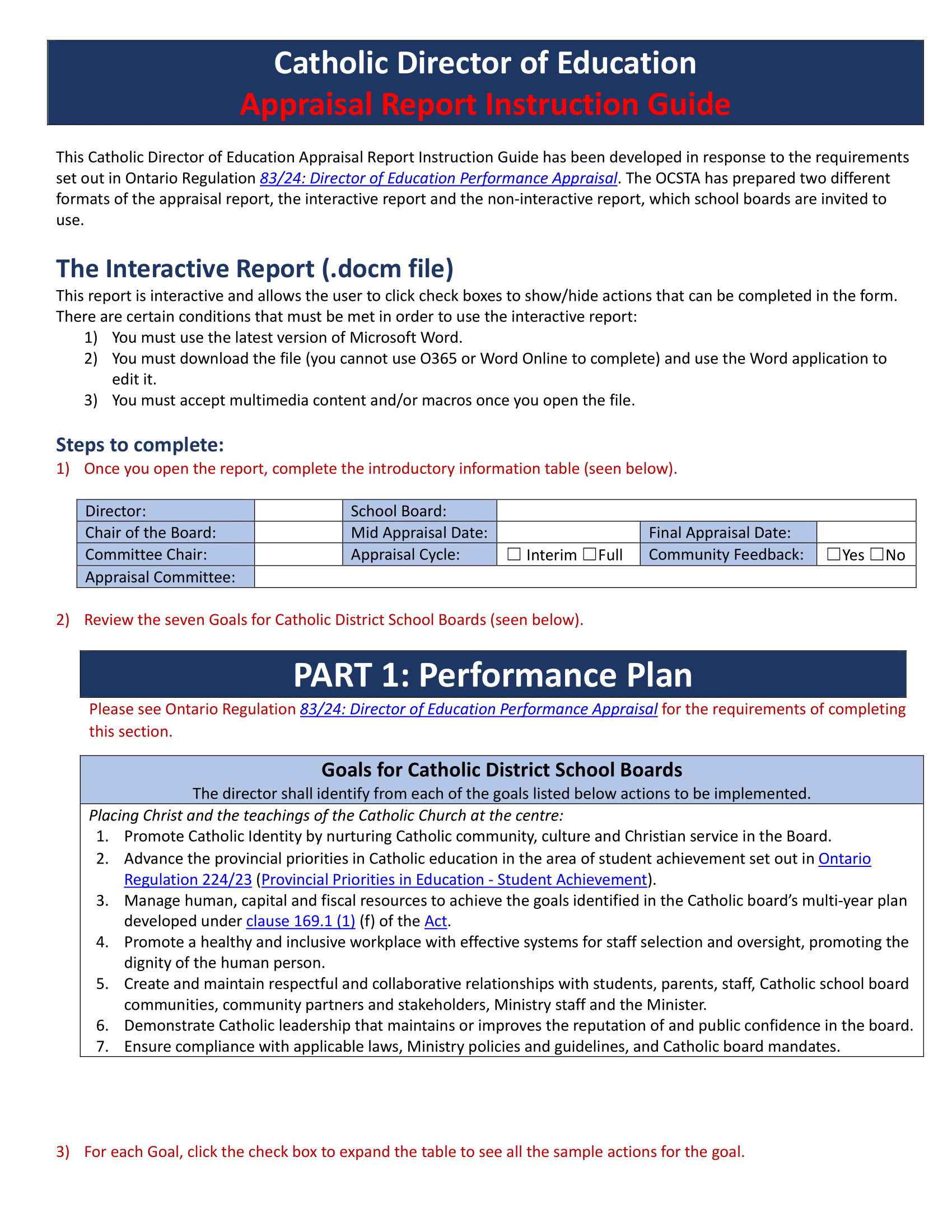
Definitions

Board
In the context of ‘the corporate Board’ refers to the St. Clair Catholic District School Board, including Trustees and senior administration. In the context of ‘the Board of Trustees’ refers only to voting members, who are the elected or appointed Trustees of the Board.
Committee
Includes all ad hoc, legislative, or special committees duly constituted by the Board in accordance with this by-law.
Chair
Refers to the Chair of the Board or of a meeting (whichever the context implies).
Vice Chair
Refers to the Vice Chair of the Board or of a committee (whichever the context implies).
Member
Refers to a voting member of the Board (elected or appointed trustees); or a member of a committee (whichever the context implies).
Director
Refers to the Director of Education and Secretary of the Board.
In-Camera Meeting
Meetings held in closed or private session. Such meetings are restricted by legislation to legal, personnel or property matters only.
Vote
The indicated preference of a Trustee in favour of, in opposition to, or abstaining from the question.
Resolution
(i) A motion having been duly passed by Trustees becomes a resolution of the Board; (ii) as a matter of formality, a motion may be made in the form of a resolution, which is always submitted in writing. Such a resolution is usually a public statement of the Board, which calls for some type of action, recognition or censure.
Conflict of Interest
The Municipal Conflict of Interest Act sets out three types of financial interest which must be declared by trustees. A conflict of interest arises where a trustee has a direct, indirect or deemed pecuniary interest that is before the Board of Trustees and that interest is not remote.
  • Direct Interest – a trustee would have a direct interest, where the trustee stands to benefit or suffer financially by a decision of the Board;
  • Indirect Interest – a trustee would have an indirect interest if the trustee is a shareholder, director or senior officer of a share or non-share corporation that has a pecuniary interest, or the member of a body that has a pecuniary interest, or is a partner or employee of a body that has a pecuniary interest;
  • Deemed Interest – a trustee would have deemed interest when the parent, spouse or child of the trustee, including daughter-in-law and/or son-in-law, has a direct or indirect pecuniary interest that is known to the trustee.
Pecuniary Interest
An interest in a matter that could monetarily affect the trustee, and includes direct, indirect or deemed pecuniary interest.
Self-Dealing
The conduct of a trustee that consists of taking advantage of their position in a transaction and acting for their own interests rather than for the interests of the public they represent as a member of the Board.

References

  • Modernizing Ontario’s Municipal Legislative Act
  • Education Act
  • Municipal Conflict of Interest Act
  • Municipal Freedom of Information and Protection of Privacy Act
  • O. Reg. 313/24

Trustee Expense Reimbursement

Date: 2000 12 01 / 2002 01 01 / 2004 05 25 / 2006 11 21 / 2010 10 27 / 2015 03 24 / 2021 03 30

Policy Statement

The St. Clair Catholic District School Board will reimburse trustees for expenses reasonably incurred in carrying out their responsibilities while representing the interests of students, the community and/or the Board. The Board also recognizes that, during their term of elected office, trustees require support services to effectively service their constituents.

Policy Goals

  1. To provide trustees, in their role of stewards and guardians of Catholic Education, with resources and supports to fulfill their obligations, as allowed through the Education Act and the parameters and guidelines of the Ministry of Education.
  2. To ensure financial integrity, accountability and transparency.
  3. To establish the parameters and guidelines under which trustees will receive supports, equipment, services and reimbursements that will enable them to communicate with constituents regarding board affairs and educational matters, to participate in various activities by virtue of their office, and to fulfill their corporate and constituency responsibilities.

Date: 2000 12 01 / 2002 01 01 / 2004 05 25 / 2006 11 21 / 2010 10 27 / 2015 03 24 / 2021 03 30 / 2024 09 01 / 2025 02 12

Administrative Procedures

This administrative procedure establishes criteria and procedures for the reimbursement of expenses incurred by trustees while performing duties on behalf of the St. Clair Catholic District School Board. The Board assumes no obligation to reimburse expenses that are not in compliance with these procedures. All amounts paid are subject to budget restrictions set annually by the Board and include expenditures from all sources of funding.

  1. Responsibility

    • The Treasurer of the Board will be responsible for the implementation of this policy and procedures and ensuring the trustees’ compliance.
    • The Treasurer of the Board or designate will inform the trustees of changes to mileage reimbursement rates on an annual basis and ensure that trustees have access to the most current electronic expense claim submission forms.
    • The Financial Services department will ensure approved expense claims are processed in a timely manner.
    • The Information Services department will coordinate the distribution of equipment and activation of services at the commencement of the trustees’ term of office.
  2. Expectations

    • Expenses must be considered reasonable and appropriate in order to be eligible for reimbursement. In other words, the expenses must be consistent with common values and accepted practices and will not be perceived as excessive.
    • The reimbursement process must be transparent and accountable with the necessary controls and approvals in place.
    • Options for meetings and professional development, such as audio or video conferencing, should be considered before attending the event in person.
  3. Travel Costs - Personal Automobile

    • Trustees will be paid mileage for authorized travel to/from their home and the location of the meeting or Board event.
    • Carpooling to common destinations is encouraged.
    • Trustees will be reimbursed at a rate per kilometre. This rate will be reviewed annually by the Treasurer of the Board and adjusted accordingly.
    • Trustees using a personal vehicle while on Board business are to adhere to the following guidelines:
      1. The vehicle must be insured at the vehicle owner’s expense for personal vehicle liability.
      2. It is the driver’s responsibility to satisfy themselves whether their motor vehicle insurance coverage should include coverage for business use of the vehicle.
      3. The Board will not reimburse the costs of insurance coverage for business use, physical damage or liability.
      4. The Board is not responsible for reimbursing deductible amounts related to insurance coverage.
      5. In the event of an accident, trustees will not be permitted to make a claim to the Board for any resulting damages.
  4. Travel Costs - Other

    • The use of a rental car/taxi service in lieu of a personal vehicle will be approved provided the cost, including rental, insurance and fuel, is less than the personal automobile reimbursement cost or the need is on an emergency basis. Collision damage waiver coverage should be waived when offered by the rental company, as the Board carries insurance coverage for rental vehicles. The insurance costs cannot be claimed as a travel expense. Luxury vehicles are prohibited. To avoid higher gasoline charges, a rental car must be re-fueled before returning it.
    • Trustees may use methods of travel (i.e. air/train fare) in which case they will be reimbursed based on actual cost as supported by an invoice. The cost must be no greater than the amount incurred when using a personal automobile. An explanation must be included where other than an economy fare is being claimed.
    • Taxis, parking costs and toll charges will be reimbursed based on actual receipts.
    • The Board will not reimburse parking fines, tickets for traffic violations or vehicle operating expenses (i.e. gasoline, repairs).
    • Cash advances will not be provided.
    • Foreign Exchange – out-of-pocket expenses will be reimbursed in Canadian funds at the current rate of exchange.
    • Travel outside of the Province of Ontario in Canada requires the prior approval of the Chair of the Board, the Director of Education and the Treasurer of the Board.
    • Travel outside of Canada is not allowed.
  5. Hotel Accommodation

    • Allowable expenses must be supported by a detailed original hotel invoice; credit card slips are not acceptable. Items reimbursed include:
      1. Accommodation in a standard room – no additional reimbursement will be made for suites, executive floors, or concierge levels
      2. A maximum of $30 per night for gratuitous lodging expenses when staying with family or friends – no receipt is required
      3. Business telephone calls, faxes
      4. Reasonable personal telephone calls
      5. Parking – If a receipt is not available (i.e. meter parking), a full explanation of the cost is required
      6. Internet services
      7. Photocopy services
      8. Tips and gratuities
      9. Hotel food service (itemized receipt required)
    • Non-Allowable expenses include:
      1. Movies and video rentals
      2. In-room mini-bar, water, snacks
      3. Bar charges
      4. Fitness facility charges
      5. Charges incurred by a family member or guest
      6. Other non-business-related expenses
  6. Meals

    • Reasonable and appropriate actual meal expenses will be reimbursed if the expense is incurred when the trustee is on Board business.
    • Actual detailed receipts must be provided to support the claim. Credit card receipts are not acceptable.
    • Reimbursement for alcohol is not permitted. Alcohol purchased for special events may be purchased by the Director of Education. (i.e. Inaugural / annual Board meetings, Annual Board-wide retirement recognition events, etc.)
    • Meal Guidelines per person (including taxes and gratuities) to a maximum of: Breakfast $25.00 Lunch $30.00 Dinner $50.00
    • Where the trustee cannot reasonably purchase a meal within these limits, the Chair of the Board and the Treasurer of the Board may approve an additional meal expense.
    • For a full day of meal claims (breakfast, lunch and dinner), trustees have the discretion to allocate the daily three meal rates among meals.
  7. Professional Development

    • Registration fees for conferences and workshops related to Board business will be paid directly by the Board or reimbursed if approved by the Chair of the Board.
    • Trustees will be reimbursed for travel to conferences, workshops and other events as approved by the Board.
      1. Attendance at the Annual General Meeting and Regional Meetings of the Ontario Catholic School Trustees’ Association is deemed approved for all trustees.
      2. Attendance at the Annual Chair and Vice-Chair Conference is deemed approved for the Chair and Vice-Chair of the Board.
      3. Attendance at the Annual General Meeting of the Canadian Catholic School Trustees’ Association is deemed approved subject to budget.
    • Other approved costs incurred while attending conferences and workshops related to Board business will be reimbursed if approved by the Chair of the Board.
    • If the event registration fee includes meals, trustees will only be reimbursed for meals not provided as part of the event package.
    • The Board shall not incur any additional expense as a result of a trustee’s spouse attending a conference, workshop or any other event.
  8. Equipment / Support Services

    • Trustees may select to be provided with a laptop computer for use during their term of office.
    • Regular ongoing maintenance and support will be provided by the Board during the trustee’s term of office.
    • All equipment will be returned to the Board at the end of the trustee’s term of office.
    • All communication services will be terminated at the end of the trustee’s term of office.
    • Office supplies will be provided by the Board.
    • The Treasurer and Chair of the Board may approve alternate equipment/services to those identified in 8.1 provided there is no increase in cost to the Board.
    • Where a trustee requires additional equipment / support services as a result of a disability or special need, these expenses will be covered by the Board.
  9. Reimbursement Procedures / Reporting

    • Expense claims must be submitted on the appropriate Board prescribed forms. The “Mileage Report” is to be used for all mileage claims and the “Expense Report” for all other expense reimbursement requests. Electronic templates of these forms will be provided to the trustees.
    • The expense claim form should include:
      1. original detailed receipts, clearly showing costs and applicable sales taxes, to support the eligible expense;
      2. description and reason for the expense
      3. the specific budget code to be charged;
      4. a copy of conference or workshop registration package if applicable; and
      5. original signature of the claimant to certify the expense claim.
    • Ineligible Expenses include:
      1. Donations to community groups or charities.
      2. Donations to schools.
      3. Donations to political activities or events.
      4. Reimbursement of personal expenses.
    • Where original receipts are not available because they have been submitted to the Ministry of Education or other funding agency, electronic copies of receipts will be accepted. If submitting electronically the claimant must retain copies of receipts until final payment is reimbursed by the Board.
    • At a minimum, expenses are to be summarized on a claim form monthly to the Financial Services Department, Attention: Accounts Payable for processing. Approved claims should be received within two calendar months. (Example: Expenses submitted on an approved January claim form to be received in Accounts Payable by March 31st). After the close of the August 31 year-end, expense claims are to be submitted within ten (10) business days. A written explanation is required if not submitted within the timeframes.
    • Claimants are required to repay any overpayments that may have been made in error. This may be resolved by deducting the amount from a subsequent expense claim.
    • Approvals Required:
      1. The Chair of the Board will approve all trustee mileage and expense reports.
      2. The Director of Education will approve the Chair of the Board’s expense reports.
      3. The Treasurer will review all trustee (including the Chair of the Board) expense reports for compliance with board policy prior to authorizing their processing for payment.
    • Should there be a dispute about the eligibility of any expense, the trustee may contest the decision during a public session of the Board.
    • Summary information about allowable trustee expense reimbursement will be made publicly available on an annual basis by the Treasurer of the Board.
    • All documentation shall be retained in accordance with the Board’s record retention guidelines.
  10. Additional Information

    • The St. Clair Catholic District School Board is committed to the principles of equity and inclusive education, consistent with our Catholic teachings, which value and promote human rights and social justice in all Board policies, programs, guidelines, operations and practices.
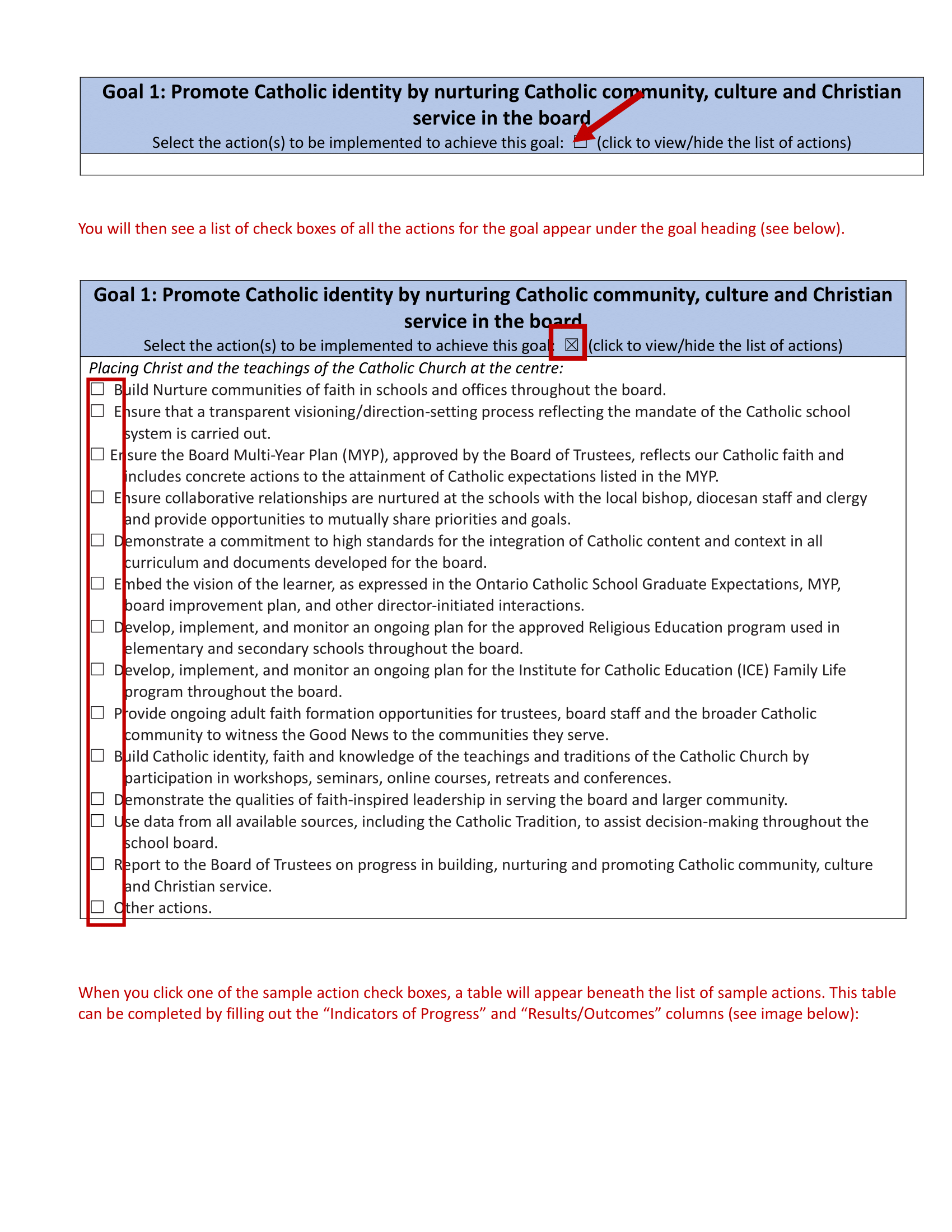
  11. References

    • Ministry Memorandum 2009:B8 – Trustee Expenditure Guideline
    • Ontario Education Act and Regulations
    • Management Board of Cabinet – Broader Public Sector Expenses Directive, January 2020
    • Management Board of Cabinet - Travel, Meal and Hospitality Expenses Directive. January 2020

Vision, Mission, Priorities and Values

Date: 2000 12 01 / 2006 09 26 / 2013 01 22 / 2019 11 12

Policy Statement

Members of the Board of Trustees exercise the distinct nature of their roles by providing policy direction and governance, which are inspired by the values and traditions of the Catholic faith and guided by the Vision, Mission, Priorities and Values of the St. Clair Catholic District School Board’s strategic plan.

Policy Goals

The Vision, Mission, Priorities and Values of the Board are reflections of the core beliefs of the St. Clair Catholic District School Board. They were developed following extensive consultation with all stakeholder groups. These central pillars of the Board’s strategic plan are self-evident and are stated below.

  • Our Vision

    Catholic Education ┼ Future Ready

  • Our Mission

    Learning together today, transforming tomorrow

  • Our Priorities
    • Learning & Innovation – Teaching transferable skills, critical thinking and creativity
    • Faith & Wellbeing – Living Catholic values to foster caring, inclusive and safe spaces
    • Partnerships – Engaging families, parish and community
    • Catholic Citizenship – Inspiring ethical, responsible stewardship
  • Our Values
    • Respect rooted in love
    • Excellence for all
    • Accountability to God, self and others
    • Engagement in our work
    • Called to serve our world