
Section D - Staff and Volunteers
Accessibility Statement
We are committed to ensuring that our policy and procedure documents are accessible to all users. Please note that some appendices may contain images of sample forms or other visual examples. These images may not be fully accessible to individuals using screen readers or other assistive technologies.
If you require an accessible version of any appendix, need the information in an alternative format, or would like additional assistance, please contact us.
Accessibility Standards
Date: 2010 01 01 / 2015 04 28 / 2023 06 20
Policy Statement
It is the policy of the St. Clair Catholic District School Board to provide an environment in all of its facilities that builds independence, dignity and respect for our students, parents/guardians, the public and our staff. Further, we are committed to giving people with disabilities the same opportunity of access to our services in the same location and in a similar way as these services are available to all others we serve. The Board believes that within the Catholic educational community, excellence in education is founded on respect for the dignity and humanity of all individuals and the development of human potential, enabling individuals and groups to participate and contribute fully within a diverse society. The key principles of independence, dignity, integration and equality of opportunity are reflected and valued in our learning and working environments, and our conduct will demonstrate our belief in the strength that diversity brings to our communities.
Policy Goals
- Confirm the Board’s policies align with the core principles of the Accessibility for Ontarians Disabilities Act (AODA).
- Strive to ensure that the identification, removal, and prevention of barriers in accordance with the AODA and all other applicable legislation is reflected and valued in our learning and working environments.
- Confirm the Board’s commitment to ensuring that all communication and interactions with persons with disabilities consider individual differences and needs.
- Establish a process for receiving and responding to feedback and confirm the feedback process will be readily available to the public.
Date: 2023 06 20
Administrative Procedures
The St. Clair Catholic District School Board as a public sector organization is responsible for providing goods and services that are barrier-free, bias-free and enabling for all. In compliance with the Accessibility Standards for Customer Service, Ontario Regulation 429/07, created under the Accessibility for Ontarians with Disabilities Act, 2005, the Board is committed to providing goods and services in a way that is accessible to all customers.
Responsibilities
-
Director of Education
- Oversee compliance with the Accessibility Standards for Customer Service policy.
-
Superintendents
- Oversee, monitor and support Principals and Managers with the implementation of the Accessibility Standards for Customer Service policy.
- Ensure that practices are consistent with the core principles of independence, dignity, integration and equality of opportunity.
- Ensure that all schools and workplaces permit and facilitate the use of assistive devices, service animals and/or support persons by those seeking customer service as outlined in the procedures to this policy.
-
Human Resource Services Department
- Provide appropriate training and training guidelines for new and current employees and volunteers, within appropriate timelines as it relates to Accessibility Standards for Customer Service.
- Report on training requirements to the Ontario government as requested.
-
Principals and Managers
- Implement the Accessibility Standards for Customer Service policy.
- Receive requests from customers with disabilities.
- Determine, in consultation with the customer and others, the most appropriate accommodation(s).
- Forward requests for accommodations to the attention of the Superintendent of Education for approval.
- Direct feedback from customers regarding the Act and/or policy to the appropriate Superintendent of Education or the senior administrator responsible for human resource services.
- Ensure that staff and volunteers interfacing with customers are trained to know the policy and procedures.
-
Employees
- Support the implementation of the Accessibility Standards for Customer Service policy and procedures.
- Participate in required training related to this policy as required.
- Direct feedback from customers regarding the Act and/or policy to their immediate supervisor.
-
Customer
- Self-identify as having a disability for which they require assistance in accessing Board services and communicating such to the appropriate Board personnel.
- Collaborate with Board staff to determine suitable mode(s) of accommodation/assistance.
Expectations
- The Board will make all reasonable efforts to ensure that all policies, practices and procedures from the date of this policy forward are consistent with the principles of independence, dignity, integration and equality of opportunity to all, with particular attention for persons with disabilities.
- The Board will welcome all members of the school and broader community to our facilities by committing our staff and volunteers to providing services that respect the independence and dignity of persons with disabilities. Such service shall incorporate measures that include but are not limited to the use of assistive devices and service animals.
- To ensure greater awareness and responsiveness to the needs of a person with disabilities, the Board will provide appropriate training for all staff and service providers who deal with the public. Training as identified above will be provided to all staff and, when appropriate, to volunteers. As new staff are hired, the training will become a component of their orientation training and will be provided within a reasonable timeframe.
- The Board will ensure that its policies and procedures related to the Accessibility for Ontarians with Disabilities Act, 2005 are made available to the public and also ensure there is capacity to provide communication about these policies and procedures in a format that takes into account a person’s disability.
- When services that are normally provided to a person with a disability are temporarily unavailable such as access to an elevator, a disruption of service notice will be posted at the site and on the Board’s website.
- In order to monitor the effectiveness of implementation of the Accessible Customer Service Standard, the Board will develop a process for receiving and responding to feedback. Information about the feedback process will be readily available to the public and will allow people to provide feedback using a number of methods.
- So that adherence to this policy can be achieved efficiently and effectively, the Board and all its managers and school-based administrators will take into account the impact on persons with disabilities when purchasing new equipment, designing new systems or planning a new initiative.
- The Board will create a feedback process that will review the implementation of this policy with the Board’s various constituency groups such as Special Education Advisory Committee (SEAC), Employee associations and unions, and citizens’ groups. Methods of feedback would include use of electronic means such as websites.
- The Board will also establish a process for consulting with frontline staff and volunteers who have a role in implementing the expectations and procedures established under this policy to review its effectiveness.
-
The following Procedures should be read in conjunction with the Accessibility Standards of Customer Service Policy:
- Use of Support Person by the General Public
- Use of Service Animal by the General Public
- Use of Assistive Devices by the General Public
- Monitoring and Feedback on Accessible Customer Service
- Notification of Disruption of Service
Additional Information
The St. Clair Catholic District School Board is committed to the principles of equity and inclusive education, consistent with our Catholic teachings, which value and promote human rights and social justice in all Board policies, programs, guidelines, operations and practices.References
- Canadian Charter of Rights and Freedom
- Ontario Human Rights Code
- Accessibility for Ontarians with Disabilities Act, 2005 (AODA)
- Accessibility Standards for Customer Service, Ontario Regulation 429/07
Definitions
- Disability
-
Any degree of physical disability, infirmity, malformation or disfigurement that is caused by bodily injury, birth defect or illness and, without limiting the generality of the foregoing, includes:
- diabetes mellitus, epilepsy, a brain injury, any degree of paralysis, amputation, lack of physical co-ordination, blindness or visual impediment, deafness or hearing impediment, muteness or speech impediment, or physical reliance on a guide dog or on a wheelchair or other remedial appliance or device,
- a condition of mental impairment or a developmental disability,
- a learning disability, or a dysfunction in one or more of the processes involved in understanding or using symbols or spoken language,
- a mental disorder,
- an injury or disability for which benefits were claimed or received under the insurance plan established under the Workplace Safety and Insurance Act, 1997; (“handicap”).
- Customer
- Any person who uses the services of the school board.
- Assistive Device
- Any device used by people with disabilities to help with daily living. Assistive devices include a range of products such as wheelchairs, walkers, white canes, oxygen tanks, electronic communication devices.
- Service Animal
- An animal that is being used because of a person’s disability and this is either readily apparent or is supported by a letter from a medical practitioner.
- Barrier to Accessibility
- Anything that prevents a person with a disability from fully participating in all aspects of the services of the Board. This includes, but is not limited to, a physical barrier, an architectural barrier, information or communications barrier, an attitudinal barrier, a technological barrier.
- Accommodation
- A means, through reasonable efforts, of preventing and removing barriers that impede individuals with disabilities from participating fully in the services of the Board.
Date: 2010 01 01 / 2015 04 28 / 2023 06 20
Applicable Reference from Accessibility Standard for Customer Service Policy:
When services that are normally provided to a person with a disability are temporarily unavailable such as access to an elevator, a disruption of service notice will be posted at the site and on the Board’s website.
Administrative Procedures
Responsibilities
- Supervisory Officers, Principals, Managers and/or the Supervisor – Communications and Community Relations will ensure that the users of Board and school services are notified when there is a disruption in services that may have an impact on access to services by people with disabilities.
Expectations
Notice of the Disruption of Services
-
Notice may be given by posting the information at a conspicuous place at or in the school or at or in board facilities. Other options that may be used include:
- posting on the Board and/or school website;
- through direct communication with users of the services in accordance with school practices.
- Notice will be provided in multiple formats where feasible and reasonable to do so.
- If the disruption is planned, notice should be provided in advance of the disruption. If the notice is unplanned, notice should be provided as soon as possible after the disruption has been identified.
- The notice of disruption of service must include information about the reason for the disruption, its anticipated duration and a description of alternative facilities or services, if any, that are available. Sample notices are provided in Appendix A.
- Generally, disruptions to all of the Board’s services, such as during a major storm or power outage, do not require this special notice. However, if the disruption has a significant impact on people with disabilities, a notice of the disruption should be provided, where reasonably possible.
Additional Information
- The St. Clair Catholic District School Board is committed to the principles of equity and inclusive education, consistent with our Catholic teachings, which value and promote human rights and social justice in all Board policies, programs, guidelines, operations and practices.
References
- Canadian Charter of Rights and Freedoms
- Ontario Human Rights Code
- Accessibility for Ontarians with Disabilities Act, 2005 (AODA)
- Accessibility Standards for Customer Service, Ontario Regulation 429/07
Definitions
- Disability
-
Any degree of physical disability, infirmity, malformation or disfigurement that is caused by bodily injury, birth defect or illness and, without limiting the generality of the foregoing, includes:
- diabetes mellitus, epilepsy, a brain injury, any degree of paralysis, amputation, lack of physical co-ordination, blindness or visual impediment, deafness or hearing impediment, muteness or speech impediment, or physical reliance on a guide dog or on a wheelchair or other remedial appliance or device,
- a condition of mental impairment or a developmental disability,
- a learning disability, or a dysfunction in one or more of the processes involved in understanding or using symbols or spoken language,
- a mental disorder,
- an injury or disability for which benefits were claimed or received under the insurance plan established under the Workplace Safety and Insurance Act, 1997; (“handicap”).
Sample Notices
-
Sample 1 – Access to School Building
To: Parents, Guardians and Community Users of our School
Maintenance work will make the main door of the school and the access ramp inaccessible from May 1 to May 8. A temporary ramp has been set up that gives access to the door at the east of the school building. We regret this inconvenience. If you have questions or concerns, please contact _______________ at [phone number].
Thank you.
Principal
-
Sample 2 – Accessible Washroom
To: Visitors to the Education Centre
Our accessible washroom is out of service due to a broken pipe. Repairs are underway and the washroom is expected to be usable again by tomorrow. In the interim, we have made arrangements for our visitors to use the accessible washroom at 123 Main Street, which is located next door to our premises. We apologize for this inconvenience.
Thank you.
Manager – Facility Services
Date: 2010 01 01 / 2015 04 28 / 2023 06 20
Applicable Reference from Accessibility Standard for Customer Service Policy:
The Board will monitor the effectiveness of implementation of the Accessibility Standard for Customer Service Policy through a process for receiving and responding to feedback. Information about the feedback process will be readily available to the public and will allow people with disabilities to provide feedback using a number of methods.
The Board will create a feedback process that will review the implementation of this policy with the Board’s various constituency groups. Examples include but are not limited to Special Education Advisory Committee (SEAC), Associations, Unions, citizens’ groups. Methods would include electronic means such as websites. Consultation with the Associations and Unions is as providers of accessible customer service.
Administrative Procedures
Responsibilities
-
The Director of Education and/or designates will implement a process for Feedback on Accessible Customer Service that has the following components:
- Information on the Board and school websites inviting users of Board services to provide feedback on their experience with or concerns about access to services for people with disabilities. A sample feedback notice is provided in Appendix A.
- Printed information available through school offices and public offices of the Board to invite people with disabilities to provide feedback on their experience with or concerns about accessibility of services. Consideration should be given to providing information in alternate formats.
- Information on how the Board will respond to feedback.
- The Director of Education and/or designates will create a process for reviewing implementation of the policy on Accessibility Standards for Customer Service that includes consultation with various constituency groups including Special Education Advisory Committee (SEAC), Associations, Unions, citizens’ groups.
- The Supervisor – Communications and Community Relations is responsible for receiving and responding to all feedback submitted.
- The senior administrator responsible for Human Resource Services is responsible for soliciting and receiving feedback from Association and Union representatives as providers of accessible customer service through their respective joint liaison committees.
Expectations
Methods for Feedback
- A range of methods for soliciting feedback will be employed to ensure optimum access to the feedback process by people with disabilities. These methods could include e-mail, verbal input or written submission.
Proactive Measures for Accessible Customer Service
- To ensure ongoing efficient and effective adherence to the Board’s policy on Accessibility Standards for Customer Service, the Board, its school-based administrators and its managers including those representing the Board in multi-board consortia will take into account the impact on people with disabilities when purchasing new equipment, designing new systems or planning a new initiative.
Additional Information
The St. Clair Catholic District School Board is committed to the principles of equity and inclusive education, consistent with our Catholic teachings, which value and promote human rights and social justice in all Board policies, programs, guidelines, operations and practices.References
- Canadian Charter of Rights and Freedom Ontario
- Ontario Human Rights Code
- Accessibility for Ontarians with Disabilities Act, 2005 (AODA)
- Accessibility Standards for Customer Service, Ontario Regulation 429/07
Definitions
- Disability
-
Any degree of physical disability, infirmity, malformation or disfigurement that is caused by bodily injury, birth defect or illness and, without limiting the generality of the foregoing, includes:
- diabetes mellitus, epilepsy, a brain injury, any degree of paralysis, amputation, lack of physical co-ordination, blindness or visual impediment, deafness or hearing impediment, muteness or speech impediment, or physical reliance on a guide dog or on a wheelchair or other remedial appliance or device,
- a condition of mental impairment or a developmental disability,
- a learning disability, or a dysfunction in one or more of the processes involved in understanding or using symbols or spoken language,
- a mental disorder,
- an injury or disability for which benefits were claimed or received under the insurance plan established under the Workplace Safety and Insurance Act, 1997; (“handicap”).
- Customer
- Any person who uses the services of the school board.
Feedback NOTICE
The St. Clair Catholic District School Board is committed to ensuring that its services meet optimum standards of accessibility for people with disabilities using the facilities and services of the Board. Comments on our services regarding how well those expectations are being met are welcome and appreciated.
Feedback regarding the way the St. Clair Catholic District School Board provides services to people with disabilities can be made verbally, by email, or in writing directed to the Supervisor – Communications and Community Relations.
Response to your feedback will be provided by direct response to the individual.
Date: 2010 01 01 / 2015 04 28 / 2023 06 20
Applicable Reference from Accessibility Standard for Customer Service Policy:
The Board will welcome all members of the school and broader community to our facilities by committing our staff and volunteers to providing services that respect the independence and dignity of people with disabilities. Such services incorporate measures that include but are not limited to the use of assistive devices.
Administrative Procedures
Responsibilities
- Supervisory Officers, Principals and Managers will ensure that staff are trained to support parents and the general public who may use assistive devices while accessing board services. Training is focused on how to interact with people using assistive devices rather than on the technical use of the assistive devices.
- Students and staff have separate and specific procedures related to their personal use of assistive devices.
Expectations
Communication regarding Use of Assistive Devices
- Each Board facility that is open to the public will, as applicable, post information in the front office/reception area welcoming the use of assistive devices and encouraging potential users to seek support from staff and volunteers as they require it. A sample notice is provided in Appendix A.
- The Board website and each school website will indicate that all Board facilities provide services that respect the independence and dignity of people with disabilities and offer services that include the use of assistive devices.
- The Board website and school websites will indicate the availability of a staff person to assist in provision of services to people with disabilities (e.g., school registration).
Additional Information
The St. Clair Catholic District School Board is committed to the principles of equity and inclusive education, consistent with our Catholic teachings, which value and promote human rights and social justice in all Board policies, programs, guidelines, operations and practices.References
- Canadian Charter of Rights and Freedoms
- Ontario Human Rights Code
- Accessibility for Ontarians with Disabilities Act, 2005 (AODA)
- Accessibility Standards for Customer Service, Ontario Regulation 429/07
Definitions
- Disability
-
Any degree of physical disability, infirmity, malformation or disfigurement that is caused by bodily injury, birth defect or illness and, without limiting the generality of the foregoing, includes:
- diabetes mellitus, epilepsy, a brain injury, any degree of paralysis, amputation, lack of physical co-ordination, blindness or visual impediment, deafness or hearing impediment, muteness or speech impediment, or physical reliance on a guide dog or on a wheelchair or other remedial appliance or device,
- a condition of mental impairment or a developmental disability,
- a learning disability, or a dysfunction in one or more of the processes involved in understanding or using symbols or spoken language,
- a mental disorder,
- an injury or disability for which benefits were claimed or received under the insurance plan established under the Workplace Safety and Insurance Act, 1997; (“handicap”).
- Assistive Device
- Any device used by people with disabilities to help with daily living. Assistive devices include a range of products such as wheelchairs, walkers, white canes, oxygen tanks, electronic communication devices.
Accessibility for Customer Service
It is the policy of the St. Clair Catholic District School Board to provide an environment in all of its facilities that builds independence, dignity and respect for our students, parents/guardians, the public and our staff. To this end, the Board welcomes individuals with disabilities:
- to use assistive devices
- to be accompanied by a support person
- to be accompanied by a service animal
- to seek support from staff and volunteers
The Board’s policy with respect to the Accessibility Standard for Customer Service can be found on our website: www.st-clair.net
Feedback regarding the way the St. Clair Catholic District School Board provides services to people with disabilities can be made verbally, by email or in writing directed to Supervisor – Communications and Community Relations, at the Catholic Education Centre, 420 Creek Street, Wallaceburg, ON, N8A 4C4.
Tel: 519-627-6762 Ext. 243
Toll Free: 1-866-336-6139 or feedback@sccdsb.net
Date: 2010 01 01 / 2015 04 28 / 2023 06 20
Applicable Reference from Accessibility Standard for Customer Service Policy:
The Board will welcome all members of the school and broader community to our facilities by committing our staff and volunteers to providing services that respect the independence and dignity of people with disabilities, such service to incorporate measures that include but are not limited to the use of service animals.
Administrative Procedures
Responsibilities
-
Supervisory Officers, Principals and Managers will ensure that all staff, volunteers and others dealing with the public are properly trained in how to interact with people with disabilities who are accompanied by a service animal.
Expectations
Access to Board Premises- Any person with a disability who is accompanied by a service animal will be welcomed on Board and/or school premises with his or her service animal and will be accompanied by the service animal while on the premises. Access will be in accordance with normal security procedures. This requirement applies only to those areas of the premises where the public or third parties customarily have access and does not include places or areas of the school or board offices where the public does not have access.
- This procedure deals solely with the individual’s right to be accompanied by a service animal. Access to classrooms for service animals used by students and staff is covered under separate procedures.
- A service animal can only be excluded from access to the premises where this is required by another law. Examples include the Health Protection and Promotion Act and the Food Safety and Quality Act. The former Act prohibits service animals in places where food is prepared, processed, or handled (e.g., kitchen of school cafeteria or culinary arts classroom) although service dogs are permitted where food is served and sold (e.g. school cafeteria or lunchroom).
- Where there is a risk to the health and safety of another person as a result of the presence of a service animal, consideration must be given to options available prior to exclusion of a service animal. An example would be a situation where an individual has a severe allergy to the service animal. It is the Board’s expectation that the situation be fully analyzed and all measures to eliminate the risk be considered, e.g. creating distance between the two individuals concerned, making reasonable alterations to schedules, etc.
- A service animal can be excluded if it is of a breed that is prohibited by law. An example would be the Ontario Dog Owners’ Liability Act which places restrictions on pit bull terriers.
- In the rare instance where a service animal must be excluded, the Board must make every effort to put alternative arrangements in place to provide the services required by the person with a disability. This could involve leaving the animal in a secure area where it is permitted by law and discussing with the person how best to serve them, e.g., a person with a vision disability might need someone (a member of staff or volunteer) to guide them.
- Where an animal is not a trained guide dog and it is not readily apparent that the animal is a service animal, the school or board staff member may ask the person using the service animal for a letter from a physician or nurse confirming that the animal is needed because of a disability. The letter does not need to identify the disability, why the animal is needed or how it is used.
- Where the person using the service animal regularly attends at the school or board facility, the principal or manager may request to keep a copy of the letter described in section 1.2 on file but only as long as required by the circumstances. Alternatively, the person using the service animal may be asked to bring a letter with them on occasions when they visit the premises. The principal or manager shall preserve the confidentiality of the letter and information contained in the letter and shall not use or disclose the letter or information except as provided for in the Municipal Freedom of Information and Protection of Privacy Act, R.S.O. 1990, cM56, or as otherwise required by law.
Additional Information
The St. Clair Catholic District School Board is committed to the principles of equity and inclusive education, consistent with our Catholic teachings, which value and promote human rights and social justice in all Board policies, programs, guidelines, operations and practices.References
- Canadian Charter of Rights and Freedom Ontario
- Ontario Human Rights Code
- Accessibility for Ontarians with Disabilities Act, 2005 (AODA)
- Accessibility Standards for Customer Service, Ontario Regulation 429/07
- Health Protection and Promotion Act
- Food Safety and Quality Act
- Ontario Dog Owners’ Liability Act
Definitions
- Disability
-
Any degree of physical disability, infirmity, malformation or disfigurement that is caused by bodily injury, birth defect or illness and, without limiting the generality of the foregoing, includes:
- diabetes mellitus, epilepsy, a brain injury, any degree of paralysis, amputation, lack of physical co-ordination, blindness or visual impediment, deafness or hearing impediment, muteness or speech impediment, or physical reliance on a guide dog or on a wheelchair or other remedial appliance or device,
- a condition of mental impairment or a developmental disability,
- a learning disability, or a dysfunction in one or more of the processes involved in understanding or using symbols or spoken language,
- a mental disorder,
- an injury or disability for which benefits were claimed or received under the insurance plan established under the Workplace Safety and Insurance Act, 1997; (“handicap”).
- Service Animal
- An animal that is being used because of a person’s disability and this is either readily apparent or is supported by a letter from a medical practitioner.
Date: 2010 01 01 / 2015 04 28 / 2023 06 20
Applicable Reference from Accessibility Standard for Customer Service Policy
The Board will welcome all members of the school and broader community to our facilities by committing our staff and volunteers to providing services that respect the independence and dignity of people with disabilities, such service to incorporate measures that include but are not limited to the use of support persons.
Administrative Procedures
Responsibilities
- Supervisory Officers, Principals and Managers will ensure that staff receive training in interacting with people with disabilities who are accessing board services accompanied by a support person.
Expectations
Access to Premises
- Any person with a disability who is accompanied by a support person will be welcomed on Board and/or school premises with his or her support person. Access will be in accordance with normal security procedures. This requirement applies only to those areas of the premises where the public or third parties customarily have access and does not include places or areas of the school or board offices where the public does not have access.
Confidentiality
- Where a support person is accompanying a person with a disability, who is the parent/guardian of a student, for the purpose of assisting in a discussion that may involve confidential information concerning the student, the Superintendent, Principal or other staff member must first secure the consent of the parent/guardian regarding such disclosure. A sample of a consent document is provided below in Appendix A.
- The parent/guardian must provide documented consent to the disclosure of confidential information in the presence of the support person.
- The support person must also provide assurance in writing to safeguard the confidentiality of information disclosed in the discussion.
- A copy of the signed consent document will be retained in the school/board office by the Principal or Superintendent.
- If the parent/guardian uses a different support person for subsequent meetings, a new signed consent will be required.
Support Persons Accompanying a Person with a Disability at School Events for which there is an Admission Fee
- Where a support person attends a school, family of schools or board-organized event at school or Board facilities for which a fee is charged, such fee will be waived for the support person who accompanies an individual with a disability who has paid a fee for attendance.
Where the Board may Require the Presence of a Support Person
-
The Board may require a person with a disability to be accompanied by a support person when on the premises, but only if a support person is necessary to protect the health or safety of the person with a disability or the health or safety of others on the premises.
-
Note: This would be a highly rare situation and would only occur where, after consultation with the person with the disability, requiring a support person is the only means available to allow the person to be on the premises and, at the same time, fulfill the Board’s obligations to protect the health or safety of the person with a disability or of others on the premises.
It is further noted that people with disabilities are free to accept a reasonable risk of injury to themselves just as other people do. Different individuals will have a different tolerance for risk. Risk should be weighed against any benefit for the person with a disability. It is not enough that the support person might help to protect health and safety; a support person must be necessary or essential to protect health and safety before you can require one – the risk cannot be eliminated or reduced by other means. Any considerations on protecting health or safety should be based on specific factors and not on assumptions. Just because someone has a disability doesn’t mean they’re not capable of meeting health or safety requirements.
-
Additional Information
The St. Clair Catholic District School Board is committed to the principles of equity and inclusive education, consistent with our Catholic teachings, which value and promote human rights and social justice in all Board policies, programs, guidelines, operations and practices.References
- Canadian Charter of Rights and Freedoms, Ontario
- Ontario Human Rights Code
- Accessibility for Ontarians with Disabilities Act, 2005 (AODA)
- Accessibility Standards for Customer Service, Ontario Regulation 429/07
Definitions
- Disability
-
Any degree of physical disability, infirmity, malformation or disfigurement that is caused by bodily injury, birth defect or illness and, without limiting the generality of the foregoing, includes:
- diabetes mellitus, epilepsy, a brain injury, any degree of paralysis, amputation, lack of physical co-ordination, blindness or visual impediment, deafness or hearing impediment, muteness or speech impediment, or physical reliance on a guide dog or on a wheelchair or other remedial appliance or device,
- a condition of mental impairment or a developmental disability,
- a learning disability, or a dysfunction in one or more of the processes involved in understanding or using symbols or spoken language,
- a mental disorder,
- an injury or disability for which benefits were claimed or received under the insurance plan established under the Workplace Safety and Insurance Act, 1997; (“handicap”).
- Support Person
- A person who assists or interprets for a person with a disability as they access the services of the Board. A support person is distinct from an employee who supports a student in the system. A support person is chosen by a person with a disability to provide services or assistance with communication, mobility, personal care, medical needs or with access to goods or services and could be a paid professional, a volunteer, a friend or a family member. He or she does not necessarily need to have special training or qualifications.
Sample Consent Form (reference only)
I, (parent/guardian), consent to the sharing of confidential information by (name of principal/teacher/other staff member) related to my child/ward (name) in the presence of my support person (name).
My support person (name) consents to safeguarding the confidentiality of the information shared.
Affirmation of Consent
-
Parent/Guardian
-
-
I undertake to safeguard the confidentiality of information shared between (school staff) and (parent/guardian) for whom I am a support person.
Support Person
-
-
Signature of Witness – Principal/Staff Member
-
Attendance Support
Date: 2010 06 22 / 2014 03 25 / 2022 05 31
Policy Statement
The St. Clair Catholic District School Board expects regular and consistent work attendance by all employees. This is integral to the delivery of quality educational programs and to the service operations of the Board. The St. Clair Catholic District School Board is committed to supporting the health and well-being of its employees and when regular attendance has been compromised employees will be supported in improving and maintaining their attendance. The Attendance Support Program is a non-disciplinary process.
Attendance support focuses on individuals whose absence is beyond their control due to various medically identifiable conditions. The program is intended to help the employee manage a medical condition so as to improve attendance. However, in some situations even with accommodation, the employment relationship may be frustrated by the employee’s inability to attend work on a regular and consistent basis. Situations involving occupational injury (approved Workplace Safety and Insurance Board claims) and Long-Term Disability are not subject to the attendance support process.
Policy Goals
- Provide a consistent and standardized attendance support program for all employees.
- Apply proactive and preventative wellness strategies that support healthy and productive employment.
- Support employees when their absence rates exceed a just and equitable threshold with the ultimate goal to return to regular, consistent and sustained work attendance of the employee within normal parameters.
- Facilitate return to work programs where applicable for employees who have been absent from work due to illness or disability.
Date: 2010 06 22 / 2014 03 25 / 2022 05 31
Administrative Procedures
Responsibilities
-
Principals / Supervisors:
- Orient their employees to the Attendance Support Policy and expectations and ensure that absences are entered into the Smart Find Express (SFE) System.
- Communicate attendance expectations to all employees through a regular review of the Attendance Support Program at the first staff meeting of the school year.
- Consult with the Safety and Disability Administrator for strategies to reduce overall absenteeism.
- Maintain regular contact with absent employees.
- Engage in a proactive approach to attendance management by examining the areas of safety training, ergonomics, and working conditions, and seek assistance where required.
- Describe preventive or proactive services available to employees through the Employee and Family Assistance Program.
- Participate in all meetings as outlined in the Attendance Support Program and provide input into the development of individualized attendance goals for each employee involved in the process.
- Provide positive reinforcement to employees who reach their attendance goals.
-
Employee:
- Maintain regular attendance.
- Report absences through normal reporting procedures.
- Participate actively in all levels of the attendance support process.
- Cooperate in setting personal attendance goals.
- Provide any appropriate medical documentation, during any level of the process in accordance with Collective Agreements, to describe the nature of the illness/injury and relevant limitations to support absences.
-
The Safety and Disability Administrator (or designate):
- Communicate attendance support thresholds to all employees at the commencement of the school year.
- Guide and support Principals/Supervisors and employees through the Attendance Support Program with the goal of maintaining the health and well-being of employees and their regular attendance.
- Serve as a resource to employees and Principals/Supervisors.
- Monitor attendance statistics and identify employees who exceed the threshold level of absences.
- Advise employees of resources available to them.
- Facilitate meetings.
- Provide assistance on the development of individualized goals at the conclusion of each meeting, taking into account all circumstances identified during each meeting.
- Provide a written outcome of each level meeting with copies to the employee, Principal/Supervisor and employee representative, if applicable.
Expectations
- Attendance Support focuses on non-culpable (innocent) absenteeism which are absences that occur when an employee, through no fault of their own, is absent from work due to injury or illness.
- Attendance Support is not an appropriate vehicle to address an employee’s performance issues.
- Attendance Support is not an appropriate process where medical reasons that are the exclusive cause for the absence suggest an accommodation. However, attendance support may be appropriate when there are medical reasons that do not warrant an accommodation but contribute to the poor attendance.
- Employees shall continue to follow Board wide procedures / plans for communicable diseases (i.e., Fifth disease, H1N1).
-
The attendance support process shall be initiated when:
- An employee has exceeded predetermined attendance threshold subject to consideration of mitigating circumstances
- Thresholds to be used;
- Threshold to initiate an Attendance Alert Letter
- Threshold to initiate individual Attendance Support Meetings
- Notification will be sent by Safety and Disability Administrator to employee advising of exhaustion of allotted sick days.
- When an employee is participating in the Attendance Support Program, and they have met the established attendance goals, they can exit the attendance support process.
Steps for addressing attendance concerns directly with individual employees
These steps are guidelines and based on the unique circumstances of the situation, the steps may be altered or adjusted.
-
Attendance Alert Letter sent by Safety and Disability Administrator to Employee
The Safety and Disability Administrator will monitor Board absenteeism rates and will initiate Attendance Alert Letters for those employees who have:
-
- Exceeded the predetermined attendance threshold subject to consideration of mitigating circumstances
-
-
Review of individual attendance with employee
The Safety and Disability Administrator will monitor Board absenteeism rates and will initiate discussion with the Principals / Supervisors for those employees who have:
- Exceeded the next predetermined attendance threshold subject to consideration of mitigating circumstances
If the Principal / Supervisor is aware of mitigating circumstances that resulted in one lengthy absence (i.e., recovery period following surgery), the Principal / Supervisor, and the Safety and Disability Administrator will decide together as to whether this step will apply. In this case, it may be more appropriate to use the Disability Management procedures outlined in the Board’s Remain at Work, Return to Work and Modified Work Program Policy.
In cases where there are no mitigating circumstances and the employee has met the above noted criteria, a review between the Principal / Supervisor, employee and the Safety and Disability Administrator is conducted. At this review meeting, the employee will be advised that their level of attendance has triggered their participation in the Attendance Support Program. The employee’s attendance record will be reviewed, and they will be encouraged to improve their attendance. An attendance goal will be set, and the employee will be advised that their attendance record will be reviewed in 3 months. If the attendance goal has been met the process will conclude; however, if the goal has not been achieved there will be a formal review meeting to which the Union representative will also attend.
The employee will be reminded that they are able to access services through Employee and Family Assistance Program, or their physician if the employee reports medical factors as the reason for the absences. If other reasons are identified by the employee that can be explored or addressed through other means (i.e., ergonomic issues, work conflict) it may be appropriate to discuss next steps to review solutions.
The Safety and Disability Administrator will prepare a letter to the employee which documents that the meeting has occurred, specifying the agreed upon goal(s) and next steps.
-
Second review of individual attendance with employee
A second review meeting will be held when the employee has not met the attendance goal established in the “Step 2” meeting. Usually this will be following a 3-month period; however, if absences escalate then a meeting may be required at an earlier date. This review meeting will be arranged by the Safety and Disability Administrator, and the relevant Union representative will attend.
At this meeting the Principal / Supervisor with input from the Safety and Disability Administrator will emphasize that the attendance support process is non-disciplinary. An attendance target will be set for the next 3 – 6 months. It will also be noted that resolution of this issue is important and improvement is required.
During the discussion period, the employee will be advised that if they have a medical condition causing them to be absent from work that they should submit documentation from their physician indicating any on-going medical restriction.
The employee will be offered support through the Employee and Family Assistance Program, and other wellness resources / information.
The results of the discussion will be documented in a letter to the employee prepared by the Safety and Disability Administrator with input from the Principal/ Supervisor, and the relevant Union will be copied.
-
Third review of individual attendance with employee
During this meeting, if the agreed upon attendance goal was met the Principal / Supervisor should provide positive feedback to the employee. A brief discussion will focus on strategies to sustain the success.
However, if the attendance goal was not met and if no medical documentation had been submitted by the employee, the same steps outlined for the “Step 3” meeting are followed.
At any time, if medical information is submitted by the employee, a meeting may be held with the Principal/ Supervisor, the employee, the Union representative and the Safety and Disability Administrator to determine an appropriate course of action. With consent from the employee, it may be necessary to gain further medical information to consider if an accommodation for medical reasons is required. Timelines for this step will vary based on the individual’s specific medical situation and the strategies used for improving attendance. Depending on the issues being dealt with, an appropriate timeframe could range from a few weeks to a few months.
There may be cases where absence concerns continue, and medical documentation is submitted but it does not suggest a need for an accommodation. In these cases, the attendance support process continues with the goal of supporting the employee in their health and regular attendance.
This step becomes formalized with a letter to the employee prepared by the Safety and Disability Administrator with input from the Principal/ Supervisor, and the relevant Union will be copied.
-
Fourth review of individual attendance with employee
If the agreed upon goal was met the Principal / Supervisor should provide positive feedback to the employee and the discussion will focus on ways to sustain the positive attendance record.
However, if the goal was not met a fourth meeting will be arranged by the Safety and Disability Administrator, and the same steps as outlined for the earlier meeting will be followed. The employee will be encouraged to improve their attendance and they will be supported in improving their attendance.
The employee will be provided with a letter to take to their physician. The letter will advise the physician that the employee has been participating in an Attendance Support Program, and it will describe the absence concerns to the physician.
The Safety and Disability Administrator will provide the employee with a summary letter. As with the previous letters, this letter is also non-disciplinary and does not question the validity of the absences (non-culpable). The letter, however, warns the employee that continued absence from work may result in a blameless discharge. The Principal / Supervisor and the Safety and Disability Administrator will establish another follow-up date.
-
Termination for excessive absenteeism (blameless discharge)
If the employee continues to have excessive absences and cannot be accommodated consideration may be given to termination for excessive absenteeism. This is a blameless discharge for non-culpable behavior and does not call into question the validity of the absences. Where objective medical information indicates the Board has an obligation to accommodate the disability of an employee, duty of accommodation processes must be initiated.
The decision whether or not to terminate is made by Human Resource Services in consultation with the senior administrator responsible for Human Resource Services.
Additional Information
The St. Clair Catholic District School Board is committed to the principles of equity and inclusive education, consistent with our Catholic teachings, which value and promote human rights and social justice in all Board policies, programs, guidelines, operations and practices.
Definitions
- Non-Culpable (Innocent) Absenteeism:
- Relates to absences as a result of illness or injury that arise due to circumstances beyond the employee’s control. These absences are not dealt with through a progressive discipline model; instead, the employee is supported through the Attendance Support Program. The Attendance Support Program recognizes that employees with non-culpable absenteeism may require assistance to attend work regularly and meet attendance expectations.
- Culpable Absenteeism:
- Relates to those absences for which employees can be held accountable. Failure to attend work without notifying the employer, lateness for work or leaving early and abuse of leave are examples of culpable absences. Employees with culpable absences are subject to progressive discipline, in accordance with the associated policy and procedures. These absences are not dealt with through the Attendance Support Program.
- Mitigating Circumstances:
- Circumstances relating to medical matters or illness which are beyond an employee’s control and could significantly impact attendance. Mitigating circumstances may include an absence of consecutive days for medical reasons such as surgery.
- Threshold Level:
- The threshold is a number of sick days identified by Human Resource Services each year for which it is reasonable that employees not exceed, unless there are special circumstances substantiated by medical documentation. Thresholds will be reviewed annually.
- Attendance Goal:
- The attendance goal set at any review meeting conducted under the Attendance Support Procedure takes into consideration the threshold level, submitted medical documentation on the case, time frame for the specific goal, and any mitigating circumstances for the situation.
Catholic School Community Council
Date: 2000 12 01 / 2001 06 12 / 2001 08 28 / 2002 05 28 / 2006 11 21 / 2013 03 05 / 2022 02 15
Policy Statement
The St. Clair Catholic District School Board is committed to supporting partnerships that involve meaningful dialogue among the home, school and parish, which is the foundational triad on which Catholic education is built.
- The Catholic School Community Council is the voice of parents and guardians in this partnership, as together we live our mission of ‘learning together today, transforming tomorrow.’
Policy Goals
- The purpose of the Catholic School Community Council is, through the active participation of parents, to improve pupil achievement and to enhance the accountability of the education system to parents.
- This policy defines the role of parents in their capacity as members of an advisory body, whose views and opinions will support Catholic education and the mission and vision of the St. Clair Catholic District School Board and its schools.
- This policy also defines the role of the Principal as the educational and organizational leader of the school; and as such, the final authority for matters in the purview of the Catholic School Community Council.
References
- Ontario Education Act
- O. Reg. 612/00
Date: 2000 12 01 / 2001 06 12 / 2001 08 28 / 2002 05 28 / 2006 11 21 / 2013 03 05 / 2022 02 15
Administrative Procedures
Responsibilities
Duties of the Catholic School Community Council
-
The Catholic School Community Council shall:
- Support and promote the vision and mission and comply with the policies of the St. Clair Catholic District School Board
- Meet at least four times during the school year
- Ensure that all meetings are open to the public and held at a location that is accessible to the public
- Ensure that a meeting of a Catholic School Community Council is only held if a majority of the current members of the Council are present and a majority of the members of the Council who are present at the meeting are parent members
- Advertise its meeting dates in the school community and encourage participation
- Ensure that minutes of its meetings and motions are kept and that the register of the minutes is available to community members
- Consider implementing a faith committee to enhance Catholic spirituality in the school and to link the community with the parish and the broader church community
- Promote the best interests of the school community
- Communicate regularly with parents and other members of the community to seek their views and preferences with regard to matters being addressed by the Council and to report on the activities of the Catholic School Community Council to the school community
- Provide annually the name and address of Catholic School Community Council members to the Director of Education
- Supervise the election procedure for Catholic School Community Councils
- Annually review the effectiveness of the Catholic School Community Council activities
-
The chairperson shall be elected by the Catholic School Community Council and shall:
- Support and promote the vision and mission and comply with the policies of the St. Clair Catholic District School Board
- Liaise with the school principal
- Call the Catholic School Community Council meetings (except for the first inaugural meeting)
- Prepare the agenda for each meeting in co-operation with the school principal
- Send the agenda to all members at least one week prior to the meeting
- Chair the Catholic School Community Council meetings
- Ensure that minutes and records of financial transactions are kept and retained for a minimum of four years
- Ensure that a copy of the minutes is sent to each member
- Ensure that the Catholic School Community Council regularly consults with the school community
- As appropriate, initiate a follow-up of decisions made by the Catholic School Community Council
- Consult, if needed, the administration and trustees of the Board
- Represent or ensure that a designate represents the Catholic School Community Council at all St. Clair Catholic District Board Parent Involvement Committee meetings
- Ensure that the Catholic School Community Council establishes aims and objectives and that they are reviewed and updated as needed
- Submit an annual written and financial report of the Catholic School Community Council activities at the end of each school year to the school principal, parents and to the St. Clair Catholic District School Board
-
Members of the Catholic School Community Council shall:
- Support and promote the vision, mission and comply with the policies of the St. Clair Catholic District School Board
- Take part in the meetings
- Make decisions within the Catholic spiritual and ethical framework
- Participate in consensus decision-making
- Liaise between the Catholic School Community Council and the community and the local parish
- Encourage parent participation as well as the participation of other people belonging to the community served by the school
- Offer pertinent advice to the school principal on all questions pertaining to student spiritual development and learning and to the successful operation of the school
- Consider agenda items from the perspective of the school
- Represent the Catholic School Community Council when designated by the Council Chair
- Be entitled to one vote in votes taken by the Council
-
The school principal shall:
- Initiate and facilitate the establishment of the Catholic School Community Council
- Participate in Catholic School Community Council meetings
- Maintain the authority of the principal’s position according to legislation, regulations and statutes
- Communicate with the Catholic School Community Council chairperson and take part in the setting of the agenda of the meetings
- Ensure that the register of minutes of meetings is kept at the school and accessible to members of the school community
- Encourage the participation of parents from all groups and of other people within the school community
- Provide for the prompt distribution to each member of the Catholic School Community Council of any materials received by the principal from the Ministry or School Board and post such material in the school in a location that is accessible to parents
- Meet the requirements of the yearly election process
- Attend every meeting of the Catholic School Community Council, unless unable to do so by reason of illness or other cause beyond control. In such cases, the Principal may designate a Vice Principal or Teacher In Charge to attend on his/her behalf.
- Act as a resource person to the Catholic School Community Council and assist the Council in obtaining information relevant to the functions of the Council, including information relating to relevant legislation, regulations and policies to allow the Council to provide sound advice
- Consider each recommendation made to the principal by the Catholic School Community Council and advise the Council of the response to the recommendation
- On behalf of the Catholic School Community Council, give written notice of the dates, times and locations of the meetings of the Council to every parent of a student who, on the date the notice is given, is enrolled in the school
- Not be entitled to vote in votes taken by the Catholic School Community Council or by a committee of the Catholic School Community Council
-
Solicit the views of the Catholic School Community Council regarding matters under its mandate including, but not limited to:
- The establishment, implementation and review of school guidelines that relate to student achievement or to the accountability of the education system to parents, including a local code of conduct and appropriate dress for students, as set out in Board policy.
- School action plans for improvement, based on the Education Quality and Accountability Office (EQAO) reports on the results of tests of students and the communication of those plans to the public.
- The Ministry of Education regulates decision-making on many subjects. The school principal will inform the Catholic School Community Council of relevant Ministry regulations and Board policy to be followed.
-
The Board shall:
- Provide liability insurance coverage for all Catholic School Community Council members while they are performing their duties and responsibilities as outlined in this policy and administrative procedures
- Consider recommendations and advise the Council of the action(s) taken in response to the recommendations (Appendix A provides the template for submitting recommendations to the Board.)
Membership
-
The membership of the Catholic School Community Council shall include:
- Parents and guardians of students enrolled in the school
- The principal and/or vice-principal
- A community representative (optional)
- A student(s) (mandatory in secondary schools; recommended, but at the discretion of the principal, in elementary schools)
- A teacher(s) from the school staff
- A non-teaching employee(s) from the school staff
- Parents/guardians shall form the majority of the Catholic School Community Council and will remain eligible to be a representative as long as their children are students in the school. Staff members, who have children in the school where they work, shall not be a parent representative on the Catholic School Community Council where their children attend; however, they may attend as a staff representative. A member of the School Board cannot be a member of a Catholic School Community Council established by the School Board.
-
The Election or Appointment of Members
- Parents/guardians shall be elected by parents and guardians of students enrolled in the school.
- The school principal/vice-principal shall be appointed by the School Board.
- In the case of a school with one or more secondary grades, one student enrolled in the school shall be appointed by the student council or elected if the school does not have a student council.
- In the case of a school with no secondary grades, one student enrolled in the school may be appointed by the principal, if the principal determines, after consultation with the other members of the Catholic School Community Council, that such an appointment is appropriate.
- The teacher representative shall be appointed by the Principal.
- The non-teaching employee representative shall be appointed by the Principal.
- The Catholic School Community Council may appoint a community representative. A parent may serve as the community representative.
- The Chair of the Catholic School Community Council shall be elected by the Catholic School Community Council.
-
Election Criteria
- Teacher: must work at the school and must be a Catholic, separate school supporter.
- Non-teacher: must work at the school.
- Student: must be Catholic, enrolled at the school.
- Parent/Guardian of students enrolled in the school: must be over 18 years old, a separate school supporter (if elementary school), not employed at the school in which the Council is established. If the person is employed elsewhere by the Board, he/she must inform other members of the employment before the election.
- Community representative (optional): must be over 18 years old, a Catholic, separate school supporter, not employed at the school in which the Council is established. If the person is employed elsewhere by the Board, the other members must be informed of the employment, before the appointment is made.
- Executive members: must be parents/guardians who are separate school supporters (if elementary school) and not employed by the Board.
The term of office for elected or appointed positions on the Catholic School Community Council shall be one school year. Elected or appointed members may seek additional terms. The Catholic School Community Council has the right to replace any member, who does not meet the expectations of this policy and procedure prior to the end of their term. The procedure will be outlined in each Catholic School Community Council’s Constitution.
-
It is recommended that the size of the Catholic School Community Council not exceed 18 members.
-
Remuneration
A person shall not receive any remuneration for serving as a member or officer of a Catholic School Community Council.
Considerations
- Members of the Catholic School Community Council must consider all issues from the school's perspective in the best interests of the school community and the students it serves.
- The Catholic School Community Council is advisory in nature and is not a forum for individuals to voice complaints. Complaints should be addressed to the school principal or superintendent.
- The Catholic School Community Council must work within the framework of federal, provincial, and municipal legislation, including the Freedom of Information and Protection of Privacy Act and the Ontario Human Rights Code.
- The Catholic School Community Council may appropriately recognize student or staff achievements. However, due to privacy legislation, members of the Catholic School Community Council are not entitled to comment on or study any matter regarding an individual student or student’s family and cannot be involved in issues relating to the performance of individual staff members.
- Any member of the Catholic School Community Council in a conflict of interest regarding a particular matter (according to the Municipal Conflict of Interest Act and Board Policy) must inform the Catholic School Community Council and be excluded from discussion and any vote on the matter.
- Recommendations of the Catholic School Community Council relating directly to the school must be submitted to the school principal (and/or designate).
- Recommendations of the Catholic School Community Council, which extend beyond the mandate of the school, must be submitted to the school principal prior to forwarding them to the Board.
Yearly Election Process for Catholic School Community Councils
- The membership of parents/guardians of the Catholic School Community Council will be open to parents/guardians who have children enrolled in the school and who wish to volunteer for the positions. Staff appointments will be made by the Principal.
-
In schools where elections are held to fill Catholic School Community Council seats, the following process shall be followed:
- The Catholic School Community Council will determine the number of positions to be filled and will inform the community served by the school.
- The election of parent members shall be held during the first 30 days of each school year, on a date that is fixed by the chair or co-chairs of the Catholic School Community Council after consulting with the principal of the school.
- Candidates shall submit a written notification of their candidacy to the principal. A person is qualified to be a parent member of a Catholic School Community Council if he or she is a parent of a student who is enrolled in the school.
- The principal of the school on behalf of the Catholic School Community Council shall, at least 14 days before the date of the election of parent members, give written notice of the date, time and location of the election, to every parent of a student who, on the date the notice is given, is enrolled in the school.
- The notice may be delivered by students to the parents of each student enrolled in the school on the date of the notice and/or posted in the school in a location that is accessible to parents.
- The election of parent members shall be by secret ballot.
- A person is qualified to vote in an election of parent members of a Catholic School Community Council if he or she is a parent of a student who is enrolled in the school.
- Electors have the right to vote once to fill each of the vacant positions. If a person votes for a number of candidates higher than the number allowed, the ballot will be declared void.
- If two candidates receive an equal number of votes for a position on the Catholic School Community Council, the successful candidate is selected by lot.
- The school shall not use its human or material resources or those of the Board, to support a candidate or a group of candidates.
- If all elected positions are not filled after the elections, the newly formed Catholic School Community Council shall appoint the number of persons required to sit on the Catholic School Community Council during the balance of the mandate. The Catholic School Community Council can operate, even if there are posts to be filled, as long as a majority of members are made up of parents/guardians.
- The school principal must call the first Catholic School Community Council meeting within the first thirty (30) days of the school year.
Additional Information
The St. Clair Catholic District School Board is committed to the principles of equity and inclusive education, consistent with our Catholic teachings, which value and promote human rights and social justice in all Board policies, programs, guidelines, operations and practices.
References
- Ontario Education Act
- O. Reg. 612/00
CATHOLIC SCHOOL COMMUNITY COUNCIL RECOMMENDATION TO THE BOARD (reference only)
School:
Topic:
Rationale
School Council Chair: _____________________________ Date: _________________________
School Principal: _______________________________ Date: _________________________
Board Response
Chair of the Board ____________________________ Date: ___________________________
Confidentiality of Medical Records
Date: 2017 04 25 / 2024 03 26
Policy Statement
The St. Clair Catholic District School Board recognizes its obligation to maintain the confidentiality of medical records provided by its employees.
Policy Goals
- To confirm the Board’s responsibility and commitment to preserving confidentiality of medical records.
Date: 2017 04 25 / 2024 03 26
Administrative Procedures
Responsibilities
- The Safety and Disability Coordinator, or designate, is solely responsible for all employee medical records and Workplace Safety Insurance Board (WSIB) claim records and is the only person who shall have access to these records.
Expectations
- Employee medical records received by the Safety and Disability Coordinator, or designate, are kept in strictest confidence by the Safety and Disability Coordinator or designate.
- Employee’s medical records and WSIB records, whether active or in storage, are maintained separately from the respective Human Resources file.
- An employee may request information contained in their medical records by contacting the Safety and Disability Coordinator or designate. Photocopies of specific information shall be given to the employee upon written request.
- No information from an employee’s medical records is given to a third party without the employee’s written consent, unless required by law. If required by law, the Safety and Disability Coordinator or designate, shall notify the employee.
- The WSIB claim records may consist of non-medical and medical records and these shall be handled in a manner consistent with the provisions of the Workplace Safety and Insurance Act.
- The confidential nature of all personal and medical information provided by the employee or their treating practitioner(s) to the school board will be respected by all involved parties.
- The medical records of former employees are retained for ten (10) years. WSIB records are to be retained for ten (10) years and records of employees exposed to regulated substances are retained permanently.
Additional Information
The St. Clair Catholic District School Board is committed to the principles of equity and inclusive education, consistent with our Catholic teachings, which value and promote human rights and social justice in all Board policies, programs, guidelines, operations and practices.References
The Workplace Safety Insurance ActCriminal Background Checks For Service Providers
Date: 2007 03 27 / 2015 04 28 / 2023 05 30
Policy Statement
The St. Clair Catholic District School Board is committed to making safety and security in its schools a priority through the implementation of the Safe Schools Act, 2000 and Ontario Regulation 521, as amended by Regulation 322/03. It is policy of the Board that Criminal Background Checks will be required of service providers and employees of service providers who have direct and regular contact with students.
Policy Goals
- Ensure all service providers and employees of service providers comply with the law in relation to submitting a Criminal Background Check.
- Provide a safe and secure learning environment that is conducive to enhancing student achievement and well-being.
- Require that the provision of services by a service provider is conditional upon the receipt of a satisfactory Criminal Background Check.
- Provide direction when evidence is received of a criminal conviction or other relevant conviction and/or in cases of non-compliance.
Definitions
- Criminal Background Check (CBC)
-
Means a document concerning an individual which:
- Was prepared by a police force or service from national data on the Canadian Police Information Centre (CPIC) database within six (6) months before the date the Board collects the document;
- Provides information concerning the individual's police record including Criminal Code (Canada) convictions, pardoned sexual offences, records of convictions under the Controlled Drugs and Substances Act, Narcotic Control Act and Food and Drugs Act and all outstanding warrants and charges; and
- Includes a Criminal Record and may include a Vulnerable Sector check.
- Service Provider
-
Means an individual who is not an employee of the Board and who comes into direct contact with pupils on a regular basis at a school site of the Board in the normal course of:
- Providing goods or services under contract with the Board, carrying out his or her employment functions as an employee of a person who provides goods or services under contract with the Board, or,
- Providing services to a person who provides goods or services under contract with the Minister.
Date: 2007 03 27 / 2015 04 28 / 2023 05 30
Administrative Procedures
Responsibilities
-
Where a service provider is contracted by the Board to provide services which will put the service provider or the service provider’s employees in direct and regular contact with students, the Board representative responsible for entering into the contract will advise the service provider with respect to the requirement to provide criminal background checks.
- Where a service provider is contracted by the School to provide services the Principal is the individual responsible for compliance with Ontario Regulation 521/01 and will advise the service provider with respect to the requirement to provide criminal background checks.
- Principals shall be responsible for ensuring service providers who come into direct and regular contact with students possess current Identification Cards or a satisfactory criminal background check.
- The senior administrator responsible for Human Resource Services shall notify principals on an annual basis which service providers require Identification Cards.
Expectations
- All service providers and employees of service providers who are identified by the Board as potentially coming into direct and regular contact with students must be in compliance with Ontario Regulation 521/01 before providing services to the Board.
- School bus drivers and driving instructors are not required to comply with Regulation 521/01. Rather, they are required to satisfy the requirements set out by the Ministry of Transportation (Ontario Regulation 49/03).
- A service provider who fails to comply with the Criminal Background Check requirements of the Board may be restricted from providing goods and services to the Board.
-
Upon arriving at a school, a service provider who provides services in school on an itinerant or as needed basis is required to report to the school office, sign in and, if applicable, show his/her Identification Card.
-
Where services are provided at a school on a regular and consistent basis, the Principal shall verify possession of a current Identification Card annually on the first day of each school year. To facilitate this process, the Principal shall:
- Obtain a list of names of service providers;
- Ensure that each service provider on record and thereafter every new service provider presents a valid Identification Card along with another identification card, preferably a photo identification card;
- At the discretion of the Principal and the Manager – Facility Services, a service provider cleared by the Principal may be issued a Board photo identification badge.
-
Where services are provided at a school on a regular and consistent basis, the Principal shall verify possession of a current Identification Card annually on the first day of each school year. To facilitate this process, the Principal shall:
Additional Information
The St. Clair Catholic District School Board is committed to the principles of equity and inclusive education, consistent with our Catholic teachings, which value and promote human rights and social justice in all Board policies, programs, guidelines, operations and practices.References
- Education Act – Ontario Regulation 521/01 and 49/03
Definitions
- Criminal Background Check
-
Means a document concerning an individual which:
- Was prepared by a police force or service from national data on the Canadian Police Information Centre (CPIC) database within six (6) months before the date the Board collects the document;
- Provides information concerning the individual's police record including Criminal Code (Canada) convictions, pardoned sexual offences, records of convictions under the Controlled Drugs and Substances Act, Narcotic Control Act and Food and Drugs Act and all outstanding warrants and charges;
- Includes a Criminal Record and may include a Vulnerable Sector check.
- Service Provider
-
Means an individual who is not an employee of the Board and who comes into direct contact with pupils on a regular basis at a school site of the Board in the normal course of:
- Providing goods or services under contract with the Board, carrying out his or her employment functions as an employee of a person who provides goods or services under contract with the Board, or,
- Providing services to a person who provides goods or services under contract with the Minister.
- Identification Card
- Means a wallet sized card valid for a three (3) year period issued by a Board approved entity (e.g. OESC, Sterling Backcheck, etc.) to an individual who has been determined to present no unacceptable risk to students, and who may attend school property and come into direct and regular contact with students.
Damage to or Loss of Personal Property
Date: 2000 12 01 / 2008 05 28 / 2013 03 05 / 2019 04 23 / 2025 01 28
Policy Statement
The St. Clair Catholic District School Board recognizes that staff and volunteers may use their own personal property, including vehicles, when on Board property. The Board accepts no liability for damage or loss of such property.
Policy Goals
- To confirm that staff and volunteers are responsible for their own personal property and that they will not be compensated for damage to or loss of such property.
Date: 2019 04 23 / 2025 01 28
Administrative Procedures
Responsibilities
- The Treasurer of the Board will be responsible for the implementation of this policy and procedure.
Expectations
- The damage to or loss of personal items of staff and volunteers is the responsibility of the owner of the item.
- Damage to or loss of personal items may be reported to the Treasurer or designate.
- The Manager - Facility Services or designate may be directed to install signs on Board property to notify that parking of vehicles is at the owner’s risk.
Additional Information
The St. Clair Catholic District School Board is committed to the principles of equity and inclusive education, consistent with our Catholic teachings, which value and promote human rights and social justice in all Board policies, programs, guidelines, operations and practices.References
- Board Policy – Damage to or Loss of Personal Property
Disability Management Program - Early Intervention, Accommodation & Return to Work
Date: 2009/07/01 / 2015/05/26 / 2024/03/26
Policy Statement
The St. Clair Catholic District School Board is committed to helping employees remain at work or facilitating the early and safe return of employees to employment.
The St. Clair Catholic District School Board will make every reasonable effort to provide meaningful, productive employment environment within which employees will maintain dignity and respect while rehabilitating from their illness, injury or disability.
Policy Goals
- Provide a system to identify and appropriately manage work restrictions following the requirements of the Workplace Safety and Insurance Act and the Ontario Human Rights Code.
- Develop a modified work program to help any employee, who due to illness, injury or disability is temporarily or permanently unable to perform their regular duties, to remain at work or return to work as soon as medically possible.
- Provide an employment environment within which employees can rehabilitate from their illness, injury or disability.
- Meet legislative requirements with respect to accommodating the needs of ill, injured, or disabled employees.
Date: 2009 07 01 / 2015 05 26 / 2024 03 26
Administrative Procedures
Responsibilities
Principal/Supervisor
- Monitor individual employee absences daily and communicate with employees to determine reasons for absence.
- Communicate regularly with an injured or ill employee to monitor recovery and provide ongoing support for the employee’s health and well-being.
- Ensure employee confidentiality in relation to absences and medical information.
- Forward all medical documentation (if received) directly to Disability Management in a secure and confidential manner.
- Attempt to accommodate an injured or ill employee in appropriate employment within the employee’s obvious functional abilities for the short term where accommodations may be needed for fewer than five (5) working days.
-
Where further medical restrictions are reported and/or medical restrictions apply for more than five (5) work days:
- Assist Disability Management in determining suitable and sustainable work for the injured or ill employee.
- Assist Disability Management in the preparation of a Modified Work Plan or Return to Work Plan where accommodation is required beyond five (5) work days.
- Modify the work or workplace and assign work as outlined in the Modified Work Plan or Return to Work Plan.
- Closely monitor the progress of the employee through the Modified Work Plan or Return to Work Plan and immediately report any problems or concerns to Disability Management.
- On the date of any work-related accident, ensure injured employee receives immediate first aid and/or medical attention and the appropriate mode of transportation if medical treatment is required.
Disability Management
- Develop and implement Modified Work or Return to Work plans in collaboration with workplace parties for the injured or ill employees within medically identified restrictions and capabilities.
- Assess the employee’s work capabilities in conjunction with medically supported restrictions and/or limitations provided by the appropriate treating medical practitioner(s) through Board or WSIB functional abilities forms.
- Inform the employee’s Principal/Supervisor of the work restrictions and capabilities and initiate the development of a Modified Work Plan or Return to Work Plan.
- Communicate regularly with injured or ill employee to monitor recovery, to offer suitable modified hours and work where appropriate, obtain medical status updates and information on functional abilities for modified duties and/or return to work planning.
- Communicate with the treating medical practitioner(s) on the level of disability if necessary.
- Co-ordinate modification of the work or workplace as needed, in conjunction with medically supported restrictions/limitations.
- Monitor injured or ill employee’s rehabilitation and progress throughout the Modified Work Plan or Return to Work Plan. Maintain records of injured or ill employees’ progress.
- Communicate with WSIB on a regular basis for work related illness or injury.
- Communicate with the Long-Term Disability carrier as necessary.
Employee
- Immediately report all illnesses, incidents and accidents to Principal/Supervisor.
- Report incidents of workplace injury/illness using the SCCDSB Online Incident Reporting form.
- When asked by the Employer, provide Functional Abilities Form(s) completed by their treating Medical Practitioner to assist with the employee’s timely and safe return to work. The employee is responsible for returning the completed Functional Abilities Form and/or medical documentation to Disability Management within twenty-four (24) hours of receipt.
- Participate in medical rehabilitation and/or treatment for recovery and to facilitate a timely return to work.
- Maintain regular contact with Disability Management to provide updates on medical status, changes in medical condition, and review progress through the Modified Work Plan, Return to Work Plan.
- Participate and cooperate in the development of an appropriate Modified Work Plan or Return to Work Plan.
- Participate and cooperate in the established Modified Work Plan or Return to Work Plan and adhere to the plan to completion.
- Inform the Principal/Supervisor of any problems requiring adjustment.
Expectations
Reporting and Early Intervention
- Employees are required to advise their Principal/Supervisor immediately of an illness or accident that prevents them from working in order to report their absence and to discuss return to work.
- Principal/Supervisor will accommodate an injured employee in appropriate employment within the employee’s obvious functional abilities and/or using WSIB Standard Medical Precautions (Appendix A) whether work related or non-occupational for the short term (fewer than five (5) work days).
- When an employee is going to be absent for five (5) consecutive days or greater, the employee may enter the Disability Management Program whereby medical documentation may be requested to facilitate early intervention, accommodation and return to work.
-
For absences five (5) consecutive days or greater the Safety and Disability Administrator may require the employee to provide an acceptable medical note or Functional Abilities Form completed by the appropriate treating medical practitioner(s) that includes the following information:
- Date of medical assessment.
- Nature of the illness or injury without diagnosis.
- Medically supported restrictions and capabilities.
- Confirmation that the employee is participating in the appropriate treatment.
- Prognosis for recovery.
- Any other information required to safely return the employee to work in a timely manner.
- Treating medical practitioner’s name, address, phone number and fax number.
- Treating medical practitioner’s signature.
Workplace Illness/Injury
- Employee must immediately report workplace illness, incident or accident to their Principal/Supervisor.
- Employee must complete the SCCDSB Online Incident Reporting form.
- Disability Management completes the Employer’s Report of Accident (Form 7) for work related injuries and submits a copy to the WSIB within three (3) calendar days of being reported to the Board.
-
Disability Management provides documentation to the employee which may contain some or all of the following as appropriate:
- Copy of Form 7 sent to WSIB for work related illness injury.
- Letter to the employee confirming any offer of suitable work based on medical precautions.
- Letter to Health Care Provider advising of the availability of modified hours and duties, a Functional Abilities Form for completion.
- Roles and Responsibilities of all parties.
Accommodation and Return to Work
- An employee who becomes ill or is injured and it appears that an absence from work will result or may require accommodation is responsible for providing medical documentation including restrictions and capabilities identified by the appropriate treating medical practitioner or specialist for assessment to Disability Management.
- Identification of candidates for the Disability Management Program shall be made initially by the Safety and Disability Coordinator based on information received from the appropriate treating medical practitioner(s) and, when appropriate, representatives of the Workplace Safety and Insurance Board and Long-Term Disability (LTD) provider.
-
A Modified Work Plan or Return to Work Plan, in general, may include, but is not restricted to, some or all of the following:
- Reduced work hours/graduated return to work
- Modification of duties
- Workplace modifications
- Removal of physical barriers
- If it is determined that the employee cannot perform the essential duties of their current position, with accommodation, reassignment to another available position may be considered if the employee has the necessary skills and abilities to perform the essential duties of that position.
- Disability Management in collaboration with workplace parties and the employee will develop a Modified Work Plan or Return to Work Plan based on medically identified limitations or restrictions. A copy of the plan will be distributed to all parties, including employee’s supervisor and union representative as well as the WSIB for WSIB claims. The initial meeting may include the employee’s supervisor and/or union representative.
- A copy of the Modified Work Plan or Return to Work Plan may be given to the appropriate treating medical practitioner with an indication that accommodations and or modified work are available. The plan may also include the information regarding the employee’s job description and physical and or cognitive demands analysis.
- Modified work is provided within the employee’s own school or service area wherever possible. Employees may be assigned to locations other than their home location as a temporary accommodation.
- While participating in the Disability Management Program, the employee’s status will be monitored by the Safety and Disability Coordinator, in consultation with the appropriate treating medical practitioner(s).
- Regular, ongoing reviews of the employee’s Modified Work Plan or Return to Work Plan will be conducted with necessary adjustments made to support the employee’s return to pre-injury/illness duties. The frequency of these reviews will be established based on medical assessments and standard recovery times.
- Regular follow-up meetings may occur during the Modified Work Plan or Return to Work Plan to ensure that the employee’s needs are being met and to make necessary adjustments to the modifications or accommodations should there be a change in the employee’s restrictions or limitations.
- Any necessary changes to the work environment will take place prior to the employee’s commencement of a Modified Work Plan or Return to Work Plan.
- The employee will continue to participate in their Modified Work Plan or Return to Work Plan until they have reached Maximum Medical Recovery and are working at full capacity within any restrictions or limitations, including those that may be permanent in nature.
- Where an employee declines an offer of the suitable and sustainable modified work in a WSIB claim, Disability Management will notify WSIB accordingly and access to paid sick leave will be reviewed.
- Where an employee declines an offer of the suitable and sustainable modified work in a non-occupational illness or injury claim access to paid sick leave will be reviewed.
- Should the employee not be able to participate in a Return to Work Plan, the employee and Disability Management will maintain regular contact. Ongoing, objective medical documentation will be required to support access to paid sick leave and to determine when participation in a Return to Work Plan will be feasible.
- The employee may be required to participate in a Functional Abilities Evaluation and/or Independent Medical Evaluation, conducted by a third party, to determine limitations and/or restrictions and to assist in the development of a Modified Work Plan or Return to Work Plan.
- The Board will endeavor to modify both the work and the workplace to accommodate the needs of permanently disabled employees if it does not cause undue hardship to the Board.
- The employee provides current medical restrictions and limitations from the appropriate treating medical practitioner(s) and/or by submitting a Functional Abilities Form.
- The Board will consider the retraining of injured employees as circumstances warrant.
- Employees who have a permanent partial disability may be given preference for suitable job postings, subject to mutual agreement by the employer and the relevant union(s).
- Employees are accommodated based on availability of positions, ability to perform the essential duties of the job, and terms and conditions as outlined by the relevant collective agreement, individual contract and/or relevant legislation.
- For work related illness or injury, an employee will be classified as having permanent restrictions if so designated by the WSIB or medical assessment satisfactory to the Employer. Otherwise, restrictions are considered temporary, and the objective is to return the employee to regular duties and regular hours of work.
- Employees who are placed in the modified work program or who have been provided ‘suitable work’ will not be eligible for overtime to prevent aggravation of their condition.
- Employees performing modified work will be paid the current rate of their pre-injury job, wherever possible, in accorerdance with the collective agreements.
- If an employee with restrictions is placed on a job to work with other employees, the other employees will not be expected to do more than 100% of expected output in order to compensate for any reduced output of the restricted employee.
- In the event of a layoff, employees on modified duties may be included in the layoff if suitable work is no longer available.
- In order to return to regular duties, an employee must provide an acceptable medical note stating they are fit to return to regular duties, unless the original note specified a specific time period.
An employee who becomes permanently disabled from an illness or injury, such that they are unable to meet the demands of their former position, may be provided with appropriate accommodations or modifications and/or suitable work based on their physical, mental, and vocational capabilities.
The conditions for providing such work may include but are not restricted to:
Ongoing Administration
Additional Information
The St. Clair Catholic District School Board is committed to the principles of equity and inclusive education, consistent with our Catholic teachings, which value and promote human rights and social justice in all Board policies, programs, guidelines, operations and practices.WSIB Standard Medical Precautions
What is a Precaution?
- A safety measure taken to prevent injury or exacerbation of an existing injury
- Activities listed are to be minimized or avoided to ensure the precaution is accommodated
- Precautions are general; specific or absolute restrictions should be documented by a health professional
- Use specific precautions provided instead of standard precautions when available
Standard Back Precautions
- Repetitive trunk movements
- Bending
- Lifting limitations
- Prolonged standing
- Prolonged postures
- Low level work
- Heavy push/pull or twisting
Standard Neck Precautions
- Repetitive neck movement
- Above shoulder and overhead activity
- Lifting limitations
Standard Shoulder Precautions
- Repetitive shoulder movement
- Lifting limitations
- Above shoulder level activity
- Repetitive use of the upper extremity against resistance
- Limited range of movement
Standard Upper Extremity Precautions (Elbow, Wrist, Hand)
- Repetitive movement of the involved joint against resistance
- Rotation (supination/pronation), pulling, pushing, lifting
- Repetitive gripping
- Maintain work surface at waist height
Standard Lower Extremity Precautions (Hip, Knee, Ankle, Foot)
- Repetitive movement of the involved joint against resistance
- Prolonged weight bearing
- Walking on rough ground
- Low level activity (e.g., stooping, squatting)
- Climbing stairs and ladders
Disconnecting From Work
Date: 2022 05 31
Policy Statement
The St. Clair Catholic District School Board supports and encourages employee health and wellness by fostering a work environment that maintains a healthy work-life balance, including our disconnecting from work policy as required by the Ontario Employment Standards Act, 2000.
Policy Goals
- Provide administrative procedures to support the ability of employees to disconnect from work by significantly reducing the practice of work-related activities or communications after-hours, including emails, telephone calls, video calls or the sending or reviewing of other messages.
- Support and promote a healthy work-life balance for employees.
Definitions
- Disconnecting from work
- Not engaging in work-related activities or communications, including emails, telephone calls, video calls or the sending or reviewing of other messages, so as to be free from the performance of work.
Date: 2022 05 31
Administrative Procedures
Responsibilities
- The senior administrator responsible for Human Resource Services will be responsible for the implementation of this policy and procedure.
Expectations
- An employee’s “Regular Hours of Work” means an employee’s normal hours of work as determined by their immediate supervisor and/or as set in their respective collective agreement, terms and conditions of employment, or employment contract. It is understood that employees may have different Regular Hours of Work depending on their position and the Board facility in which they work.
- Employees are encouraged to send emails and voicemails during their Regular Hours of Work, where possible.
-
The Board aims to provide employees reasonable flexibility to perform their work and so does not prohibit sending emails or voicemails outside of their Regular Hours of Work; however, it asks that employees:
- Be aware that the recipient(s) may feel compelled to answer emails outside of standard hours of operation or their Regular Hours of Work “right away” and thus encourages the sender to set realistic response time expectations for the recipient(s), where possible.
- Employees should be mindful of scheduling meetings with colleagues that are outside of an attendee's Regular Hours of Work, it being recognized that circumstances requiring meetings outside of standard hours of operation or one’s Regular Hours of Work hours may occur.
-
In the ordinary course of operations, there will be circumstances where it is necessary to perform work or contact employees/colleagues/parents/other third parties outside of standard hours of operation or one’s Regular Hours of Work, including but not limited to (“Exceptions”):
- Checking availability for scheduling;
- To fill in on short notice for a colleague;
- Where unforeseeable circumstances or an emergency may arise;
- Other operational needs that require contact outside of one’s Regular Hours of Work.
- Employees in school/managerial leadership positions are generally expected to monitor their incoming messages outside of their Regular Hours of Work, in order to ensure that all matters are managed within an appropriate time frame, considering the nature and urgency of each issue.
- This Policy does not restrict the Board’s right to schedule and modify the hours of work of employees, nor does it prohibit employees from working outside of their Regular Hours of Work. However, these Procedural Guidelines do not supersede language contained within each employee’s collective agreement, terms and conditions of employment, or employment contract. In the case of conflict, the language within the respective collective agreement, terms and conditions of employment / employment contract or an employee’s entitlements under the Ontario Employment Standards Act, 2000 shall prevail.
- All employees are encouraged to turn on their out-of-office notifications and change their voicemail messages when on vacation, on a leave of absence or during Board designated non-working days (e.g. Christmas Break, two-week summer shutdown, etc.).
- A copy of this policy and procedure shall be provided to all new employees within thirty (30) days of the date of employment.
- Any changes to this policy or procedure will be communicated to all employees within thirty (30) days of any such changes.
Additional Information
The St. Clair Catholic District School Board is committed to the principles of equity and inclusive education, consistent with our Catholic teachings, which value and promote human rights and social justice in all Board policies, programs, guidelines, operations and practices.Definitions
- Disconnecting from Work
- Not engaging in work-related activities or communications, including emails, telephone calls, video calls or the sending or reviewing of other messages, so as to be free from the performance of work.
- Regular Hours of Work
- The normal hours of work for the employee as determined by their immediate supervisor and the respective collective agreement, terms and conditions of employment, or employment contract. It is understood that employees may have different Regular Hours of Work depending on their position and the Board facility in which they work.
References
- Ontario Employment Standards Act 2000
Electronic Monitoring
Date: 2023 03 28
Policy Statement
The St. Clair Catholic School Board is committed to ensuring the safety of staff and students, as well as the efficiency and integrity of Board electronic systems and operations. As such, the Board utilizes electronic monitoring as a tool to assist in maintaining a safe and secure learning and working environment for its students, staff, and community members.
Policy Goals
- Inform employees of the monitoring, observation, and surveillance procedures within schools and on school board premises, including electronic devices and services used by staff.
- Confirm that the Board operates systems in compliance with relevant legislation and the parameters of Board policies in order to ensure the safety and protection of staff, students, facilities, property, and information technology.
Date: 2023 03 28
Administrative Procedures
This Administrative Procedure outlines the forms of electronic monitoring in use by the Board, for the purpose of ensuring a safe working environment for staff and students and the continued safety and efficiency of the Board’s operations. The purpose of this procedure is to provide a description of how and in what circumstances the Board electronically monitors employees and the purpose for which the information obtained through electronic monitoring may be used. A list of electronic systems that may be monitored is provided in Appendix A.
Responsibilities
- Director of Education: Responsible for ensuring the implementation of and compliance with this Administrative Procedure, including the designation of required resources.
- Human Resource Services: Responsible for ensuring all new employees receive a copy of this Administrative Procedure and ensuring current employees are required to review annually.
- Superintendents, Principals, Vice Principals, Managers, and Supervisors: Responsible for having an understanding of this Administrative Procedure and ensuring all monitoring is aligned with this Administrative Procedure.
- All Staff: Responsible for having an understanding of this Administrative Procedure and reviewing this Administrative Procedure annually.
Expectations of Electronic Monitoring
The Board conducts electronic monitoring for the following reasons and in the following circumstances. The Board conducts electronic monitoring to ensure we:
- Protect staff, students, and technology from harm
- Keep our facilities and property safe and secure
- Protect electronic resources from unauthorized access
- Protect against loss, theft, or vandalism
- Routine Monitoring: The Board routinely monitors electronic systems. The Board may monitor and access any files, documents, electronic communications, and use of the internet at any time to ensure the integrity of our electronic systems.
-
Demand Monitoring: The right of the Board to access data collected via our electronic systems (Board provided technology or personal devices when using Board credentials and/or networks) may arise in a number of situations, including but not limited to:
- To comply with legislative disclosure or access requirements under MFIPPA (Municipal Freedom of Information and Protection of Privacy Act) and PHIPA (Personal Health Information Protection Act) or to assist with the investigation and resolution of a Privacy Breach.
- For Board owned technology, because of regular or special maintenance of the electronic information systems.
- For Board owned technology, when the Board has a business-related need to access the employee’s system, including, for example, when the employee is absent from work or otherwise unavailable.
- In order to comply with obligations to disclose relevant information in the course of a legal matter or legislated requirement.
- When the Board has reason to believe that there has been a violation of the Code of Conduct, Board Policy, or is undertaking an administrative, legal, or disciplinary investigation.
- For Video Surveillance, as outlined in the Board's Video Surveillance Policy and Procedure.
- The Board may, in its discretion, use information obtained through electronic monitoring to determine if there has been a violation of its policies and/or any other misconduct. Where appropriate, such information may lead to disciplinary action, up to and including termination of employment.
- This Policy and Procedure seeks to meet the requirements put in place by recent legislative amendments. Nothing in this Policy shall be interpreted to create any greater right or benefit than what is available under existing legislation, or to restrict any of the Board’s legal rights.
Additional Information
The St. Clair Catholic District School Board is committed to the principles of equity and inclusive education, consistent with our Catholic teachings, which value and promote human rights and social justice in all Board policies, programs, guidelines, operations and practices.Definitions
- Demand Monitoring: Electronic monitoring in which critical business systems and/or logs for those systems are accessed due to a legitimate business requirement.
- Electronic Monitoring: Review of the data or output of electronic systems deployed on corporate networks, devices, as well as work tools with embedded sensors (e.g., telematics and similar technologies).
- Electronic System: A device connected via wired or wireless communication to exchange real time data. This includes end user devices but also the servers and systems the Board uses to conduct their business. Examples include email, firewalls, ventilation controls and wireless access points.
- Personal Network Device: An end user device, owned by the user, which has the capability to connect to a computer network, either through a network wire or using a radio designed to connect to a wireless computer network. Examples include laptops, netbooks, some portable music players, some portable game devices and most cellular telephones.
- Routine Monitoring: Electronic monitoring in which critical business systems are routinely checked against quality control rules to make sure they are always of high quality and meet established standards.
References
- Bill 88, Working for Workers Act (Amendment), 2022
- Employment Standards Act, 2000
- Responsible Use of Technology Policy and Procedure
- Video Surveillance Policy and Procedure
- Municipal Freedom of Information and Protection of Privacy Act, R.S.O. 1990, c. M.56
- Personal Health Information Protection Act, 2004, S.O. 2004, c. 3, Sched.
Electronic Monitoring Applicable Systems
| Tool | What is monitored? | How | Purpose |
|---|---|---|---|
| Vehicle telematics / GPS | All fleet vehicles during use | Vehicle sensors | To allow information about fleet management, driver safety and theft |
| Network Monitoring | All network traffic | Packet analysis/log collection | To ensure service management and network protection is maintained |
| Web-Filtering | All internet traffic | Firewall system | To protect from harmful or inappropriate online content |
| Account Authentication | Staff login to services | Authentication Server | Protection against unauthorized access |
| VPN | Staff remote login to services | Authentication Server and application | Protection against unauthorized access |
| Electronic Communications | All e-mail traffic | Exchange/Gmail system | Prevent the transmission of inappropriate/confidential data over unsecure e-mail. |
| Access Cards (FOB) | Each scan at door readers | Door access control system | Control access to buildings and shared printers at all facilities. Also used to lock-down facilities in an emergency situation. |
| Device Management (laptop/desktop) | Installed on all Board laptops/desktops. | Mobile device management console | Protects against loss/theft and enforces security settings to ensure cyber protection and safe use. |
| Device Management (Chromebooks) | Installed on all Board Chromebooks. | Management console | Protects against loss/theft and enforces security settings to ensure cyber protection and safe use. |
| Device Management (iPADs) | Install on all Board iPads | Management console | Protects against loss/theft and enforces security settings to ensure cyber protection and safe use. |
| Device Management (Board Cell Phones) | Installed on all Board managed cell phones | Management console | Protects against loss/theft and enforces security settings to ensure cyber protection and safe use. |
| Video Camera Systems | Some facilities, exterior and internal hallways | Video surveillance cameras and recording systems | Protects against loss/theft, illegal activity, behavioral/incidents. Monitors and detect any suspicious activity in a designated area inside or outside of a school or facility. |
| Board supported applications | Staff login and data changes | Authentication Server and/or built into specific application | Protection against unauthorized access and history of data changes. |
| Phone System | All facilities | Private Branch Exchange (PBX) phone system | To ensure service management such as call quality (bandwidth, latency, jitter, packet loss, compression), call volume and voicemail storage monitoring. |
Employee Development and Performance Appraisal
Date: 2002 11 26 / 2007 01 30 / 2015 04 28 / 2023 05 30
Policy Statement
The St. Clair Catholic District School Board recognizes that employees derive satisfaction from fulfilling their responsibilities in a work environment that establishes clear expectations and provides direction and affirmation. A clearly defined performance appraisal program encourages a culture of excellence and fosters employee development, continuous growth and accountability. It is the policy of St. Clair Catholic District School Board to conduct performance appraisals on employees.
Policy Goals
- Provide ongoing direction, guidance, support and regular reviews of performance in order to assist employees to achieve goals and objectives and improve organizational performance.
- Enable the management and monitoring of standards.
- Promote a method by which the job performance of an employee is documented and evaluated.
Date: 2001 11 27 / 2005 05 24 / 2007 01 30 / 2015 04 28 / 2023 05 30
Administrative Procedures
Responsibilities
-
- Under the direction of the Director of Education, employees shall undergo a performance appraisal in accordance with the performance appraisal model developed for the specific employee group.
- The senior administrator responsible for Human Resource Services shall maintain and approve any changes to performance appraisal models.
- The senior administrator responsible for Human Resource Services will advise supervisors when a performance appraisal for an employee is due.
- The employee’s immediate supervisor(s) shall notify the employee prior to any formal performance appraisal and shall conduct the performance appraisal.
Expectations
-
- Performance appraisal of staff will be administered in accordance with the appropriate performance appraisal program as established by the Board.
- Performance appraisals will be completed on a cyclical basis in accordance with applicable legislation and/or terms of locally developed administrative procedures.
- Supervisors will receive training to support the implementation of the performance appraisal process for each employee group they supervise.
- All Employees will adhere to the guidelines for performance appraisals and work collaboratively with their supervisors during the appraisal cycle.
Additional Information
The St. Clair Catholic District School Board is committed to the principles of equity and inclusive education, consistent with our Catholic teachings, which value and promote human rights and social justice in all Board policies, programs, guidelines, operations and practices.Equal Opportunity Employment
Date: 2000 12 01 / 2008 02 27 / 2013 03 05 / 2019 06 18 / 2025 06 17
Policy Statement
The St. Clair Catholic District School Board (the Board) believes in the principle and practice of equal employment opportunity for all persons regardless of sex, age, race, disability, ancestry, place of origin, colour, ethnic origin, sexual orientation, gender identity, receipt of public assistance, citizenship, creed, marital or family status, or record of offences for which a pardon has been granted, according to the provisions of the Ontario Human Rights Code and the Employment Equity Act.
The Board’s commitment to equal opportunity applies to all employment practices, including recruitment, selection, advancement and other terms and conditions of employment respecting current and prospective employees. The Board’s implementation of this commitment will be in accordance with the denominational rights conferred upon it under Section 93 of the British North American Act and guaranteed under Section 29 of the Canadian Constitution.
Policy Goals
- To acknowledge the inherent dignity and worth of every person and the right to employment without discrimination.
- To support the objective of attracting and retaining a workforce that reflects the diversity of the population of Chatham-Kent and Sarnia-Lambton.
Date: 2000 12 01 / 2008 02 27 / 2013 03 05 / 2019 06 18 / 2025 06 17
Administrative Procedures
Responsibilities
- The senior administrator responsible for Human Resource Services is responsible for the implementation of this policy and procedure.
- The Human Resource Services Department, Managers and/or Principals ensure that the job postings and descriptions contain requirements or duties for employment that are reasonable, genuine, and directly related to the performance of the job.
Expectations
- All employees support and work together to achieve the mission and vision of Catholic Education.
- Criteria and qualifications for positions will be established in a fair and objective manner. Recruitment for positions will be completed as widely as is appropriate to ensure that qualified applicants have the opportunity to apply. This statement however, in no way mitigates the right of the Board to exercise its denominational rights in the hiring process.
- The qualifications criteria for all positions shall be published electronically and will notify internal and external candidates about the availability to accommodate in the recruitment and assessment process.
- The Board shall take into account the accessibility needs of its employees with disabilities as well as individual accommodation plans when providing career development, advancement and redeployment.
Additional Information
The St. Clair Catholic District School Board is committed to the principles of equity and inclusive education, consistent with our Catholic teachings, which value and promote human rights and social justice in all Board policies, programs, guidelines, operations and practices. Ontario Human Rights Code can be viewed at the following link: http://www.ohrc.on.ca/en/ontario-human-rights-code.Freedom from Harassment & Discrimination
Date: 2000 12 01 / 2007 03 27 / 2015 04 28 / 2016 09 27 / 2024 05 28 / 2025 06 17
Policy Statement
The St. Clair Catholic District School Board (the Board) shall make every effort to provide a workplace environment that respects the dignity of the person and is free from harassment and discrimination.
Behaviour, actions, and/or attitudes that undermine the development of trusting relationships, and/or threaten personal achievement and well-being, will be viewed as unacceptable to the Board and will be dealt with accordingly.
Policy Goals
- Develop and support a work and learning culture that values diversity and inclusion, fosters respect, and does not tolerate harassment or discrimination.
- Outline rights, responsibilities, and types of behaviours which fall within the scope of this policy.
- Outline procedures for handling and resolving complaints if this policy is breached.
Definitions
Discrimination
Discrimination includes, but is not limited to, differential and/or unfair treatment based on a prohibited ground set out in the Ontario Human Rights Code (“the Code”). Specific examples include:
- Not individually assessing the unique merits, capacities and circumstances of a person;
- Making stereotypical assumptions based on a person’s presumed traits; or
- Having the impact of excluding persons, denying benefits or imposing burdens;
Discrimination does not include differential treatment, which is permitted under the Code for special programs, special interest organizations, and special programs. Discrimination can be intentional or unintentional, and direct or indirect.
Prohibited Grounds
As set out in the Code, the Prohibited Grounds are:
- Age
- Ancestry
- Colour
- Race
- Citizenship
- Ethnic origin
- Place of origin
- Creed
- Disability
- Family status
- Marital status (including single status)
- Gender identity
- Gender expression
- Receipt of public assistance (in housing only)
- Record of offences (in employment only)
- Sex (including pregnancy and breastfeeding)
- Sexual orientation
Harassment
Workplace harassment is defined in accordance with the Ontario Occupational Health and Safety Act (OHSA) as: engaging in a course of vexatious comment or conduct against a worker in a workplace, including virtually through the use of information and communications technology, that is known or ought reasonably to be known to be unwelcome; or workplace sexual harassment.
Harassment typically involves a pattern of comments or conduct that occurs over time. However, a single incident of a serious nature may be sufficient to constitute harassment.
Harassment includes comment or conduct targeted towards a particular individual, as well as comment or conduct directed toward a group of individuals that creates a poisoned working environment for members of that group.
Virtual harassment can include unwelcome behaviour conducted through digital channels and platforms such as emails, instant messages, video calls, social media, and can be verbal, written or visual.
The reasonable exercise of management functions is not considered harassment for the purpose of this policy. The reasonable exercise of management functions includes, but is not limited to:
- Giving reasonable instruction or supervisory direction to an employee;
- Providing constructive criticism or counselling;
- Enforcing workplace standards;
- Taking corrective or disciplinary action; or
- Conducting performance appraisals.
Workplace Sexual Harassment
The OHSA further defines Workplace Sexual Harassment as:
- Engaging in a course of vexatious comment or conduct against a worker in a workplace, including virtually through the use of information and communications technology, because of sex, sexual orientation, gender identity or gender expression, where the course of comment or conduct is known or ought reasonably to be known to be unwelcome; or
- Making a sexual solicitation or advance where the person making the solicitation or advance is in a position to confer, grant or deny a benefit or advancement to the worker and the person knows or ought reasonably to know that the solicitation or advance is unwelcome.
References
- Ontario Human Rights Code
- Occupational Health and Safety Act
Date: 2000 12 01 / 2007 03 27 / 2015 04 28 / 2016 09 27 / 2024 05 28 / 2025 06 17
Administrative Procedures
Responsibilities
The St. Clair Catholic District School Board (the Board) is responsible for ensuring the provision of a work and learning environment free of harassment and discrimination in accordance with the Ontario Human Rights Code.
The senior administrator responsible for Human Resource Services will be responsible for the implementation of this policy and procedure and will promptly investigate allegations of workplace harassment and/or discrimination submitted under this policy.
The Board will inform employees of this policy and reporting mechanism provided in this procedure and will ensure employees are aware of their right to report workplace harassment and/or discrimination.
All employees and volunteers share the responsibility of establishing and maintaining a climate of respect within this community, as well as addressing any situations in which respect is lacking. This means not engaging in, allowing, condoning or ignoring behaviour contrary to this policy and procedure.
Expectations
- Each employee and volunteer may exercise the right to request information or to lodge a complaint based on this policy and procedure without fear or threat of reprisal for so doing.
- Where the parties are unable to resolve a complaint themselves, it is preferable that the complaint be resolved within the work group with the assistance of the employee’s immediate supervisor. Where resolutions are not achieved at that level, the complaint will be referred to the senior administrator responsible for Human Resource Services for investigation and resolution.
- The Board will provide fair and due process for all parties involved in the reported incident(s) before, during and after the investigation.
- Employees have the right to be accompanied by an association or union representative. A person other than an association or union representative may accompany individuals at the discretion of the Employer.
- All parties involved in any incident of workplace harassment and/or discrimination under investigation by the Board will be advised to respect the confidentiality of the case and the confidentiality of any discussion and any documentation related to the investigation.
- Confidentiality will be respected as much as possible; however, it may not be absolute due to the nature of the resolution process. For example, disclosure may be required for investigating or taking corrective action with respect to the complaint, or disclosure may be required by law.
- A spirit of fairness must guide the proceedings. This includes the respondent’s right to know both the allegations and the complainant, and the right of both parties to a fair and impartial resolution process. Every attempt will be made to resolve complaints expediently to ensure fair treatment for both the complainant and the respondent and to guard against unsubstantiated claims which might result in gossip, loss of credibility, dignity or respect.
- Disciplinary actions will be subject to the related provisions of Board collective agreements and terms and conditions of employment.
- All parties, including those responsible for the resolution of complaints, have the right to seek advice from the Ontario Human Rights Commission. However, in the event the complainant chooses to file the complaint with the Commission or in the event either the complainant or the respondent retains legal counsel to resolve the complaint, the internal process will cease, and the matter will be turned over to the Ontario Human Rights Commission.
- Nothing in this procedure precludes the Board from invoking an investigation in accordance with these procedures in a situation where the Board reasonably believes that workplace harassment and/or discrimination may have occurred, even though no person has complained about a violation of this policy.
Stages of Complaint
The following process describes three stages: personal resolution, informal resolution and formal resolution. Action taken by a complainant, or that will be discussed with a complainant, will depend on the circumstances of the case. In all but the most serious cases, the Board would hope that the matter could be resolved through the personal resolution or informal resolution stages. The aim is to arrive at a constructive and mutually acceptable outcome wherever possible.
Personal Resolution
Where an individual feels offended by the comments, behaviour, or actions of others, they are advised to tell the offender to cease and desist. Similarly, where personalities or interpersonal conflict contribute to a negative environment, honest communication is encouraged to attempt to resolve the situation and restore a healthy and effective atmosphere in which to work.
The following process is recommended in such situations:
- Ask to speak privately to the person whose behaviour bothers you.
- Explain what about the behaviour bothered you, why and/or how (or, where the behaviour is harassing, ask the person to stop).
- Give the other person the opportunity to respond.
- If resolved, it is over and should not be discussed with any other staff.
- If not resolved or if resolved but happens again, submit a complaint to your supervisor.
Informal Resolution
Where the parties to a complaint are unable to resolve the matter among themselves, the complainant should inform their immediate supervisor as to the nature of the complaint and request an intervention.
Depending on the nature of the complaint, the supervisor will either attempt to facilitate a resolution or refer the complaint to the senior administrator responsible for Human Resource Services for investigation and resolution.
A ‘local’ or ‘informal’ resolution facilitated by an immediate supervisor may take many forms, including but not limited to a verbal apology, written apology, mutual verbal agreement or mutually agreed letter of resolution. In any event, the immediate supervisor will document and file the facts giving rise to the complaint, any evidence presented or otherwise obtained and the resolution to the complaint.
Formal Resolution
Failing resolution of the matter through personal or informal resolution, the complainant shall submit a formal complaint verbally or in writing, requesting formal resolution, to the senior administrator responsible for Human Resource Services.
If the complaint contains allegations against the senior administrator responsible for Human Resource Services or the Director of Education, the Board will refer the investigation to an external investigator to conduct an impartial investigation. If the complaint contains allegations against any other member of Executive Council, the Board may refer the investigation to an external investigator to conduct an impartial investigation.
The report of the complaint should include:
- name(s) of the employee who has allegedly experienced workplace harassment and contact information;
- name of the alleged harasser(s), position and contact information, if known;
- name of any witness(es) or other person(s) with relevant information to provide about the incident, and their contact information, if known;
- details of what happened including date(s), frequency, and location(s) of the alleged incident(s);
- any supporting documents the employee may have in their possession that are relevant to the complaint; and
- a list of any documents a witness, another person, or the alleged harasser, may have in their possession that are relevant to the complaint.
A complaint of workplace harassment and/or discrimination should be reported as soon as possible after experiencing or witnessing an incident. This allows the incident to be investigated in a timely manner.
The senior administrator responsible for Human Resource Services or external investigator will attempt to facilitate a resolution mutually agreeable to the complainant, respondent, the Board, and in some cases the Association or Union.
Where such a mutual agreement is not achieved, a resolution to the complaint will be administered. In either case, resolution may be within the range of a finding that there is no objective evidence to support the complaint, to termination of employment.
The formal resolution process will typically involve:
- receipt of the complaint;
- collection and examination of files and records;
- interviewing of the complainant;
- interviewing of witnesses;
- interviewing of the respondent, disclosure of the complaint and opportunity to respond; and
- resolution, which may include a report summarizing the complaint, investigation, findings and whether workplace harassment and/or discrimination was found or not.
The complainant and the respondent, if they are an employee of the Board, will be informed in writing of the results of the investigation and of any corrective action that has been taken or that will be taken as a result of the investigation. All records of the investigation will be kept confidential. The investigation documents, including this report, should not be disclosed unless necessary to investigate an incident or complaint of workplace harassment, take corrective action or otherwise as required by law.
Additional Information
The St. Clair Catholic District School Board is committed to the principles of equity and inclusive education, consistent with our Catholic teachings, which value and promote human rights and social justice in all Board policies, programs, guidelines, operations and practices.
Definitions
Discrimination — includes, but is not limited to, differential and/or unfair treatment based on a prohibited ground set out in the Ontario Human Rights Code (“the Code”). Specific examples include:
- not individually assessing the unique merits, capacities and circumstances of a person;
- making stereotypical assumptions based on a person’s presumed traits;
- having the impact of excluding persons, denying benefits or imposing burdens;
Discrimination does not include differential treatment which is permitted under the Code for special programs, special interest organizations, and special programs. Discrimination can be intentional or unintentional, and direct or indirect.
Prohibited Grounds
As set out in the Code, the Prohibited Grounds are: age, ancestry, colour, race, citizenship, ethnic origin, place of origin, creed, disability, family status, marital status (including single status), gender identity, gender expression, receipt of public assistance (in housing only), record of offences (in employment only), sex (including pregnancy and breastfeeding), and sexual orientation.
Harassment
Harassment — Workplace harassment is defined in accordance with the Ontario Occupational Health and Safety Act (OHSA) as: engaging in a course of vexatious comment or conduct against a worker in a workplace, including virtually through the use of information and communications technology, that is known or ought reasonably to be known to be unwelcome; or workplace sexual harassment.
Harassment typically involves a pattern of comments or conduct that occurs over time. However, a single incident of a serious nature may be sufficient to constitute harassment.
Harassment includes comment or conduct targeted towards a particular individual, as well as comment or conduct directed toward a group of individuals that creates a poisoned working environment for members of that group.
Virtual harassment can include unwelcome behaviour conducted through digital channels and platforms such as emails, instant messages, video calls, social media, and can be verbal, written or visual.
The reasonable exercise of management functions is not considered harassment for the purpose of this Policy. The reasonable exercise of management functions includes, but it is not limited to: giving reasonable instruction or supervisory direction to an employee, providing constructive criticism or counselling, enforcing workplace standards, taking corrective or disciplinary action, or conducting performance appraisals.
Workplace Sexual Harassment
The OHSA further defines Workplace Sexual Harassment as:
- engaging in a course of vexatious comment or conduct against a worker in a workplace, including virtually through the use of information and communications technology, because of sex, sexual orientation, gender identity or gender expression, where the course of comment or conduct is known or ought reasonably to be known to be unwelcome; or
- making a sexual solicitation or advance where the person making the solicitation or advance is in a position to confer, grant or deny a benefit or advancement to the worker and the person knows or ought reasonably to know that the solicitation or advance is unwelcome.
References
- Ontario Human Rights Code
- Occupational Health and Safety Act
Integrated Accessibility Standards
Date: 2012 11 27 / 2018 01 23 / 2024 05 28
Policy Statement
The St. Clair Catholic District School Board recognizes the inherent dignity of all persons and is committed to meeting the needs of persons with disabilities, to enable full accessibility throughout the Board’s operations, including with respect to information, communication, employment, and student transportation. The St. Clair Catholic District School Board is committed to providing services to our students, parents/guardians, the public and our staff that are free of barriers and biases.
Policy Goals
- To facilitate compliance with the Accessibility for Ontarians with Disabilities Act (2005) and Ontario Regulation 191/11, Integrated Accessibility Standards.
- To outline the parameters for providing services to people with disabilities related to information, communication, employment, and student transportation.
- To confirm that the principle of equity of opportunity is reflected and valued in our learning and working environments.
- The Board is committed to ensuring that people with disabilities have the same opportunity of access to our services in a similar way as these services are available to all others we serve.
- The Board is committed to meeting, in a timely manner, the accessibility needs of people with disabilities in the provision of services.
References
- Accessibility for Ontarians with Disabilities Act, 2005 (AODA)
- Integrated Accessibility Standards, Ontario Regulation 191/11
Date: 2012 11 27 / 2018 01 23 / 2024 05 28
Administrative Procedures
Information and Communication
The Board is committed to ensuring that people with disabilities have the same opportunity of access to our services as do all others we serve. The Board is committed to meeting the accessibility needs of people with disabilities, in a timely manner, in the provision of services related to information and communications.
-
Responsibilities
- Supervisory Officers, Principals, and Departmental Managers will ensure that all staff, volunteers, and others providing services and programs on behalf of the board have received training in the requirements of the Integrated Accessibility Standards including the Standards related to Information and Communications.
- Initial training was completed by January 1, 2014.
-
Feedback
- The Board will ensure that its processes for receiving and responding to feedback are accessible to persons with disabilities.
- Upon request the Board will provide or arrange for the provision of accessible formats and/or communication supports to facilitate feedback.
- The Board will notify the public about the availability of accessible formats and communications supports with regard to its feedback processes.
- The above provisions were in place by January 1, 2014.
-
Procurement
- The Board and all its managers and school-based administrators will, wherever practicable, incorporate accessibility criteria and features when procuring or acquiring goods and services, designing new systems, or planning a new initiative that are related to provision of information and communication services.
- The above approach was in place by January 1, 2013.
-
Provision of Information and Communications in Accessible Formats
- Upon request, the Board will provide, or arrange for the provision of, accessible formats and communications supports for persons with disabilities to facilitate their access to the services of the Board.
- Accessible formats and communications supports will be provided in a timely manner that takes into account the person’s accessibility needs and at a cost no greater than the regular cost charged to other persons.
- The Board will determine the suitability of an accessible format or communication support and, in so doing, will consult with the person making the request.
- The Board will notify the public, through websites, general publications, and other relevant means, about the availability of accessible formats and communications supports.
- The effective date of the provisions in Provision of Information and Communications in Accessible Formats was by January 1, 2014.
-
Accessible Websites
- The Board ensured that, as of January 1, 2014, all new websites and web content on these sites will conform to the WCAG 2.0 at Level A.
- The Board ensured that, as of January 1, 2021, all its internet websites and web content will conform to WCAG 2.0 at Level AA.
- These requirements do not include Live Captions or Pre-recorded Audio Descriptions.
- These requirements apply to:
- Websites and web content, including web-based applications, that the Board controls directly or controls through a contractual relationship that allows for modifications of the product.
- Web content published on a website after January 1, 2012.
- Where the Board determines that meeting these requirements is not practicable, such determination will include consideration of:
- The availability of commercial software or tools or both.
- Significant impact on an implementation timeline that was planned or initiated before January 1, 2012.
-
Educational and Training Resources and Materials
- The Board will, upon notification of need, provide educational or training resources or materials in an accessible format that takes into account the accessibility needs due to a disability of the person to whom the material is to be provided.
- To do so, the Board will procure through purchase or obtain by other means an accessible or conversion-ready electronic format, where available.
- If the resources cannot be procured or converted into an accessible format the Board will arrange for the provision of comparable resources.
- The Board will, upon notification of need, provide information on the requirements, availability, and descriptions of programs in an accessible format to persons with disabilities.
- The Board will, upon notification of need, provide student records in an accessible format to persons with disabilities.
- The effective date for these services to be in place was January 1, 2013.
-
Training for Program/Classroom Staff
- The Board will ensure that all staff involved in program or course design, delivery, and instruction will be provided with accessibility awareness training related to these responsibilities.
- The Board will keep a record of the training provided including the dates on which training was provided and the number of individuals to whom training was provided.
- The effective date for provision of this training was as of January 1, 2013.
-
School Libraries
- The Board will ensure that school libraries are able to provide, procure or acquire an accessible or conversion ready format of print resources upon request by a person with a disability, if such material is available in a conversion ready format.
- The effective date of the provision in School Libraries was January 1, 2015.
- The Board will ensure that school libraries are able to provide, procure or acquire an accessible or conversion ready format of digital or multimedia resources materials upon request by a person with a disability, if such material is available in a conversion ready format.
- The effective date of the provision in School Libraries is January 1, 2020.
Definitions
- Information
- Includes data, facts and knowledge that exist in any format, including text, audio, digital or images, and that conveys meaning.
- Communications
- Means the interaction between two or more persons or entities, or any combination of them, where information is provided, sent, or received.
- Accessible formats
- Include but are not limited to options such as large print, screen readers, braille, audio format, captioning.
- Conversion-ready
- Is an electronic or digital format that facilitates conversion into an accessible format.
- WCAG
- Refers to the World Wide Web Consortium Web Content Accessibility Guidelines.
Employment
The Board is committed to ensuring that people with disabilities have the same opportunity of access to employment opportunities and services as do all employees and prospective employees. The Board is committed to meeting the accessibility needs of people with disabilities, in a timely manner, in the provision of services related to employment.
The procedure with regard to Employment applies only to employees and does not apply to volunteers and other non-paid individuals.
-
Responsibilities
- Supervisory Officers, Principals, Departmental Managers and other staff who have responsibility for hiring and employee selection and/or supervise the work of employees of the Board will ensure that the provisions in this procedure are implemented.
- Staff of the Board’s Human Resource Services Department will ensure that the provisions of this procedure are incorporated in their practices.
-
Recruitment
- The Board will ensure that in its recruitment outreach practices the public is made aware that the Board will provide accommodation for applicants with disabilities in its recruitment processes.
- Employees of the Board will be made aware that the Board provides accommodation for applicants with disabilities in its recruitment processes.
- When the Board selects job applicants for a job selection process, the Board will make applicants aware that, upon request, they have access to accommodations in relation to materials and processes that will be used for applicant selection and that they will be consulted about the necessary accommodations that take into account their accessibility needs due to disability.
- When the Board makes an offer of employment, the Board will notify the successful applicant of its policy of accommodating employees with disabilities.
-
Supports for Employees
- The Board will inform employees of the Board’s policy of supporting employees with disabilities and procedures that provide for job accommodations.
- The Board will make this information available as soon as practicable to new employees and will provide updated information as policies are revised.
-
Accessible Formats and Communication Supports
- Where an employee with a disability so requests, the Board will consult with the employee to provide or arrange for accessible formats and communication supports in relation to information that is generally available to employees in the workplace and that the employee needs to perform the employee’s job.
- The Board, in determining the suitability of an accessible format or communication as required by Accessible Formats and Communication Supports, will consult with the employee.
-
Workplace Emergency Response Information
- The Board will ensure that individualized workplace emergency response information is provided to employees who have a disability provided the disability is such that individualized information is necessary and the Board has been made aware of the need for accommodation due to the disability. The Board will provide the necessary information as soon as practicable after becoming aware of the need for accommodation.
- If an employee who receives individualized workplace emergency response information requires assistance, the Board will, with the consent of the employee, provide such information to the person designated to provide assistance to the employee.
- The Board will review individualized workplace emergency response information:
- When the employee moves to a different location in the board;
- When the employee’s overall accommodations needs or plans are reviewed; and
- When the Board reviews its general emergency response procedures.
-
Individual Accommodation Plans
- The Board will have in place a written process for the development of documented individual accommodation plans for employees with disabilities.
- The Board’s written process will address:
- How the employee requesting accommodation can participate in the development of the individual accommodation plan.
- The means by which the employee is assessed on an individual basis.
- How the Board can request an evaluation by an outside medical or other expert, at the Board’s expense, to assist in determining if accommodation can be achieved and, if so, how it can be achieved.
- How the employee can request to have a representative of their bargaining unit, or another workplace representative if the employee is not a member of a bargaining unit, participate in the development of the accommodation plan.
- The steps taken to protect the privacy of the employee’s personal information.
- The frequency with which the individual accommodation plan will be reviewed and updated and how this will be done.
- How the reasons for denying an individual accommodation plan will be provided to an employee, if accommodation is denied.
- How the Board will ensure that the individual accommodation plan is provided in a format that takes into account the employee’s accessibility needs due to disability.
- The Board will provide individual accommodation plans that:
- Include, if requested any information regarding accessible formats and accommodation supports provided;
- Include, if required, individualized workplace emergency response information; and
- Identify any other accommodation to be provided.
-
Return to Work Process
This return to work process does not replace or override any other return to work process created as a result of any other statutory compliance, e.g. under the Workplace Safety and Insurance Act.
- The Board will develop, put in place and document a return to work process for its employees who have been absent from work due to a disability and require disability-related accommodations in order to return to work.
- The return to work process will:
- Outline the steps the Board will take to facilitate the return to work of employees who were absent because their disability required them to be away from work; and
- Use documented individual accommodation plans as part of the process. Ensure that all staff involved in program or course design, delivery and instruction will be provided with accessibility awareness training related to these responsibilities.
Performance Management
In administering performance appraisal processes in respect of employees with disabilities, the Board will take into account the accessibility needs of employees with disabilities as well as individual accommodation plans.
Career Development
Where the board provides career development and advancement to its employees, the Board will take into account the accessibility needs of employees with disabilities as well as any individual accommodation plans.
-
Redeployment
Where the Board has in place a redeployment process, the Board will take into account the accessibility needs of employees with disabilities as well as any individual accommodation plans during the redeployment process.
Definitions
- Performance management
- Means activities related to assessing and improving employee performance, productivity and effectiveness with the goal of facilitating employee success.
- Career development and advancement
- Includes providing additional responsibilities within an employee’s current position and the movement of an employee from one job to another that may be higher in pay, provide greater responsibility or be at a higher level, or a combination of these. For both additional responsibilities and employee movement this is usually based on merit or seniority or a combination of these.
- Redeployment
- Means the reassignment of employees to other departments or jobs as an alternative to layoff when a particular job or department has been eliminated.
Student Transportation
The St. Clair Catholic District School Board is committed to meeting, in a timely manner, the accessibility needs of students with disabilities in the provision of services related to student transportation.
The provision of accessible student transportation services will include the development of an individual school transportation plan for each student who has a disability and requires specialized transportation to and from school. The plan will be developed by the Board’s Special Education staff in collaboration with Chatham Kent Lambton Administrative School Services “CLASS” student transportation staff and in consultation with the student’s parents or guardians.
-
Responsibility
- The Superintendent responsible for Special Education and the managerial staff responsible for student transportation will ensure that the provisions of this administrative procedure are implemented.
- The effective date for the provisions of this Administrative Procedure to be in place was by January 1, 2014.
-
Individual School Transportation Plans
- The Superintendent responsible for Special Education or their designate, school Principal or their designate will, in consultation with parents or guardians, annually identify students with disabilities who require specific transportation services; such identification will, wherever possible, be made prior to the commencement of the school year.
- Annually, the complete lists of students who require individual student transportation plans will be reviewed by the Board’s Special Education staff in collaboration with Chatham Kent Lambton Administrative School Services “CLASS” student transportation staff. The eligibility of each student will be reviewed. Confirmation of eligible students will be communicated with the Manager of Student Transportation Services and the student's route information will be communicated as per the CLASS procedure. If a student's needs have changed, and their eligibility status is impacted, parents/guardians, the school and CLASS will be notified.
- In consultation with parents or guardians, the Superintendent responsible for Special Education, or their designate, will work with the Manager of Student Transportation Services, or their designate, to develop an individual student transportation plan for each student with a disability who requires specific transportation services.
-
Content of Individual School Transportation Plans
- An individual school transportation plan shall, in respect of each student with a disability requiring specific transportation services, include the following:
- Details of the student’s assistance needs with respect to transportation to and from school; and
- Provisions for the boarding, securement, and disembarking of the student, as applicable.
- An individual school transportation plan shall, in respect of each student with a disability requiring specific transportation services, include the following:
-
Communication of Responsibilities re Individual School Transportation Plans
- The Superintendent responsible for Special Education, or their designate, and, where appropriate, the Student Transportation Manager or their designate, or the school Principal, or their designate, will identify and communicate roles and responsibilities about the implementation of the Individual School Transportation Plan to the following:
- The independently contracted transportation provider;
- The parents or guardians of the student with the disability;
- The operator (driver) of the student transportation vehicle;
- The appropriate members of the school staff (e.g., Principal, teacher, educational assistant);
- The student with the disability.
- The Superintendent responsible for Special Education, or their designate, and, where appropriate, the Student Transportation Manager or their designate, or the school Principal, or their designate, will identify and communicate roles and responsibilities about the implementation of the Individual School Transportation Plan to the following:
Definitions
- Individual school transportation plan
- Is a plan that provides details of the arrangements that meet the transportation needs of an individual student who has a disability.
- Operator
- Means the driver of the school transportation vehicle.
- Transportation Provider
- Is an entity or person who has entered into an agreement with the board for the transportation of students in accordance with the Education Act.
- Transportation Services
- Means transportation that a board provides for students in accordance with the Education Act.
Additional Information
The St. Clair Catholic District School Board is committed to the principles of equity and inclusive education, consistent with our Catholic teachings, which value and promote human rights and social justice in all Board policies, programs, guidelines, operations and practices.
References
- Accessibility for Ontarians with Disabilities Act, 2005 (AODA)
- Accessibility Standard for Customer Service, Ontario Regulation 429/07
- Integrated Accessibility Standards, Ontario Regulation 191/11
- Ontario Human Rights Code
- Ontarians with Disabilities Act, 2001
- Workplace Safety and Insurance Act
Mandatory Religious Education Courses
Date: 2000 12 01 / 2013 04 23 / 2019 04 23 / 2025 06 17
Policy Statement
As an educational partner with parents and the Catholic Church, the St. Clair Catholic District School Board (the Board) believes that the spiritual dimension is an essential component in the development of our students. Therefore, it is important that teaching staff have adequate knowledge of Catholic teachings and the proper formation and attitude to foster the spiritual growth of students through religious education courses.
Policy Goals
- To ensure new teachers shall take the Religious Education in Catholic Schools Part I course, or equivalent, within the first two years of employment with the Board.
- To ensure newly appointed principals and vice principals shall have the Religious Education in Catholic Schools Part I course, or equivalent, at the time of their appointment and are encouraged to pursue Religious Education Specialist.
- To ensure newly appointed department heads, consultants, and special assignment teachers shall have the Religious Education in Catholic Schools Part I course, or equivalent, within the first two years of appointment and are encouraged to pursue Religious Education Specialist.
Definitions
Religious Education in Catholic Schools Part I – This course supports the ongoing commitment of Catholic teachers to religious literacy, personal and communal renewal and the building of faith community in our Catholic schools. The foundational component of in-depth scripture study, coupled with faith development, liturgical celebration and ethical studies through the Catholic lens, enables teachers to make faith connections within themselves and their classroom curriculum. The integration of an informed faith with teaching practice enables teachers to support the Ontario Catholic Graduate Expectations professionally and powerfully.
Religious Education Specialist – The focus of this course is the call received through baptism to be leaders and ministers of the faith. Through a close examination of the Judeo-Christian call to witness to the love of the living God at work in the world, this course calls Catholic educators to fulfill their baptismal promise to be the light of Christ in their vocations as Catholic teachers and Catholic leaders. The course teaches an awareness which enables Catholic educators to make faith connections within themselves, the classroom curriculum, and the school.
Parent Involvement Committee
Date: 2000-12-01 / 2006-11-21 / 2013-01-22 / 2022-02-15
Policy Statement
The St. Clair Catholic District School Board recognizes and values the co-operative advisory role of School Community Councils through the Parent Involvement Committee.
Policy Goals
The purpose of the Parent Involvement Committee is to support, encourage and enhance parent engagement at the Board level in order to improve student achievement and well-being.
References
- Ontario Education Act
- O. Reg. 612/00
Physical Intervention of Students
Date: 2004 03 30 / 2016 02 23 / 2023 05 30
Policy Statement
The St. Clair Catholic District School Board is committed to the health and well-being of its staff and students. The St. Clair Catholic District School Board recognizes the impact of positive school culture on the academic achievement of students and the overall wellbeing of all school community members and supports the development of safe, caring, equitable and inclusive Catholic school environments. The St. Clair Catholic District School Board permits the use of intervention, including physical intervention, to effectively manage student behaviours.
As a last resort, Board staff may physically intervene with a student who has lost self-control and presents an immediate and significant physical risk to self and/or others.
Policy Goals
- To ensure that the St. Clair Catholic District School Board will provide a safe, caring, equitable and inclusive Catholic learning environment for students and staff.
- To elicit positive behaviours and to assist staff members to prevent and if necessary, de-escalate a potential crisis.
- To ensure that planned physical interventions are implemented cooperatively with the approval of parents and in consultation with appropriate Board personnel, therapist or medical authority and are utilized as directed by the therapist or medical authority.
Date: 2004 03 30 / 2016 02 23 / 2023 05 30
Administrative Procedures
Responsibilities
Human Resources Department will:
- Provide annual Behaviour Management Systems training dates for staff.
- Ensure each elementary and secondary school will have a minimum of two staff members trained and certified in Behaviour Management Systems training as part of the Emergency Response Team of the school. Other factors, including but not limited to the size and specific needs of the school, will determine the actual number of trained staff in any school.
Special Education Department will:
- Provide training in Behaviour Management Systems for staff members who will regularly be involved in planned physical intervention.
The Principal will:
- Be trained appropriately in Behaviour Management Systems.
- Approve the Safety Plan (Appendix B). Prior to the implementation of the Safety Plan there will be consultation with parent(s) or guardian(s) as indicated on the Safe Physical Intervention Parent Notification Form (Appendix D).
- Submit the Safety Plan to the Principal of Special Education and the appropriate school Superintendent of Education for review and consultation prior to implementation.
- Along with the appropriate staff, develop a proactive behaviour plan geared toward reducing or eliminating the need for physical intervention, if physical intervention is occurring with a student on a frequent basis.
-
If physical intervention occurs:
- Debrief the students who witness a physical intervention, and if appropriate, communicate with the parents of the students about the containment incident.
- Debrief staff members who have been involved in the physical intervention of a student. The debriefing will occur within twenty-four (24) hours of the intervention or as soon as possible. Information from the debriefing will be recorded on the Debriefing for Staff form (Appendix D).
- Consideration needs to be given to the employees involved in the intervention. Depending on the circumstances, the employee will require time to regain composure prior to being re-assigned to duties. The time required will vary from incident to incident and individual to individual.
- Log the use of intervention procedures and a Physical Intervention Incident Report (Appendix A) will be completed when physical intervention is utilized. A copy of this report is submitted to the appropriate school Superintendent of Education. The original is filed in the Documentation File of the Ontario Student Record (O.S.R.).
- Record any injury to staff and/or students during a physical incident on the Physical Intervention Incident Report (Appendix A). In addition, the Principal will ensure that student injury will be reported to OSBIE and staff injuries will be reported in accordance with internal Board procedures.
- Report any injury to a student during a physical intervention immediately to parent(s)/guardian(s).
- Ensure that all employees who have regular contact with students with a recent history of behaviour that may pose a risk to self or others are informed of the risk of injury when interacting with these students. Related information is contained in the Safety Plan (Appendix B).
- Use the Notification of employees – Risk of Injury from Student Form (Appendix FE) to document that all employees, who have regular contact with students that have a current history of violent aggressive behaviour in school, are informed of the risk and related information. This documentation will be maintained in the principal’s office and is considered confidential.
Expectations
Training
For a planned physical intervention only safe, effective physical containment strategies may be used with students. Staff must be trained and certified appropriately in Behaviour Management System.-
Safe Intervention
- Staff may respond to disruptive or imminent risk student behaviour using the following steps:
- A non-verbal or verbal request to stop or alter behaviour;
- A non-verbal or verbal request to leave the area and report/wait elsewhere;
- Consider removing the trigger – whomever is causing imminent risk;
- A physical intervention involving redirection without force;
- A physical intervention with minimal, reasonable force given the situation;
- Contact with parent/guardian; and
- Contact with the police, as necessary.
- Staff may respond to disruptive or imminent risk student behaviour using the following steps:
-
Emergency Physical Intervention
- Use of emergency physical intervention precludes prior consultation with parent/guardian but requires notification to the parent/guardian after the incident and documentation on the Physical Intervention Incident Report (Appendix A).
-
Planned Physical Intervention
- When a student’s needs or history of acting-out potential high-risk behaviour indicates physical intervention as a last resort in a planned behavior management strategy, the educational team shall work together to support the student.
- With parental consent, input and consultation with appropriate community agencies or medical professionals may be acquired in the development of the Safety Plan (Appendix B) by the school based educational team.
- In conjunction with the Individual Education Plan (IEP), a Safety Plan (Appendix B) is reviewed each term in elementary schools and every semester in secondary schools by the team involved with that student and modified as required.
NOTE: The completion of the Physical Intervention Incident Report (Appendix A) does not preclude the need to complete a Violent Incident Form if applicable. Refer to Safe School Policy.
Additional Information
The St. Clair Catholic District School Board is committed to the principles of equity and inclusive education, consistent with our Catholic teachings, which value and promote human rights and social justice in all Board policies, programs, guidelines, operations, and practices.
Definitions
Corporal Punishment
Corporal punishment refers to the act of striking a student either with one’s hand or with an object, such as a leather strap. The St. Clair Catholic District School Board does not permit the use of corporal punishment with any student under any circumstance.
Intervention
Intervention refers to a range of positive teaching techniques employed as a standard part of the classroom management system, which involves contact with the student. As such, it includes, but is not limited to, physical contact, which occurs when:
- The student is being rewarded or praised;
- The teacher, educational assistant or administrator is attempting to establish or improve rapport during work sessions, play periods and counselling;
- Role playing is being employed for the teaching of social skills or problem solving;
- A student requires assistance in attending to a task;
- A student requires assistance in controlling excessive body movements;
- Nonverbal cues are given to the student as a means of assisting him/her to recognize misbehavior, improve self-control or avoid disciplinary procedures; and
- A student requires hand-over-hand guidance to successfully perform a task.
Physical Intervention of Students
Physical intervention of students refers to the preventative procedure employed in exceptional circumstances where there is imminent concern that a student may injure herself/himself or others. Physical intervention may involve the use of physical force which physically limits a student from performing an injurious action.
Emergency Physical Intervention
Is the utilization of physical intervention as the action taken in a crisis situation in which a student poses an immediate risk to himself/herself or others. This type of physical intervention can occur without prior consultation with parent(s) and guardian(s) and the requirement that only trained staff is involved.
Planned Physical Intervention
Is the utilization of physical intervention as the final step in a sequence of actions following the onset of imminent risk behaviour. This type of intervention requires:
- Prior consultation with parent(s) and guardian(s);
- The involvement of the Special Education Consultant and if appropriate the involvement of community professionals in the development of the Safety Plan (Appendix B);
- Intervention by persons who are trained and certified in Behaviour Management System techniques including the use of physical intervention, using the least force necessary where physical intervention presents less of a risk of injury than the behaviour, and who have knowledge of the individualized programming needs of the student.
Physical Intervention Devices
Devices that are intended to ensure the physical safety of students from accident or self-inflicted injuries are permitted. Examples of such devices include straps or belts to prevent students from falling out of chairs or wheelchairs, standing frames, protective equipment for students with seatbelts and equipment designed to prevent self-injury. Such equipment is prescribed by an appropriate therapist or medical authority and utilized as directed by the therapist or medical authority.
References
Education Act and Regulations
Child and Family Services Act (CFSA)
Occupational Health and Safety Act (OHSA)
The Ontario Human Rights Commission (OHRC)
Physical Intervention Incident Report
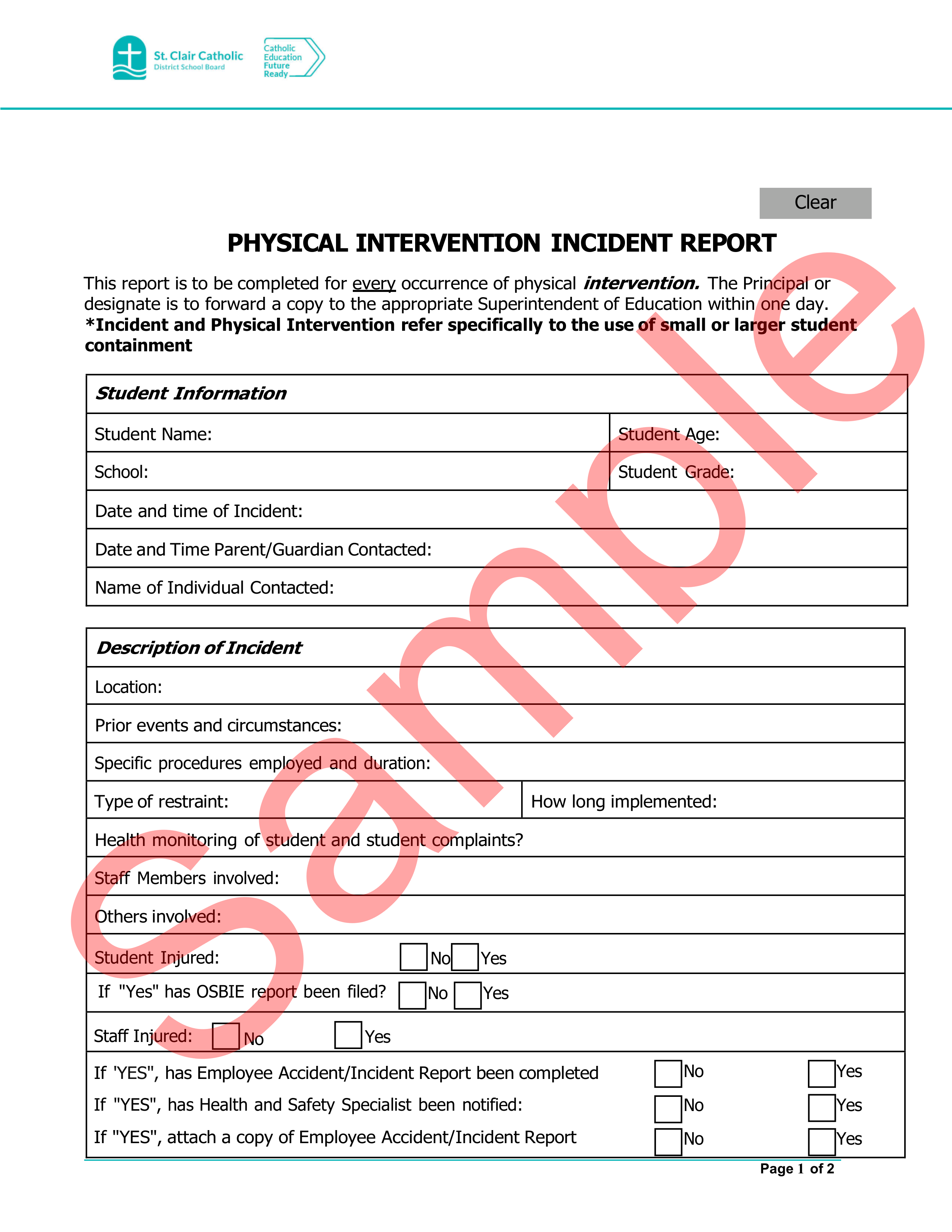
School Safety Plan
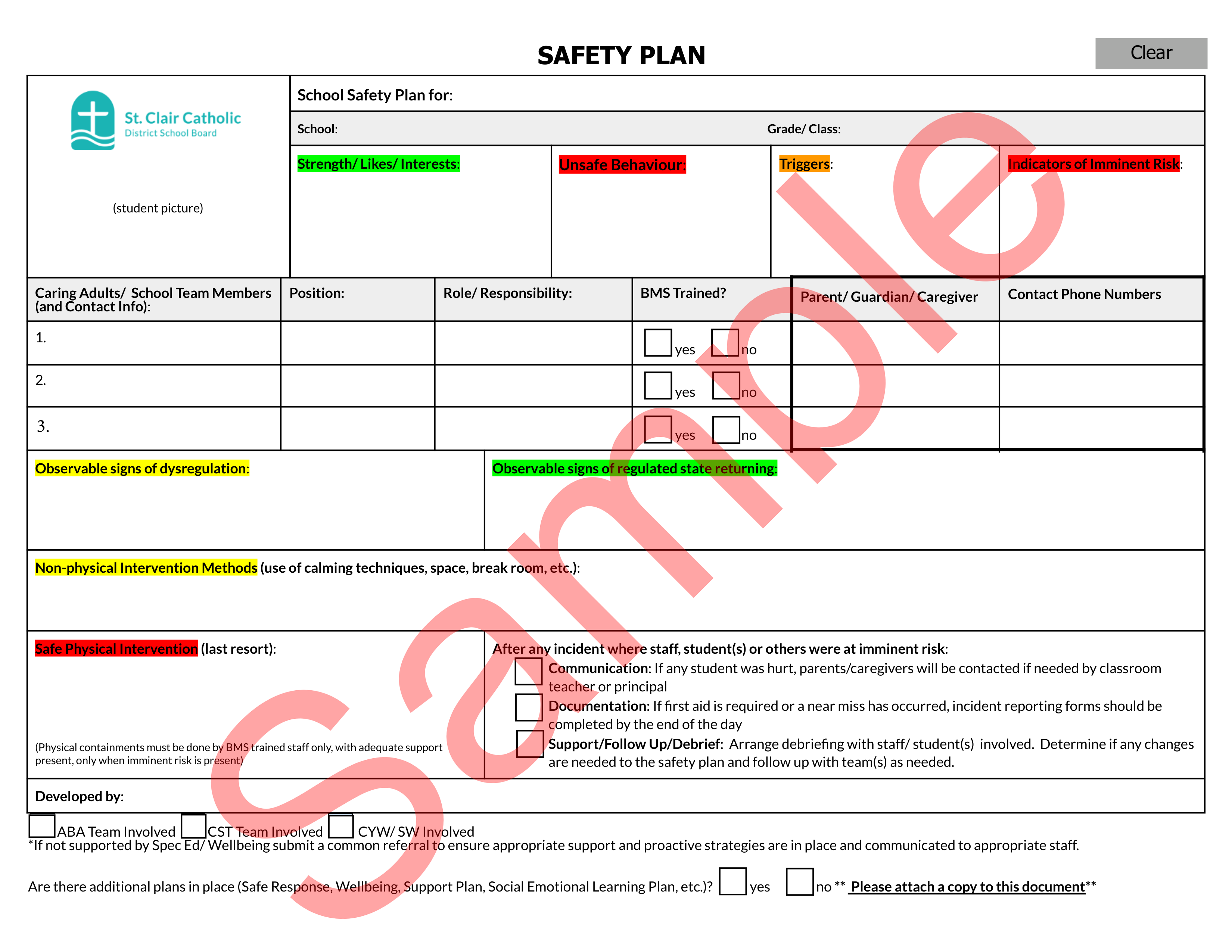
Safety Plan Development
Rationale
Staff and student safety is of paramount importance to the St Clair Catholic District School Board. The procedures that follow are designed to assist school teams in the development and implementation of a safety plan. The purpose of the plan is to prepare for, prevent and/or respond to at-risk student behaviours; as well as to provide a documented response for all staff supporting a specific student, to ensure that a consistent approach is utilized. The emphasis must be on preventative measures to support the student before challenging behaviour occurs.
This guideline does not replace the Policies and Procedures for Physical Intervention of Students or Workplace Violence.
Procedure
- When a student has exhibited challenging behaviour that puts themselves or others’ safety at risk, a safety plan should be developed (ideally in partnership with the student) to identify potential risks and the strategies required to support that student. A school-based team meeting must be held to discuss the students’ needs, potential triggers, and the supportive personnel (caring adults) available to the student during the school day. Ensure that parents, school staff and system support members (those currently involved) are included/consulted in the process.
- Draft a safety plan, completing all fields of the document. Download a copy of the attached Safety Plan (Appendix B) and save a copy before completing. [** This plan does not replace a “my support plan” for suicidal or self-harming students.]
- Following the completion of the safety plan, contact the system support staff that has been involved with the student (ABA, CST, CYW, SW) to collaborate on proactive measures that can be taken to prevent safety issues from occurring. If no one has been involved, submit a Common Referral Form.
- Share the plan with all staff that regularly interact with the student, including classroom teacher, PRT, Itinerant Teachers, Principal, Vice-Principal, and EA (where applicable). The plan must be stored in a safe place but is not to be stored in the OSR. A copy must be included in daybook/supply staff notes for occasional teachers and casual EAs, where appropriate.
- Review and revise the plan at least twice per year or after a significant change in baseline behaviour or circumstances (e.g., medication review). Previous copies should be destroyed. Once a plan is no longer required, remove the plan by destroying all copies.
- After an incident in which the safety plan has been required, a debriefing must occur (see the checklist for follow up actions to be taken, in the bottom right-hand corner of the plan).
Definitions
- Caring Adult
- People within the school building that the student identifies as supportive for them.
- Unsafe Behaviour
- Behaviour that the student exhibits that may potentially cause harm to themselves or others (e.g., climbing cabinets, running in unsafe spaces, physical aggression, self-injurious behaviour, etc.).
- Triggers
- Any situation, specific setting, specific people, language (including tone of voice, volume, word choice), etc. that increase the likelihood that the student may engage in unsafe behaviours (e.g., loud noises, excessive talking, being reprimanded, etc.).
- Non-Physical Intervention
- Approaches or activities that will assist to de-escalate the situation or support the student in calming (e.g., taking a walk, physical activity, calm down space, sensory room, etc.).
- Safe Physical Intervention
- Specific containment methods as taught during Behaviour Management Systems Training (BMS). Physical intervention must only be implemented by staff that have up-to-date BMS certification and in situations where there is imminent risk to the safety of the student or others.
- Dysregulation
- Actions that may indicate the potential for challenging behaviour to occur (e.g., grunting, pacing, swearing, yelling, glaring, etc.).
- Regulated State
- The state that is typical for that student (e.g., calm, focused, engaged in learning, etc.).
Non-Physical Intervention Measures
Non-physical intervention measures may include, but are not limited to:
- Calm, soft voice
- Notice/praise on-task behaviour
- Change activity
- Redirect; use humour if appropriate
- Take for a walk
- Ask how you can help
- Speak calmly, use soft eye contact
- Sit close by
- Active listening (for message, not delivery)
- Build relationships daily
- Divert attention
- Reduce stimuli
- Model slow deep breathing and invite student to follow
- Send on a task
- Offer to read a book or do a calming activity with them
- Offer options and alternatives
- Accommodate needs when possible
- Don’t overload with directions
- Remove audience
- Repeat student’s request
Safe Physical Intervention Parent Notification
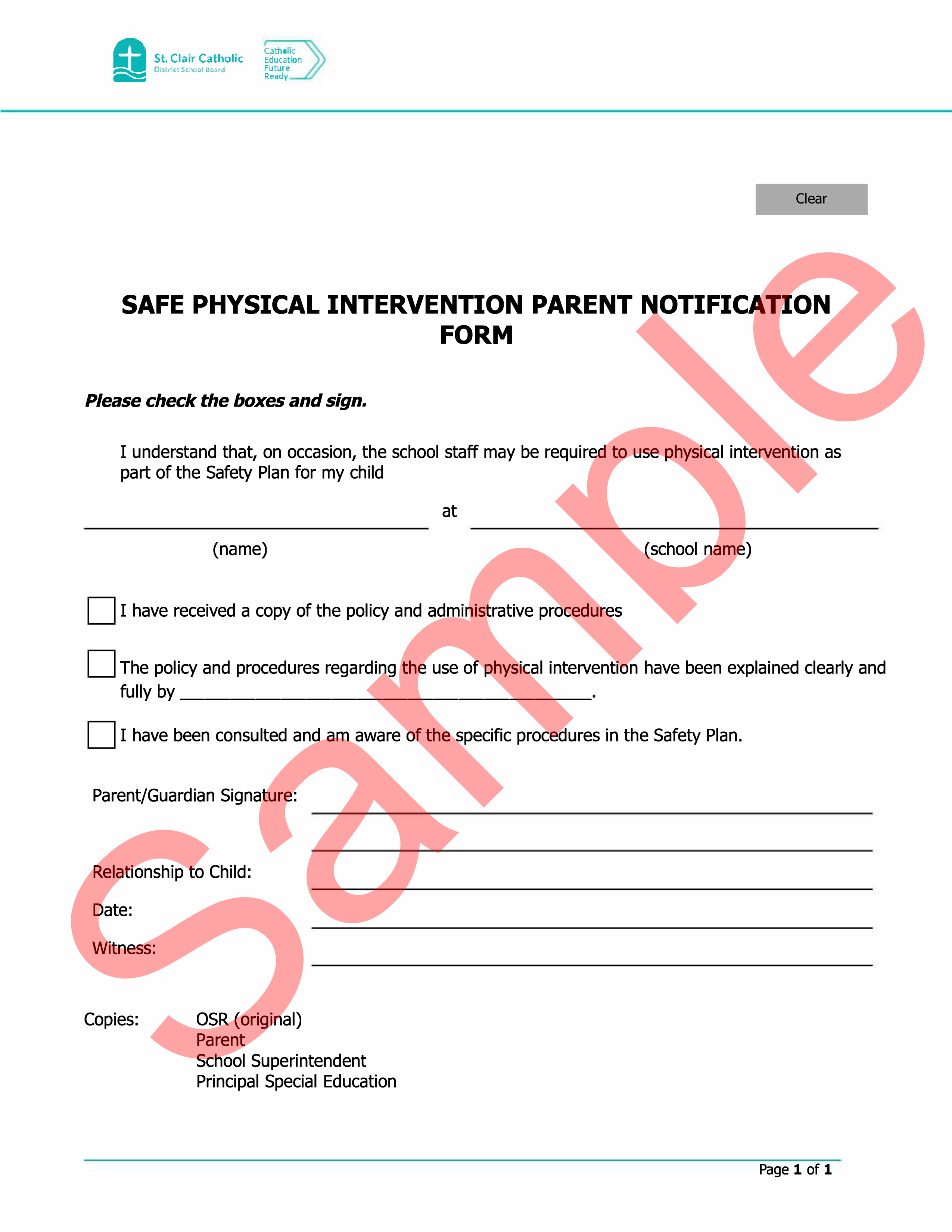
Review and Debriefing
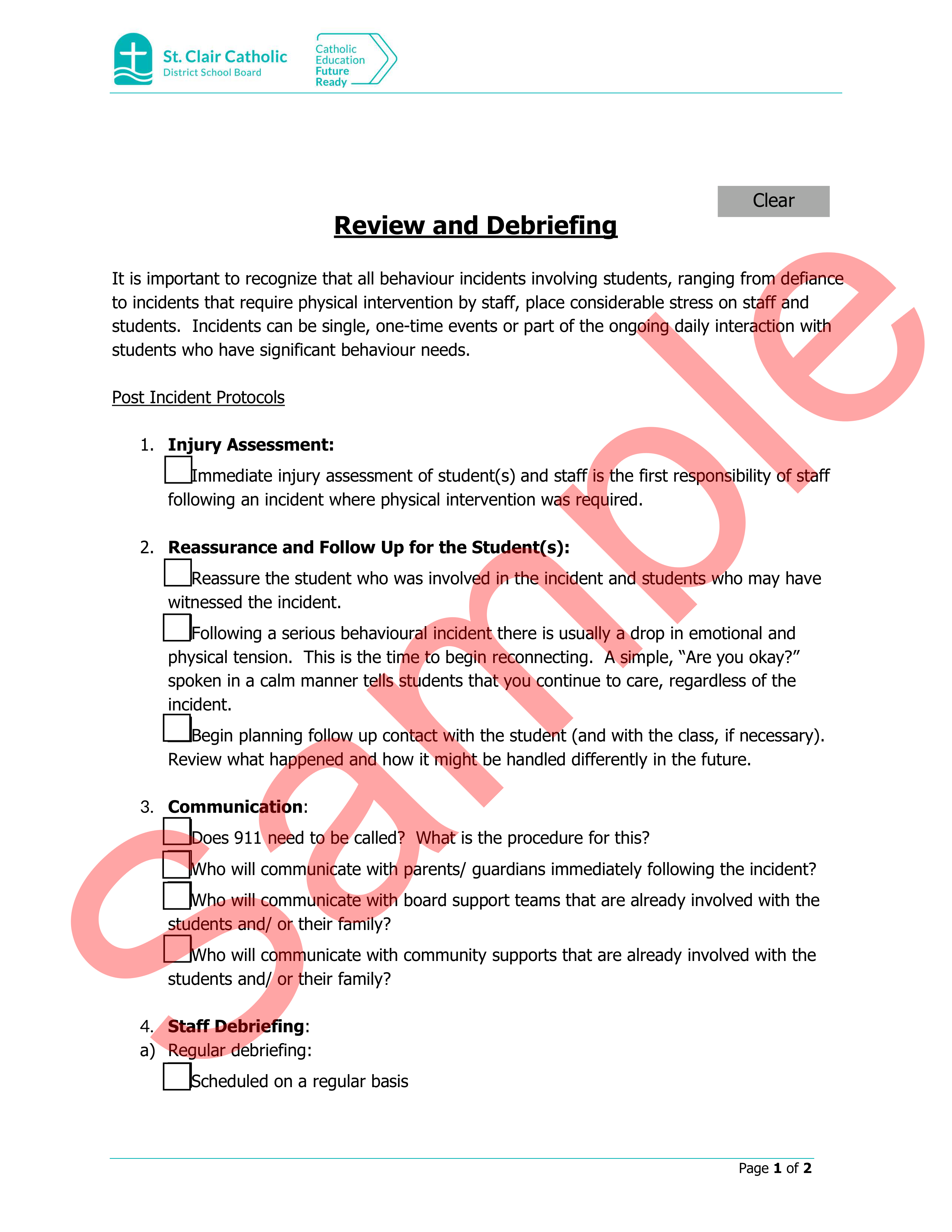
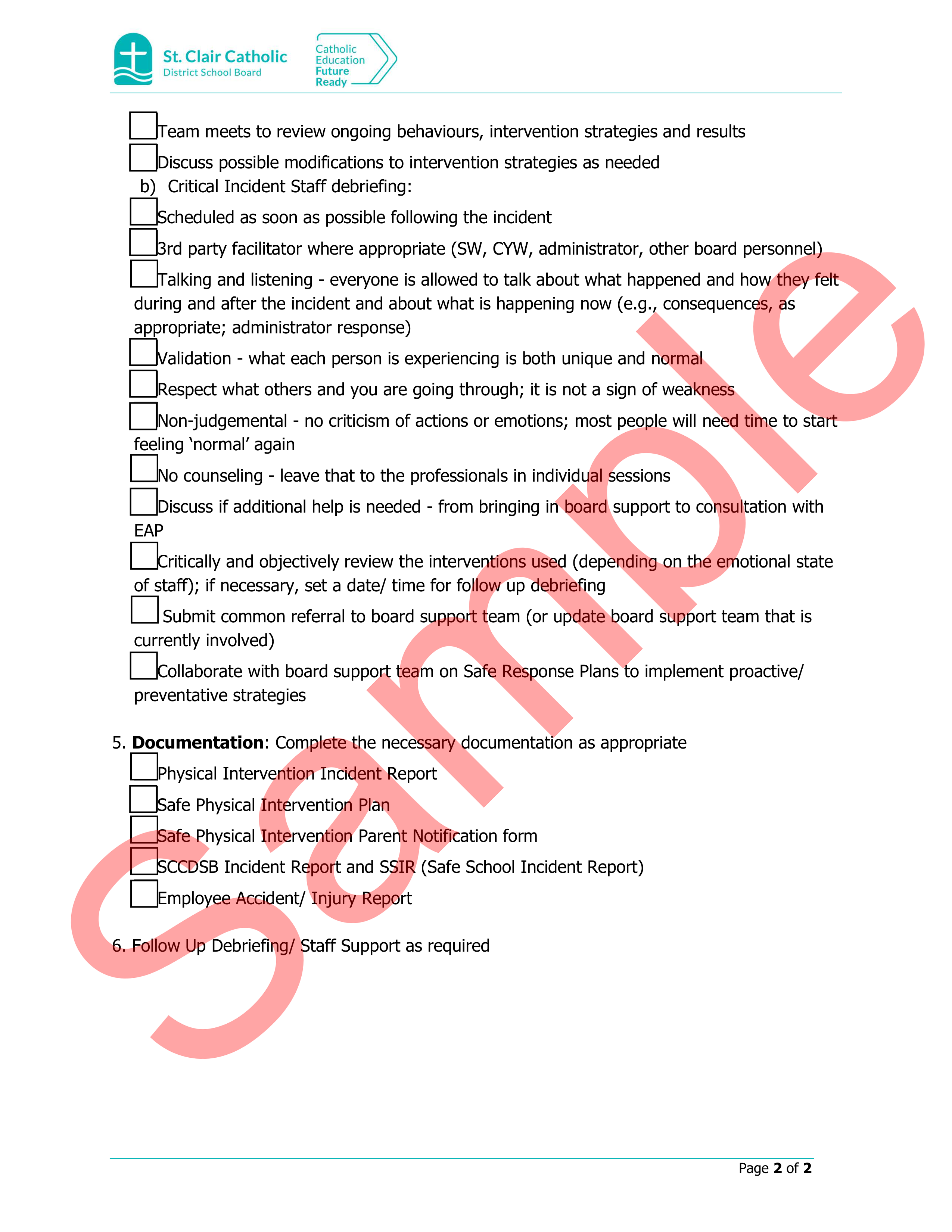
Notification of Employee-Risk of Injury from Student
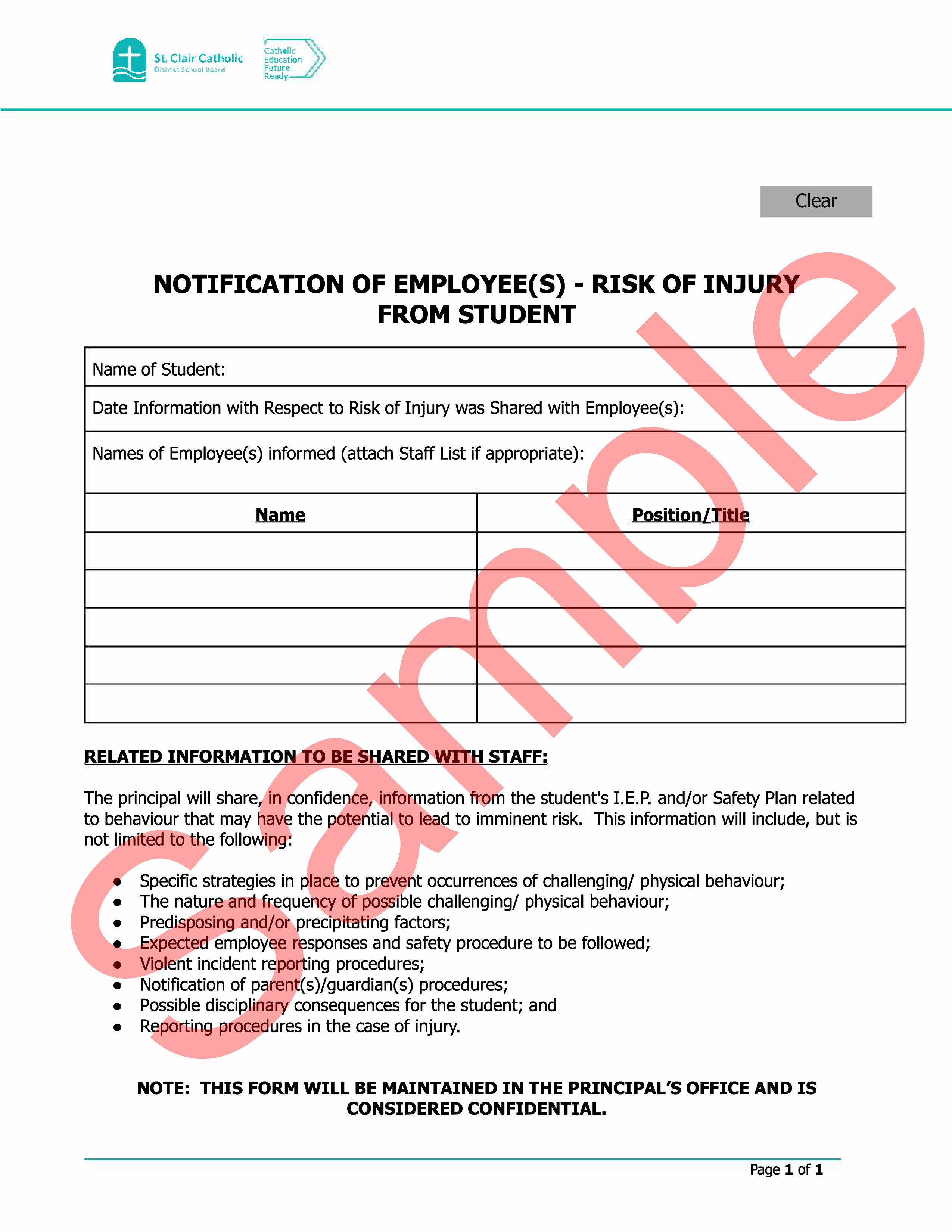
St. Clair Catholic District School Board Advisory Council
Date: 2000-12-01 / 2006-11-21 / 2013-01-22
Policy Statement
The St. Clair Catholic District School Board recognizes and values the co-operative advisory role of School Community Councils through the Board Advisory Council.
Policy Goals
The Board and local School Community Councils will dialogue and work co-operatively for the benefit of students, through regularly scheduled meetings of the St. Clair Catholic District Board Advisory Council.
Teacher Hiring Conflict of Interest
Date: 2021 03 30
Policy Statement
The St. Clair Catholic District School Board is committed to a fair and transparent teacher hiring process and shall give due regard to avoid any conflicts of interest. No employee with the Board shall participate in, or influence the outcome of, the hiring of a person with whom the employee has a relationship.
Policy Goals
- Define and address potential, apparent and actual conflicts of interest.
- Facilitate the ability to maintain the highest business and ethical standards, and to facilitate the protection of the integrity of employees in the course of teacher hiring responsibilities to the Board.
- Provide guidance to employees so that conflicts of interest are recognized and either avoided or resolved expeditiously through appropriate disclosure and management.
Definitions
- Conflict of Interest
- Means a potential, apparent, or actual conflict where an Employee's financial or other personal interest, whether direct or indirect, conflicts or appears to conflict with the Employee's responsibility to the Board, or with the Employee's participation in any recommendation or decision pertaining to teacher hiring within the Board.
- Employee
- Means full-time or part-time Employees of the School Board involved in teacher hiring.
- External Activity
- Means any activity of an Employee outside the scope of her/his employment with the School Board undertaken as part of a commercial or volunteer enterprise.
- Relationship
- Means any relationship of the Employee to persons of his or her immediate family whether related by blood, adoption, marriage, or common-law relationship, and any relationship of an intimate and/or financial nature during the preceding five years, any student-supervisor relationship, or any other past or present relationship that may give rise to a reasonable apprehension of bias.
- Supervisor
- Means the person to whom an Employee reports.
Date: 2021 03 30
Administrative Procedures
Responsibilities
-
- The senior administrator responsible for Human Resource Services will be responsible for the implementation of this Policy and Procedure.
- All employees have an obligation to disclose to their Supervisor or the senior administrator responsible for Human Resource Services any Conflict of Interest related to teacher hiring.
Specific Conflicts
Without restricting the generality of this Policy, the following circumstances may give rise to Conflicts of Interest:
- Participating in, or influencing the outcome of the appointment, hiring, promotion, supervision, or evaluation of a person with whom the Employee has, or has had, a Relationship;
- Acceptance by an Employee of a gift from any of the following persons or entities if a reasonable person might conclude that the gift could influence the employee when performing hiring duties with the School Board:
- A person, group, or entity that has dealings with the School Board;
- A person, group, or entity to whom the Employee provides services in the course of his or her duties to the School Board;
- A person, group, or entity that seeks to do business with the School Board.
An Employee who is offered a gift in the circumstances described above shall, in writing, notify his or her Supervisor.
Procedures for Disclosure of Conflicts of Interest
- The Employee must disclose in writing to their Supervisor or the senior administrator responsible for Human Resource Services as soon as she/he could reasonably be aware that a Conflict of Interest exists.
- The existence of a Conflict of Interest does not necessarily preclude involvement in the issue which has given rise to the Conflict (“the Matter”).
- The Employee must declare, in writing, the nature and extent of the Conflict of Interest no later than any meeting or process in which the Employee participates and at which the Matter is to be considered.
- The Employee must refrain from taking part in any discussion or decision-making in relation to the Matter and withdraw from any meeting or process when the Matter is being discussed until a decision has been reached regarding the manner in which the Conflict of Interest will be addressed.
- A Conflict of Interest involving an Employee may also be reported to a Supervisor by any other person. A report to a Supervisor about the existence of a potential, apparent or actual conflict of interest shall be made in writing.
Procedures for Management of Conflicts of Interest
- If the Supervisor or the senior administrator responsible for Human Resource Services to whom the disclosure is made also has a Conflict of Interest, the disclosure should be made in writing to the person at the next highest level of authority.
- The Supervisor or the senior administrator responsible for Human Resource Services will investigate to determine if a Conflict of Interest exists. Where appropriate, the Supervisor or the senior administrator responsible for Human Resource Services may consult with the Employee and/or others.
- If the Supervisor or the senior administrator responsible for Human Resource Services determines there is a Conflict of Interest, the Supervisor or the senior administrator responsible for Human Resource Services should resolve the matter as per section 5.0 below and shall document, in writing, any remedies that have been applied.
Options for Resolving Conflicts of Interest
-
If a Supervisor or the senior administrator responsible for Human Resource Services determines that a Conflict of Interest exists, the Supervisor or the senior administrator responsible for Human Resource Services will decide a course of action from the following options:
- If the Matter pertains to section 2.1(i) above and where the Employee may be knowledgeable and have information central to the discussion, the Employee with a Conflict or appearance of Conflict may be permitted to be involved in the Matter without participating in the final decision described in section 2.1(i) above.
- If an Employee fails to disclose a Conflict as per section 3.0 above, a range of remedies can be applied, up to and including the termination of employment.
- All disclosures and resolutions shall be documented by Human Resource Services, with all documentation kept in the affected employee’s personnel file.
Adherence and Disciplinary Action
- Adherence to this Policy, in letter and in spirit, is crucial to the relationships of trust that exist between the Board, its Employees, and the public. Contraventions of this Policy, whether arising from dishonesty or inattention, undermine these relationships and may lead to disciplinary action.
- For Employees, disciplinary sanctions for breach of this policy may take a range of forms appropriate to the nature of the contravention and could include dismissal from employment.
Additional Information
The St. Clair Catholic District School Board is committed to the principles of equity and inclusive education, consistent with our Catholic teachings, which value and promote human rights and social justice in all Board policies, programs, guidelines, operations and practices.Definitions
- Conflict of Interest
- Means a potential, apparent, or actual conflict where an Employee's financial or other personal interest, whether direct or indirect, conflicts or appears to conflict with the Employee's responsibility to the Board, or with the Employee's participation in any recommendation or decision pertaining to teacher hiring within the Board.
- Employee
- Means full-time or part-time Employees of the School Board involved in teacher hiring.
- External Activity
- Means any activity of an Employee outside the scope of her/his employment with the School Board undertaken as part of a commercial or volunteer enterprise.
- Relationship
- Means any relationship of the Employee to persons of his or her immediate family whether related by blood, adoption, marriage, or common-law relationship, and any relationship of an intimate and/or financial nature during the preceding five years, any student-supervisor relationship, or any other past or present relationship that may give rise to a reasonable apprehension of bias.
- Supervisor
- Means the person to whom an Employee reports.
Teacher Hiring Practices
Date: 2021-03-30
Policy Statement
The St. Clair Catholic District School Board believes in fair, consistent, and transparent teacher hiring processes.
All teacher hiring decisions shall be made in accordance with the Ontario Human Rights Code; school board collective agreements, both central and local; the Education Act and all applicable regulations thereunder, including, but not limited to, Ontario Regulation 298: Operation of Schools. Hiring decisions will be in accordance with the denominational rights conferred upon it under Section 93 of the British North America Act and guaranteed under Section 29 of the Canadian Constitution. This Policy and Procedure may be reviewed and revised in response to changes to any relevant legislation or collective agreements.
Policy Goals
- Create a well-prepared, qualified, and diverse workforce in the education sector.
- Establish fair, consistent, and transparent teacher hiring processes.
- Remove barriers for Indigenous peoples and equity-seeking groups at each stage of the hiring process.
- Confirm the Board’s commitment to equal opportunity employment and acknowledge the inherent dignity and worth of every person and the right to employment without discrimination.
Date: 2021 03 30 / 2023 06 20
Administrative Procedures
Responsibilities
-
- The senior administrator responsible for Human Resource Services will be responsible for the implementation of this policy and procedure.
Expectations
-
- All teacher hiring decisions shall be made in accordance with: the Ontario Human Rights Code; school board collective agreements, both central and local; the Education Act and all applicable regulations thereunder, including, but not limited to, Ontario Regulation 298: Operation of Schools.
- Preferential consideration will be given to qualified Roman Catholic applicants in accordance with the denominational rights conferred upon it under Section 93 of the British North America Act and guaranteed under Section 29 of the Canadian Constitution.
- Criteria and qualifications for positions will be established in a fair and objective manner and be designed to provide the best possible program. The Board shall ensure the job posting contains requirements or duties for employment that are reasonable, genuine and directly related to the performance of the job.
- Recruitment for teaching positions will be completed as widely as is appropriate to ensure that qualified applicants have the opportunity to apply. This statement however in no way mitigates the right of the Board to exercise its denominational rights in the hiring process.
- All Ontario College of Teachers certified teachers are encouraged to apply and shall be provided equal opportunity for any position (occasional, long-term occasional, or permanent) for which they are qualified irrespective of where they are currently employed.
- Applicants shall be required to fill out an on-line application (Apply to Education) which shall be accessible from the Board’s web site.
- The qualifications for all positions shall be published electronically and will notify internal and external candidates about the availability of accommodation in the recruitment and assessment process. Candidates may access reasonable accommodation at any stage of the recruitment by contacting Human Resource Services.
- The Board shall take into account the accessibility needs of its employees with disabilities as well as individual accommodation plans, when providing career development, advancement and redeployment.
- Applicants will be evaluated based on more than one source. These sources may be different between postings.
- Where interviews occur, they will take place before a panel of at least two (2) interviewers. Where possible, the Board will make efforts to establish panels which draw on different experiences, skill sets, and educational and professional backgrounds.
- All applicants will be assessed against the same criteria for pre-screening to determine who will be invited to an interview. Where interviews are conducted, candidates shall be asked the same questions. A structured evaluation and selection tool shall be used for each applicant. Panel members will assess each candidate independently.
- Documents related to the recruitment and selection, including structured evaluation tools, shall be retained by the Board for a period of one year.
- The Board is committed to a fair hiring process, which is free from any bias, nepotism, and/or conflict of interest. Conflicts of interest shall be avoided or resolved in accordance with the Board’s Teacher Hiring Conflict of Interest Policy.
- After the panel has gained consensus on the preferred candidate(s) and prior to the offer of employment, the chairperson shall ensure that the references provided by the candidate(s) are contacted.
- All applicants who have been interviewed shall be informed by the Human Resource Services Department of the status of their application within a reasonable time following the interview.
- Where requested by the applicant, the Board will make best efforts to provide interview feedback in a timely manner. To request such feedback the applicant must contact the Human Resource Services Department.
- The Board is committed to continually monitoring and evaluating the effectiveness of this Policy and Procedure and to make adjustments as necessary. In particular, the Board will monitor and evaluate this Policy and Procedure to ensure they promote anti-discriminatory practices.
Additional Information
The St. Clair Catholic District School Board is committed to the principles of equity and inclusive education, consistent with our Catholic teachings, which value and promote human rights and social justice in all Board policies, programs, guidelines, operations and practices. Ontario Human Rights Code can be viewed at the following link: http://www.ohrc.on.ca/en/ontario-human-rights-code.Tobacco, Cannabis & Smoke-Free Environment
Date: 2000 12 01 / 2008 02 27 / 2013 01 22 / 2022 05 31
Policy Statement
The St. Clair Catholic District School Board is free from the harmful effects of the use of tobacco products, cannabis products, shisha and other imitation smoking-related products and accessories.
The Board will declare, establish, and maintain an environment free from tobacco, cannabis, smoke, and vapour. This means that smoking and/or holding lighted tobacco and/or cannabis products, as well as consuming or using any smokeless tobacco and/or cannabis products, shisha or imitation smoking-related products and accessories, including e-cigarettes and vaporizers are prohibited anywhere on Board property or property that is used for board purposes. The procedure also pertains to property that is used for school purposes that fall under a shared land use agreement with the local municipality and to vehicles parked on property at all times.
Policy Goals
- To ensure compliance with the Smoke-Free Ontario Act, 2017.
- To ensure students, employees, and visitors are aware of the smoking and vaping prohibitions, including not smoking or vaping within 20 metres of all Board owned sites and property.
Definitions
- Board Property
- Refers to any property owned or occupied by the Board, including administrative and non-administrative buildings, schools (and their surrounding property), and Board owned or leased vehicles and machinery. Temporary structures erected on Board property are also considered Board property. Property that is used for school purposes that fall under a shared land use agreement also meets the definition of Board Property.
- Tobacco Product
- Is defined as any product containing, made, or derived from tobacco that is intended for human consumption, whether chewed, smoked, heated, absorbed, dissolved, inhaled, sniffed or ingested by any other means, or any component part, or accessory of the tobacco product. Common types of tobacco products include but are not limited to cigarettes, cigarillos, cigars, chew, plug, snus, snuff, blunt wraps, beedies, and shisha (tobacco or herbal).
- Cannabis Product
- Is defined as any product containing, made or derived from cannabis that is intended for human consumption whether smoked, heated, inhaled, dissolved, or ingested by any other means, or any component part, or accessory of the cannabis product. Common types of cannabis products include dried cannabis (e.g., joints, spliffs, blunts), concentrated cannabis products (e.g., hash, hash oil, shatter, wax), and edible cannabis concentrates (food or drink products containing cannabis).
- Imitation Smoking and Vapour Products
- Include any product that resembles any tobacco or electronic smoking or vaped product, and/or is marketed or intended to be used as an alternative to tobacco use, that is not an approved smoking cessation device. Prohibited imitation smoking and vapour products can include electronic cigarettes, cigars, and pipes as well as the cartridges and solutions, whether or not they contain nicotine. They produce a vapour that resembles smoke. They consist of a battery-powered delivery system that vaporizes and delivers a liquid chemical mixture that may be composed of various amounts of nicotine, propylene glycol, and/or other chemicals. This does not include any product that is approved by Health Canada as a quit smoking aid (e.g. nicotine patches, mist, inhalers, gum and lozenges), or is prescribed as a medicine for lung ailments (e.g. Ventolin or steroid inhaler).
- Tobacco, Cannabis and Smoking-Related Accessory
- Means any item that is used for the consumption of a tobacco or cannabis product, including but not limited to pipes, bongs, cigarette holders, lighters, matches, rolling papers, cigarette cases, spit bottles, tins, tubs, chargers, mouth pieces, cutters, charcoal, waterpipe / hookah, grinders and dabbers/nails.
- Tobacco, Cannabis, and Smoke-Free Environment
- Is an environment that is free from the harmful effects of second-hand smoke and vapour, and free from the use of any tobacco product, cannabis, imitation tobacco and smoking-related products or accessories.
Date: 2010 06 22 / 2014 03 25 / 2022 05 31
This Administrative Procedure applies to all students, staff, trustees, parents, visitors, volunteers, community partner agencies, facility renters, contractors and any other individual on Board property or in vehicles parked on Board property or on property that is used for school purposes that fall under a shared land use agreement.
This Administrative Procedure applies to all school-sponsored or school-related events, and out-of-classroom programs and activities approved by, or under jurisdiction of the Board. This includes school business, on school buses, or during any part of a school field trip, including athletic team trips and school club excursions.
Administrative Procedures
Responsibilities
-
Superintendents, Principals, Managers:
- To provide leadership and support to ensure the Tobacco, Cannabis, and Smoke-Free Environment Policy is implemented.
- To ensure that the Tobacco, Cannabis, and Smoke-Free Environment Policy, and related procedures are followed and communicated to staff, students, parents and other visitors.
- To ensure prescribed and required signage is posted in compliance with the Smoke Free Ontario Act (SFOA, 2017) and the Tobacco, Cannabis and Smoke-Free Environment Policy.
-
To ensure compliance with the SFOA, 2017. This legislation includes all schools and school property, plus public areas within 20 metres of any point on the perimeter of a school or school property. In these areas no person shall:
- Smoke or hold lighted tobacco.
- Smoke or hold lighted cannabis.
- Smoke and hold lighted shisha.
- Use an electronic cigarette.
- Consume a prescribed product or substance.
Further, no person shall sell or supply any of the following to a person who is less than 19 years old:
- A tobacco product.
- A vapour product.
- A prescribed product or substance.
This includes any exchange that occurs between students, or peer to peer.
- To address and report any non-compliance with the SFOA, 2017 and the Tobacco, Cannabis and Smoke-Free Environment Policy.
- Liaise and collaborate with Enforcements Officers (Tobacco) and other Provincial Enforcement Agents as needed.
- To communicate the expectations of this policy to all Board employees at the time of hire.
- To report violations of the SFOA, 2017, and the Tobacco, Cannabis and Smoke-Free Environment Policy to school administration.
- To ensure compliance with the SFOA, 2017, and the Tobacco, Cannabis and Smoke-Free Environment Policy.
- To refer students presenting challenges with addictions from the use of substances to appropriate supports.
- To reinforce content and messages that are promoted through curriculum and health education.
- To liaise and collaborate with Enforcements Officers (Tobacco) and other Provincial Enforcement Agents as needed.
Expectations
- This policy and procedure is governed primarily by the Smoke Free Ontario Act and the Cannabis Act which prohibits smoking and/or holding lighted tobacco and/or cannabis products, as well as consuming or using any smokeless tobacco and/or cannabis products, shisha or imitation smoking-related products and accessories, including e-cigarettes and vaporizers are prohibited anywhere on Board property or property that is used for board purposes or within a twenty (20) metre perimeter of public areas outside of Board owned property and in Board operated vehicles.
- Persons who fail to comply with the Acts are subject to consequences as may be imposed by enforcement of the Smoke Free Ontario Act, Cannabis Act, the Board’s policies on Safe School, Student Discipline, Tobacco, Cannabis, Alcohol and Drugs at School, and/or Codes of Conduct and the local schools, which may include fines and/or discipline.
- Appropriate signage shall be posted at all entrances, exits, other locations in order to confirm smoking and vaping is prohibited.
- In accordance with the Smoke-Free Ontario Act and the Board’s Smudging Protocol, exceptions are made for the traditional use of tobacco. Therefore, if an Indigenous person requests to use tobacco for traditional Indigenous cultural or spiritual purposes, every effort will be made to accommodate the individual in an appropriately designated space.
Additional Information
The St. Clair Catholic District School Board is committed to the principles of equity and inclusive education, consistent with our Catholic teachings, which value and promote human rights and social justice in all Board policies, programs, guidelines, operations and practices.References
Legislation
- Smoke-Free Ontario Act, 2017
- Cannabis Act
Other Related
- Sec A: Policy - Board Code of Conduct
- Sec B: Policy - Safe Schools
- Sec B: Policy – Student Discipline
- Sec B: Policy - Tobacco, Cannabis, Alcohol and Drugs at School
- The Board’s Smudging Protocol
Definitions
- Board Property
- Refers to any property owned or occupied by the Board, including administrative and non-administrative buildings, schools (and their surrounding property), and Board owned or leased vehicles and machinery. Temporary structures erected on Board property are also considered Board property. Property that is used for school purposes that fall under a shared land use agreement also meets the definition of Board Property.
- Tobacco Product
- Is defined as any product containing, made, or derived from tobacco that is intended for human consumption, whether chewed, smoked, heated, absorbed, dissolved, inhaled, sniffed or ingested by any other means, or any component part, or accessory of the tobacco product. Common types of tobacco products include but are not limited to cigarettes, cigarillos, cigars, chew, plug, snus, snuff, blunt wraps, beedies, and shisha (tobacco or herbal).
- Cannabis Product
- Is defined as any product containing, made or derived from cannabis that is intended for human consumption whether smoked, heated, inhaled, dissolved, or ingested by any other means, or any component part, or accessory of the cannabis product. Common types of cannabis products include dried cannabis (e.g., joints, spliffs, blunts), concentrated cannabis products (e.g., hash, hash oil, shatter, wax), and edible cannabis concentrates (food or drink products containing cannabis).
- Imitation Smoking and Vapour Products
- Include any product that resembles any tobacco or electronic smoking or vaped product, and/or is marketed or intended to be used as an alternative to tobacco use, that is not an approved smoking cessation device. Prohibited imitation smoking and vapour products can include electronic cigarettes, cigars, and pipes as well as the cartridges and solutions, whether or not they contain nicotine. They produce a vapour that resembles smoke. They consist of a battery-powered delivery system that vaporizes and delivers a liquid chemical mixture that may be composed of various amounts of nicotine, propylene glycol, and/or other chemicals. This does not include any product that is approved by Health Canada as a quit smoking aid (e.g. nicotine patches, mist, inhalers, gum and lozenges), or is prescribed as a medicine for lung ailments (e.g. Ventolin or steroid inhaler).
- Tobacco, Cannabis and Smoking-Related Accessory
- Means any item that is used for the consumption of a tobacco or cannabis product, including but not limited to pipes, bongs, cigarette holders, lighters, matches, rolling papers, cigarette cases, spit bottles, tins, tubs, chargers, mouth pieces, cutters, charcoal, waterpipe / hookah, grinders and dabbers/nails.
- Tobacco, Cannabis, and Smoke-Free Environment
- Is an environment that is free from the harmful effects of second-hand smoke and vapour, and free from the use of any tobacco product, cannabis, imitation tobacco and smoking-related products or accessories.
Volunteers
Date: 2000 12 01 / 2004 09 01 / 2013 03 05 / 2023 06 20
Policy Statement
The St. Clair Catholic District School Board recognizes and welcomes the important role of volunteers within our schools. Volunteer contributions enrich student educational experiences and contribute to the effective partnership between a school and its community. The Board believes that within the Catholic educational community, excellence in education is founded on respect for the dignity and humanity of all individuals and the development of human potential, enabling individuals and groups to participate and contribute fully within a diverse society.
Policy Goals
- Encourage and support the involvement of volunteers within our schools.
- Provide consistent application of volunteers in our schools to support the safety and well-being of our students.
Definitions
Volunteer – an individual approved by a Supervisory Officer, Principal or Manager who provides regular services without remuneration and agrees to undertake a designated task that is compliant with current legislative requirements and collective agreements. Volunteers may support a classroom, school, or system-wide initiatives.
Date: 2000 12 01 / 2004 09 01 / 2013 03 05 / 2023 06 20
Administrative Procedures
Responsibilities
-
The Volunteer will:
- Perform assigned duties as directed by the Principal or designate.
- Comply with all Board requirements regarding vulnerable sector screening, offence declarations and confidentiality.
- Maintain confidentiality of all information pertaining to staff and students.
- Demonstrate a clear understanding of their activities, duties, responsibilities, rights and the parameters of their involvement.
- Understand that volunteers will neither be responsible for discipline or evaluation of students nor for the identification or diagnosis of students’ learning strengths or difficulties.
- Inform the Principal and/or teacher if experiencing difficulty or concerns in carrying out assigned duties.
- Ensure that views expressed support the mission and vision of the Board.
- Participate in any training or orientation sessions offered to volunteers in the school that would assist them in their role.
- Become familiar with and comply with all appropriate and applicable classroom, school, and Board policies and procedures.
-
School Staff will:
- Welcome volunteers as a support to the school and staff.
- Understand that volunteers do not assume any responsibility for the diagnosis of learning strengths or difficulties, the assignment of program, or the assessment and evaluation of student progress.
- Understand that volunteers do not assume the responsibility for classroom discipline.
- Bring to the Principal’s attention any difficulties with the work or behaviour of a volunteer in the school.
- Provide volunteers with a clear understanding of tasks.
- Supervise volunteers working within their classrooms.
-
The Principal will:
- Determine volunteering needs in the school.
- Recruit, select and screen volunteers (see Recruitment, Selection and Screening).
- Promote and maintain a positive partnership with volunteers.
- Maintain ongoing communications with volunteers.
- Approve and clarify the tasks and assignments of volunteers.
- Provide training and orientation of volunteers.
- Develop and supervise the implementation of a tracking system indicating those volunteers in the school on a daily basis (i.e., Volunteer sign in book and identification badge).
- Provide and ensure the utilization of volunteer identification badges for all volunteers.
- Monitor and support the volunteer involvement in the school (i.e., deal with volunteer concerns, ensure volunteer supervision, assist with communication of school and Board policy where appropriate).
- Consider the well-being of both the child and the teaching staff when determining the appropriateness of volunteer placements.
- Place and remove, when necessary, volunteers within the school.
- Keep on file in a secure location all forms signed by volunteers for the current school year.
Expectations
Determining Volunteering Needs
- Principals should consult with the school staff and the school Catholic Community Council to determine needs, equitable access to the opportunity to volunteer, and tasks/assignments which could be supported with a volunteer.
Recruitment, Selection and Screening
-
The recruitment, selection and screening process is aimed at filling the needs of the school.
-
Recruitment
-
Inform the community of volunteer opportunities through a variety of means, including, but not limited to:
- Newsletters
- School Website
- School Catholic Community Council Meetings
- Meet the Teacher Night/Curriculum Evenings
- Surveys
-
Inform the community of volunteer opportunities through a variety of means, including, but not limited to:
-
Selection
- In selecting a volunteer who performs duties on a regular basis, Principals will encourage volunteer participation from a wide representation of the community.
- The Principal should, in consultation with staff inviting volunteers, determine the best placement for the volunteer.
-
Screening
- The depth and degree of screening by the Principal will be dependent upon the volunteering activity, the extent of interaction with and responsibility for students, and the degree of direct supervision of the volunteer.
- New volunteer applicants must be interviewed by the Principal. This may be an informal process for candidates who are well known to the school.
- When parents/guardians or grandparents wish to volunteer in their home school, the Principal, in consultation with staff, should screen and approve the volunteer candidate. The knowledge that teachers and other staff members have about prospective volunteers should be considered.
- Volunteers from the community who are not parents/guardians or grandparents of students attending the school, should provide two references which will be checked by the Principal.
-
The following volunteers will be required to submit a Vulnerable Sector Check and must undergo the formal screening process:
- Volunteers who have direct and regular contact with students
- Supervisors on overnight excursions
- Students on practicum assignments from university and college programs, including co-op programs
- Non-parent, non-guardian volunteers not known to the school community
- Others, as deemed necessary by the Principal
- Volunteers will be directed to have a Vulnerable Sector Check completed and on file at the school prior to commencing their duties.
- Volunteers who have previously submitted a Vulnerable Sector Check are required to complete an annual Offence Declaration (Appendix D).
-
Volunteers must sign the following forms, to complete the formal screening process:
- the Volunteer Interview Form (Appendix A)
- the Volunteer Agreement (Appendix B)
- the Volunteer Confidentiality Agreement (Appendix C)
- The Principal and/or designate retains the authority to accept or decline any volunteer’s offer of service.
-
Recruitment
Training and Orientation
- All volunteers need to be properly welcomed and provided with essential basic information. A tour of the school, introduction to staff and orientation workshop is essential. The orientation workshop should include information regarding the daily routine, schedules, pertinent health and safety information (e.g. fire escape routes), and any pertinent information from school and Board policies.
- Volunteers must follow sign in procedures and wear visitor badges at all times.
- Every volunteer must demonstrate a clear understanding of their activities, duties, responsibilities, rights and the parameters of their involvement.
- Volunteers should demonstrate a clear understanding of the procedures to be followed if they encounter any difficulties with students.
- Volunteers shall be made aware of health and safety issues, legal liability, and procedures to report abuse.
Monitor
- The Principal is ultimately responsible for the actions and activities of any volunteer within the school.
- It is essential to monitor the activities of individual volunteers and to provide them with feedback as necessary.
- The Principal will determine whether a change in volunteer assignment or the decision to terminate volunteer activity is necessary.
- The performance of volunteers should be reviewed as determined by the Principal.
Recognition of Volunteers
- The efforts of all volunteers should be recognized. Volunteers are giving of their time, energy, skills and resources.
-
The type of recognition may vary from school to school. Some suggestions for acknowledgment are:
- Acknowledging contributions through the school newsletter
- Annual school recognition assembly, event, luncheon, etc.
- Invitation to special school events
Additional Information
The St. Clair Catholic District School Board is committed to the principles of equity and inclusive education, consistent with our Catholic teachings, which value and promote human rights and social justice in all Board policies, programs, guidelines, operations and practices.Definitions
- Volunteer
- An individual approved by a Supervisory Officer, Principal or Manager who provides regular services without remuneration and agrees to undertake a designated task that is compliant with current legislative requirements and collective agreements. Volunteers may support a classroom, school, or system-wide initiatives.
- Vulnerable Sector Check
- A Criminal Background Check designed to ensure individuals in a position of trust or authority over vulnerable populations through employment or volunteer work do not have a criminal history, or any other history which may indicate that they may pose a threat to vulnerable populations. It is a collection of offence information, including convictions, outstanding warrants, charges and judicial orders available from a local police agency's records management system and other systems/records where authorized. This check will include sexual offence convictions for which the individual has received a record suspension where authorized by the Minister of Public Safety and Emergency Preparedness.
- Offence Declaration
-
Means, in respect of a Board, a written or electronic declaration signed by an individual listing all of the individual’s convictions for offences under the Criminal Records Act (Canada) up to the day of the declaration:
- that are not included in a Criminal Background Check collected by the Ontario College of Teachers
- that were not included in the last Criminal Background Check collected by the Board
- for which a pardon under Section 4.1 of the Criminal Records Act (Canada) has not been issued or granted.
Volunteer Interview Form
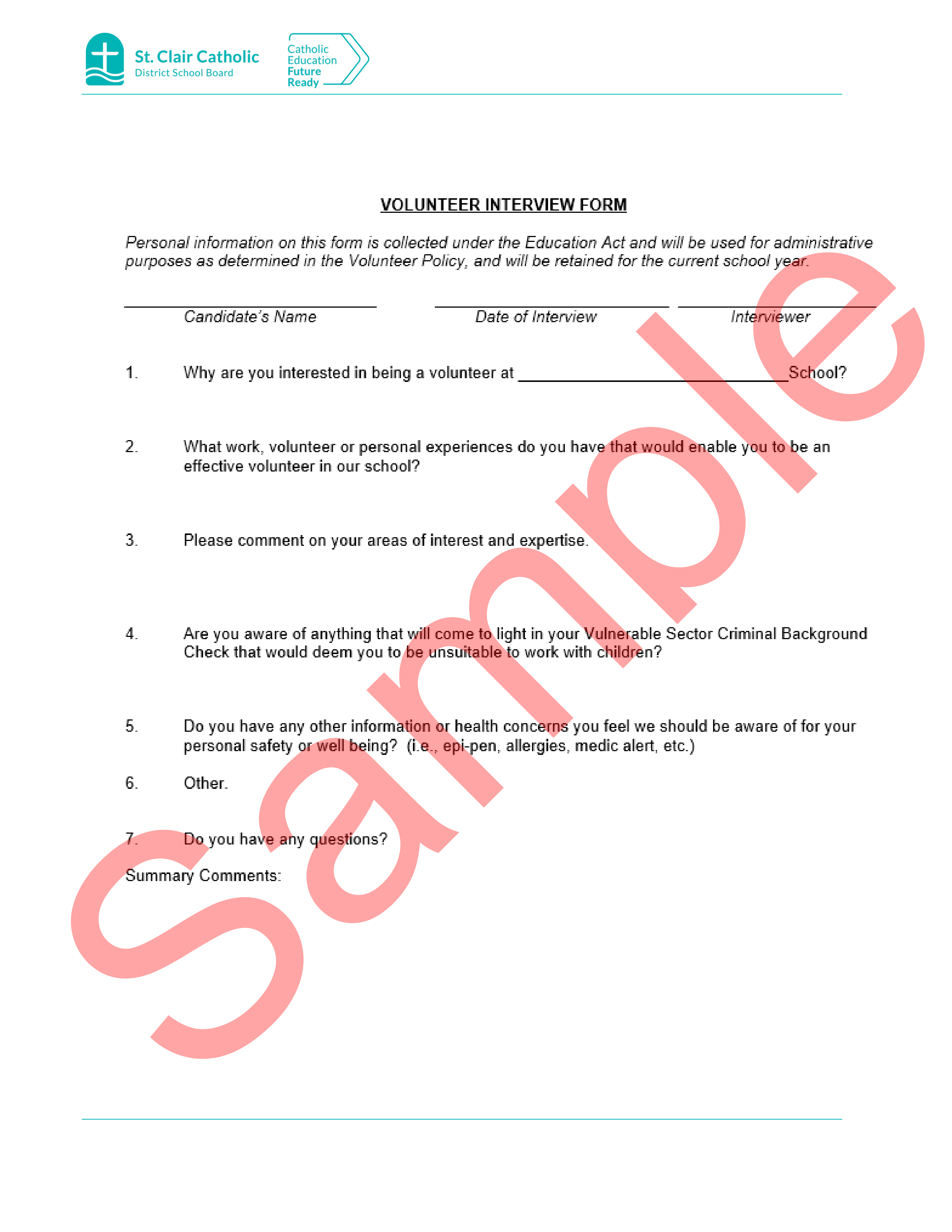
Volunteer Agreement
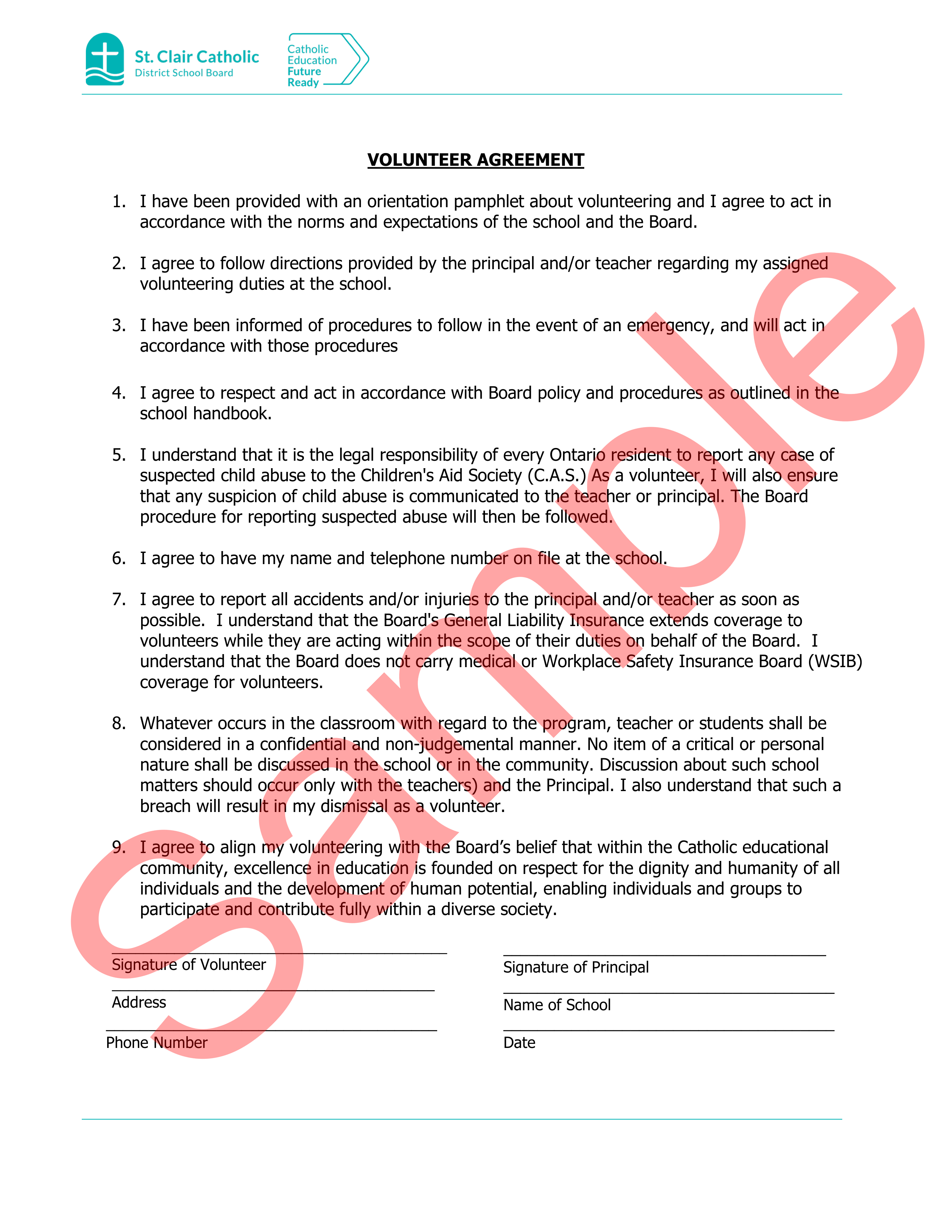
Confidentiality Agreement
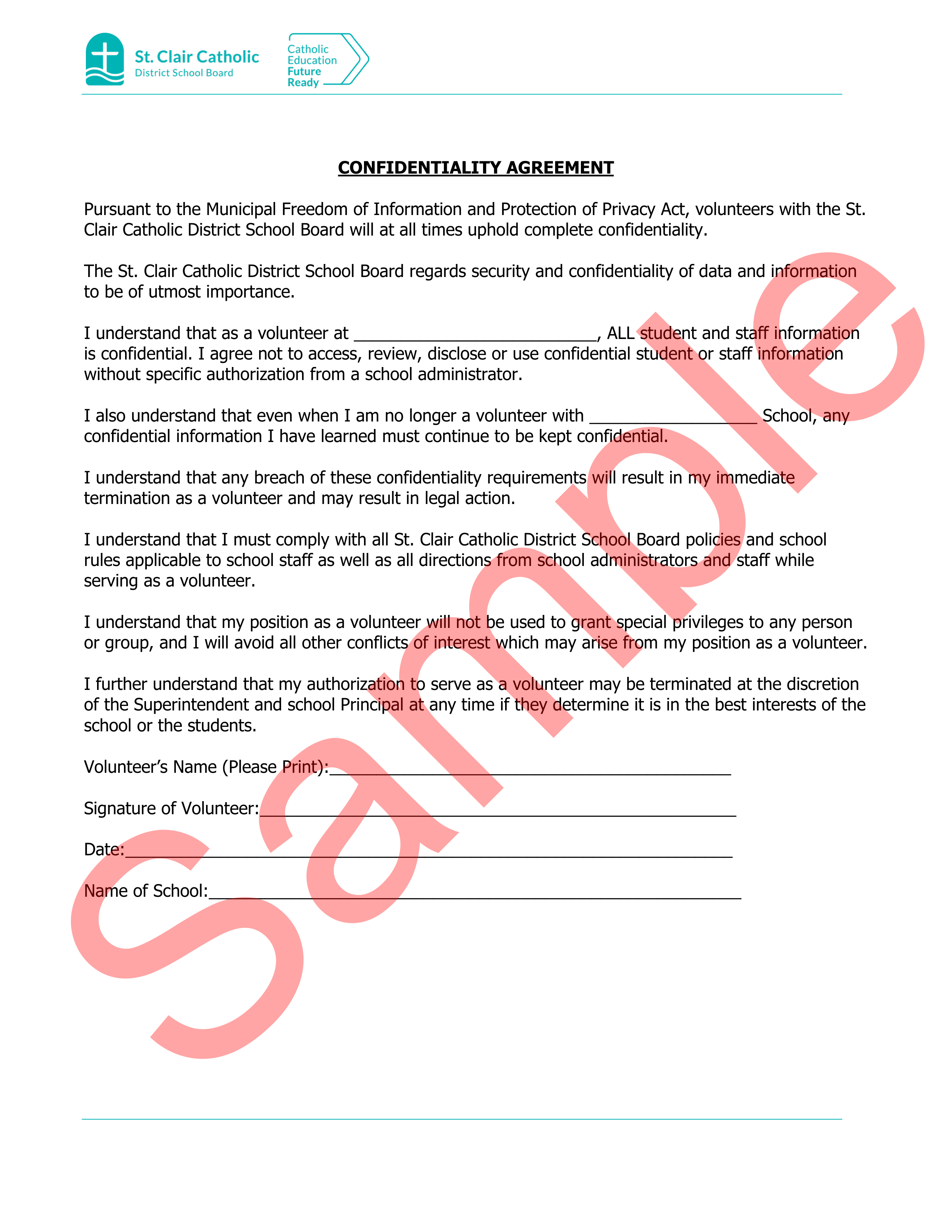
Offence Declaration
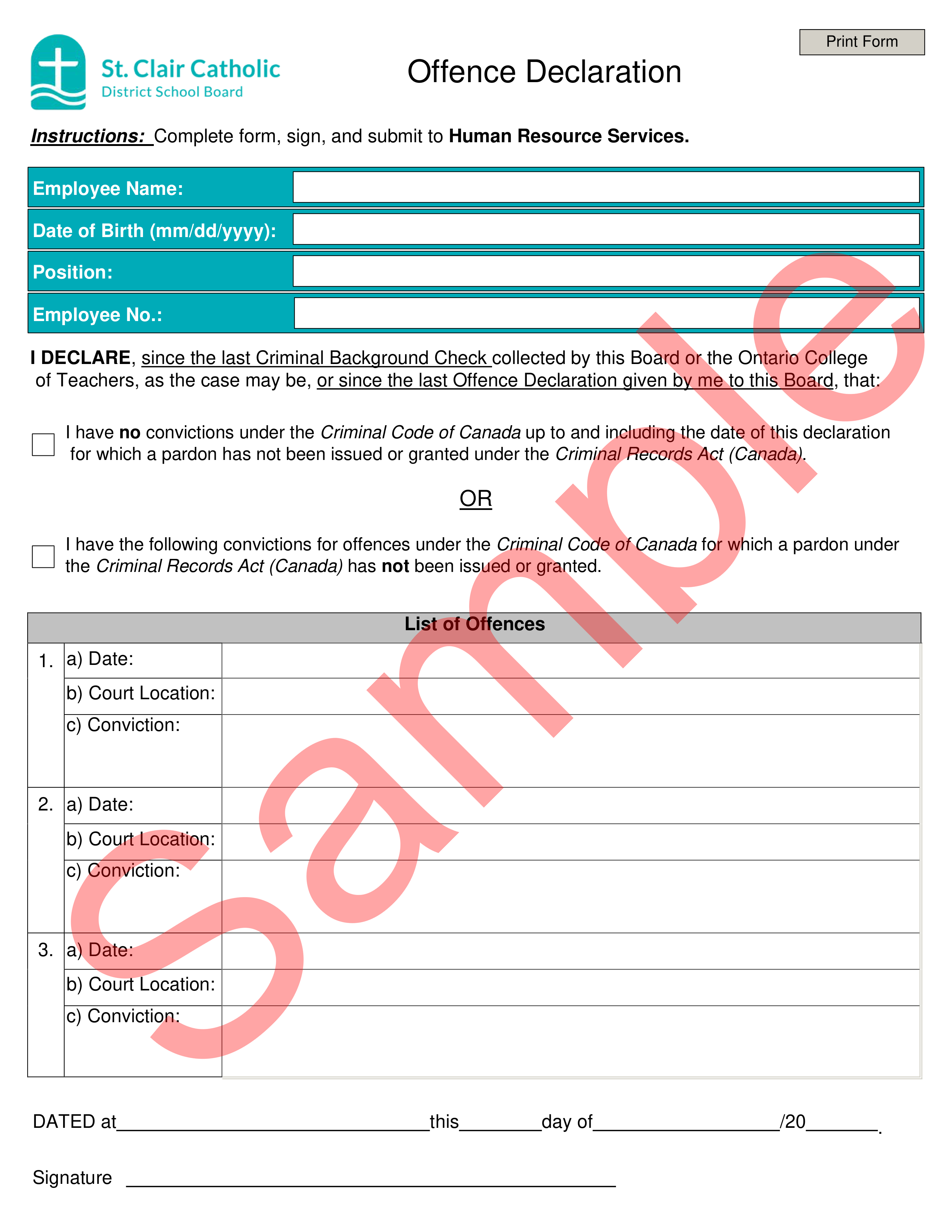
Workplace Dress Code
Date: 2000 12 01 / 2011 06 30 / 2012 08 31 / 2018 01 23 / 2024 06 18
Policy Statement
The St. Clair Catholic District School Board believes that employee attire reflects the values consistent with a Catholic School System.
Policy Goals
- Require all Board employees to project a professional image to our students, parents, visitors, co-workers, school volunteers and all stakeholders in Catholic Education.
- Confirm the Board’s commitment to the principles of equity and inclusive education, consistent with our Catholic teachings, which value and promote human rights and social justice.
Date: 2000 12 01 / 2011 06 30 / 2012 08 31 / 2018 01 23 / 2024 06 18
Administrative Procedures
Responsibilities
- All staff are responsible for adhering to this Dress Code Policy.
- The Principal of the school may declare not more than one (1) dress down day per week for the school.
- The Director of Education may declare a limited number of dress down days for the central office staff.
- Attire on dress down days and school spirit days may be more casual; however, it is still required that dress project a professional image.
Expectations
Dress and Appearance
The expectation for the dress and appearance of employees is one that promotes a professional image.
- Staff shall dress professionally for their assigned tasks.
- Board issued identification badges must be worn at all times and must be positioned above the waist with the employee’s picture showing.
- While on duty, custodial and maintenance staff shall wear Board approved uniforms.
- Clothing with offensive, culturally insensitive or inappropriate words, terms or logos, with large logos, with pictures, with cartoons or with slogans shall not be worn.
Footwear
Wearing appropriate footwear can play an important role within our schools and worksites in reducing accidents. It is the responsibility of all staff to wear footwear that is appropriate for the job. When choosing footwear, staff should take the time to consider their job tasks and the environmental conditions of their work area in relation to the potential for injury to the foot and/or the potential for slips, trips, and falls. Staff should refer to the Board’s Footwear Safety Guidelines to assist with choosing the appropriate footwear for the various circumstances that may be encountered within our School Board.
Additional Information
The St. Clair Catholic District School Board is committed to the principles of equity and inclusive education, consistent with our Catholic teachings, which value and promote human rights and social justice in all Board policies, programs, guidelines, operations and practices.
References
- Occupational Health and Safety Act
Workplace Health & Safety
Date: 2000 12 01 / 2003 06 24 / 2005 03 30 / 2008 02 27 / 2015 04 28 / 2023 05 30
Policy Statement
The St. Clair Catholic District School Board is committed to work with its employees to maintain a safe and healthy work environment.
The St. Clair Catholic District School Board has a vital interest in the well-being of its employees and as an employer has the ultimate responsibility for worker health and safety. Supervisors are accountable for the health and safety of those workers under their supervision. It is the responsibility of supervisory staff to ensure that the work environment, including machinery and equipment, is safe; that all work is performed in compliance with safe work practices outlined by the Board; and that all workers are trained in their specific work tasks to protect their health and safety.
Every employee of the St Clair Catholic District School Board has a responsibility to work co-operatively to protect his/her own personal safety in compliance with applicable legislation and safe work practices as outlined by the Board. Every employee has an obligation to report unsafe circumstances or practices to his/her supervisor.
Policy Goals
- Develop and undertake measures to ensure that every reasonable precaution is taken to provide a safe and healthy work environment for all employees.
- Meet or exceed legislated requirements with respect to Workplace Health and Safety.
- Ensure that a health and safety program is provided, maintained and revised annually, as required.
- Set expectation requiring every employee’s full commitment and participation in the Board’s Health and Safety Program.
Date: 2000 12 01 / 2003 06 24 / 2005 03 30 / 2008 02 27 / 2015 04 28 / 2023 05 30
Administrative Procedures
Responsibilities
-
- The Director of Education will ensure that a health and safety program is maintained, communicated and implemented in accordance with the provisions of the applicable legislation and regulations, and that employees will actively participate in the program.
- The Director of Education will review the Workplace Health and Safety Policy annually and have it clearly posted in each workplace.
- The Director of Education, or designate will maintain and support a Joint Health and Safety Committee which operates under the "Terms of Reference for the Joint Health and Safety Committee.”
- The senior administrator responsible for Human Resource Services and the Safety and Disability Administrator will provide direction and support for the health and safety programs within the Board.
-
Where health, safety, environmental and other related legislation and regulations have been proclaimed by the Province of Ontario, the Director of Education, or designate, will institute the necessary programs, including but not exclusive of the following:
- Training and supervision to protect the health and safety of the worker and acquaint workers with workplace hazards;
- Health programs to disseminate the latest developments in health and safety and disease prevention;
- A reporting system whereby injury trends can be recognized and analyzed for preventive measures;
- An inventory of chemicals and other hazardous materials that exist in Board buildings and a process for safe storage;
- Health and safety committees as required, so that health and safety and environmental issues can be addressed or directed to the appropriate agency;
- Emergency procedures for dealing with such sudden unexpected situations as fires, explosions, major releases of hazardous materials, violent occurrences or natural hazards;
- A schedule and process for regular inspections of the workplace to assess and control hazards.
- Employees have a common responsibility for their own health and safety and that of others and are required to adhere to safe work practices and to report to their supervisor any unsafe or unhealthy conditions or practices.
Expectations
-
- The Board will model and promote efforts that lead to a safe and healthy environment. Supervisory officers, principals, managers, and all other supervisory staff are accountable for implementing applicable Board safety programs, for complying with the Ontario Occupational Health and Safety Act, and for ensuring that workplaces under their direct control are kept in a healthy and safe condition.
- Every supervisor who has charge of a workplace or workers will be familiar with the Board’s Health and Safety Program and will maintain and implement the program in the workplace.
- Employees will actively participate in meeting the Board’s commitment to health and safety through cooperation and shared responsibility as required by the Ontario Occupational Health and Safety Act and through the safety programs of the Board.
Additional Information
The St. Clair Catholic District School Board is committed to the principles of equity and inclusive education, consistent with our Catholic teachings, which value and promote human rights and social justice in all Board policies, programs, guidelines, operations and practices.References
- Occupational Health and Safety Act
Workplace Violence Prevention
Date: 2010 06 22 / 2015 04 28
Policy Statement
The St. Clair Catholic District School Board is committed to providing a violence-free workplace in which all people respect one another and work together to achieve common goals. Any act of workplace violence is unacceptable. Workplace violence in any form erodes the mutual trust and confidence that are essential to the well-being of our staff.
The Board is committed to addressing any form of workplace violence or threat of violence reported. This includes inappropriate behaviour reported to have occurred while on or off Board premises, while engaging in workplace activities or workplace social events. This policy also addresses the threat of domestic violence being carried out in the workplace when that information is shared.
This policy applies to all members of the Board community including but not limited to: trustees, students, employees, visitors such as parents and community members, volunteers, permit holders, contractors and employees of other organizations who work on or are invited onto Board property.
Policy Goals
- Encourage and support an environment that reflects Catholic values of respect and dignity of the person and that is free from workplace violence.
- Confirm that all acts of workplace violence are strictly prohibited.
- Set the framework for an effective and comprehensive workplace violence prevention and response program that meets the requirements of the Occupational Health and Safety Act.
Definitions
Workplace: The workplace is any place where employees perform work or work-related duties or functions. Schools and school-related activities, such as extra-curricular activities and excursions, comprise the workplace, as do Board offices and facilities. Conferences and training sessions fall within the ambit of this policy.
Workplace Violence:
- The exercise of physical force by a person against an employee, in a workplace, that causes or could cause physical injury to the employee,
- An attempt to exercise physical force against an employee, in a workplace, that could cause physical injury to an employee,
- A statement or behaviour for which it is reasonable for an employee to interpret as a threat to exercise physical force against the employee that could cause physical injury to the employee.
Date: 2010 06 22 / 2015 04 28 / 2022 05 31
Administrative Procedures
A – Addressing Workplace Violence
Responsibilities
- Under the Occupational Health & Safety Act, the Board as the employer is responsible to take every precaution reasonable to protect employees by developing a policy concerning workplace violence which includes the definition of “Workplace Violence”. The employer will post this policy in the workplace in an area common to all employees.
- The Board shall develop and maintain a Workplace Violence Program to include measures and procedures to control risks, means to summon immediate assistance if workplace violence occurs, steps for reporting incidents of workplace violence and steps in dealing with domestic violence. A process for conducting an investigation will be outlined.
-
The Principal/Supervisor will advise the employee of his/her responsibility to advise the Board or his/her Supervisor of any incident or risk of workplace violence of which he/she is aware.
-
In consultation with the Safety and Disability Administrator, Principal/Supervisors will release information to an employee that may be at risk of workplace violence from a person with a history of violent behaviour if:
- the employee can be expected to encounter that person in the course of his or her work; and
- the risk of workplace violence is likely to expose the employee to physical injury.
-
In consultation with the Safety and Disability Administrator, Principal/Supervisors will release information to an employee that may be at risk of workplace violence from a person with a history of violent behaviour if:
-
To assist in maintaining a safe work environment, the Board shall provide employees with the following:
- Training that will review the Workplace Violence Prevention policy and procedures;
- Information on reporting incidents of workplace violence and the investigation process;
- A list of agencies in the area that can assist in coping with workplace or domestic violence.
- This policy shall be reviewed annually with the Joint Health & Safety Committee.
Expectations
- To assist in minimizing workplace violence, a risk assessment was completed by employees that identified risks and where controls are required. The assessment took into account all circumstances that are common to workplaces and specific to Board workplaces. The results of the assessment were shared with the Joint Health & Safety Committee. A risk assessment will be conducted as often as necessary, or at the recommendation of the Joint Health & Safety Committee.
- Principals/Supervisors are required to take every precaution reasonable against violence in the workplace of which they are aware. This also includes awareness of any domestic violence situations that is likely to expose an employee to physical injury in the workplace.
- The Principal/Supervisor will not disclose more personal information than is reasonably necessary to protect the employee from physical injury.
- This policy prohibits reprisals against individuals, acting in good faith, who report incidents of workplace violence or who act as witnesses. The Board will take all reasonable and practical measures to prevent reprisals, threats of reprisal, or further violence. Reprisal is defined as any act of retaliation, either direct or indirect.
B – Addressing Identified Risks
The St. Clair Catholic District School Board takes a proactive approach to identify and address hazards in the workplace. The Board conducted a Risk Assessment to identify any risks of violence in the workplace. The following risks were identified and procedures were created to eliminate and/or minimize the risks.
Safety in the Workplace – Parking Lots
Board employees identified lighting in the school parking lots as a risk for violence in the workplace.
- The Board is responsible to ensure all lights in school parking lots on Board property are maintained and in working order.
- During the monthly workplace inspection an inspection of the lights located in the parking lot will occur.
- The school custodian is required to enter work orders for lights which need replacing or repair.
- The Principal/Supervisor is responsible to address any individual issues that may be brought up as a concern.
- Employees who will be leaving the building after dark should park their vehicle near the school entrances.
Safety in the Workplace – Aggression by Students Toward Employees
Board employees identified students who become hostile and aggressive towards employees as a risk for violence in the workplace.
- Students have a right to education under the Education Act; policies and procedures are in place and training is provided to respond to situations where students become aggressive or hostile towards employees.
- The Board requires all employees (Principal, Emergency Response Team members, Educational Assistants) who are regularly required to apply intervention techniques to participate in training with respect to non-violent crisis intervention.
- The Principal/Supervisor is responsible to ensure any violent incidents that occur between an employee and a student are reported by completing an Accident/Incident Report Form.
- The Joint Health & Safety Committee reviews incidents of aggression by students towards employees for possible trends. They determine if future actions are required and make recommendations to the Board accordingly.
- In cases involving students with special needs, Human Resource Services consults with the Special Education Department where trends may suggest a change in the student’s individual education plan may be warranted.
Safety in the Workplace – Working Alone
Board employees identified employees working alone as a risk for violence in the workplace. Any employee working alone must have a communication plan during that working alone time.
-
Custodians
- Custodians who work alone are required to follow the procedural guideline set out by the Facility Services Department “Solitary Worker’s Communication Plan.”
- Custodians are required to perform an inspection of the building before leaving for the evening to account for any employees who may still be working. The custodian is to notify the employee that they will be working alone and that they are required to set the alarm at departure.
- The school security systems will no longer be alarmed automatically. Custodians will be required to set the alarm as they depart for the night unless other employees are still in the building where they will be notified as in 5.1.2. If the alarm is not set by the designated time, the maintenance pager will be called and someone will be dispatched to the school to investigate.
-
All other employees
- Employees who work after hours or over the weekend are responsible to ensure they have a communication plan in place in the event of an emergency or risk of violence in the workplace.
- Employees are required to sign in and out when working after hours or during the weekend.
-
Communication Plan
- When employees are working after hours or on weekends they must advise a colleague or a family member that they will be at work at a particular time. The two parties will agree on a check time and a plan of action if the employee is not reporting in at the agreed upon check time.
Safety in the Workplace – Other Measures
Measures which are already in place to protect employees from violence in the workplace include:
- The Board requires all Board employees to wear identification badges while at work in any Board facility. Identification badges should clearly show the employee’s photo and should be positioned above the waist so as to be clearly visible.
- Visitors must “sign-in” when entering a school or Board facility. They will be provided with a visitor’s badge that they will wear during their time at the Board facility.
- To control visitor access to elementary schools during the school day, all doors are located with a security access system in place at each entrance.
- School phones have a direct speed dial button which contacts the school office immediately.
- When Board employees are working after hours/weekends, they are required to keep all doors locked.
C – Reporting Workplace Violence
Every employee is required to report incidents where workplace violence has occurred or where it is likely to occur. Nothing in this procedure takes away the right of an individual to report such incident to the police. Furthermore, at any time during the investigation of a report of workplace violence the Board may decide it necessary to submit a police report. The following procedure outlines the steps required for reporting incidents of workplace violence.
Responsibility
Employee
- The employee is to report the incident to his/her Principal/ Supervisor.
- The employee is required to complete an Accident/ Incident Report Form.
- Pending the investigation, the employee will follow the directions given by his/her Principal/Supervisor and the Safety and Disability Administrator.
Principal/Supervisor
- The Principal/Supervisor is responsible to take all precautions reasonable to ensure workplace safety and the safety of persons reporting an incident of violence.
- The Principal/Supervisor is responsible to immediately notify the Safety and Disability Administrator or the senior administrator responsible for Human Resource Services of an incident of violence in the workplace.
- In the event the injury to the employee is critical, the Principal/Supervisor is to make an immediate contact with the senior administrator responsible for Human Resource Services, who will contact the Ministry of Labour accordingly.
- In the event of a critical injury, the Ministry of Labour will provide direction, otherwise the principal or designate is to conduct an immediate investigation into the assault, establishing facts and questioning witnesses.
- Where the alleged assailant is an employee, the Principal/Supervisor ensures there is no further contact between the employees and makes an immediate contact with the senior administrator for Human Resource Services for direction and to conduct the investigation.
Safety and Disability Administrator
- The Safety and Disability Administrator will conduct an investigation into the report of workplace violence.
- The Safety and Disability Administrator will report to the senior administrator responsible for Human Resource Services or designate of the results of the investigation. As a result of the investigation, recommendations necessary to remedy the incident and put measures in place to control the risks may result.
- The Safety and Disability Administrator will present the incident and findings of the investigations to the Joint Health & Safety Committee.
- The Safety and Disability Administrator will report to the Workplace Safety and Insurance Board any incidents of workplace violence for which the employee seeks medical attention or has lost time from work.
- When appropriate, the Safety and Disability Administrator will further report to Senior Administration.
Joint Health & Safety Committee
- The Joint Health & Safety Committee will review the incidents of Workplace Violence for trends and to determine if future actions are required and make recommendations to the Board accordingly.
D – Summoning Immediate Assistance
In the moments preceding or during an event of workplace violence, employees need to have options available to summon immediate assistance.
Expectations
When an employee is the victim of workplace violence or where violence is likely to occur, the employee can summon immediate assistance with one of the following mechanisms. The method of summoning assistance will depend on a variety of circumstances including time of day and location. Depending on the situation, the employee has options such as:
- Call to others, the Office, or 911 for “HELP!”
- School-wide P.A. System to page for assistance throughout the school
- 2-way Radio (Walkie/Talkie)
- Activate Fire Alarm
E – Domestic Violence
The St. Clair Catholic District School Board is committed to take every precaution reasonable to protect employees from domestic violence that is likely to expose employees to physical injury in the workplace.
Unlike many risks which may lend themselves to regular and ongoing assessment, the risk of domestic violence in the workplace is much more variable and less easily anticipated.
Responsibility
- The Board is responsible for taking action to reduce the risk of physical injury in the workplace against an employee from a domestic violence situation. Information regarding domestic violence is attached in Appendix A.
- All employees are responsible for creating and maintaining a workplace environment in which employees are protected from domestic violence that may expose employees to physical injury in the workplace.
- Employees who believe that they or other employees are subject to domestic violence that may expose them or other employees to physical injury in the workplace are responsible to inform their supervisor as stated in Section 28 (1) (d) of the Occupational Health & Safety Act.
- The Principal/Supervisor is responsible to treat all reports of domestic violence in confidence and to notify the Safety & Disability Administrator or designate.
- The Safety & Disability Administrator or designate is responsible to conduct an investigation by gathering information, making any necessary arrangements to ensure the safety for the victim or other employees in the workplace which may include contacting the police.
- The Safety & Disability Administrator or designate is responsible to provide the victim and other employees with information about supports available for situations of domestic violence.
- A Threat Assessment Team consisting of the Principal/ Supervisor, Safety & Disability Administrator and the senior administrator responsible for Human Resource Services will review each case of threat of domestic violence to ensure the level of threat is evaluated and appropriate safety measures are put in place.
F – Informing Employees of Potential Student Violence
The St. Clair Catholic District School Board is committed to taking every precaution reasonable to protect employees from violence presented by students that is likely to expose the employee to workplace violence in the workplace.
Unlike many risks which may lend themselves to regular and ongoing assessment, the risk of violence in the workplace from students can be much more varied and less easily predicted. In addition, the Board is committed to ensuring students’ right to an education and the obligation to protect their right to privacy from undue disclosure of private information.
The goal of this procedure is to clarify when information will be shared with employees regarding risks of workplace violence by students so that safety is enhanced and privacy is protected.
Responsibility
- All employees are responsible for creating and maintaining a workplace environment in which employees are protected from violence including the reporting of violent incidents according to the Board’s Student Discipline Policy.
- Communicating on a “need to know” basis protects the privacy of the student and ensures that personal information about the student is restricted to an appropriate number of employees.
- The Principal/Supervisor is responsible for treating all reports of violence in confidence to the extent possible pursuant to this procedure. The Principal/Supervisor is also responsible for determining whether a student poses a risk of workplace violence and determining the extent of and to whom the information will be disclosed. The disclosure of information only occurs when there is a history of workplace violence. It is important to note that the employer is only permitted to disclose the amount of student information reasonably necessary to protect employees from physical injury.
-
Each situation will be considered on a case-by-case basis, taking into account the needs of the individuals involved. The following considerations will guide the Principal when determining the extent to which employees will be warned of a risk of workplace violence:
- Date of the event. The general guideline of a time frame when determining a history of violence is within the past 12 months.
- Degree, intent, and frequency of the workplace violence.
- The individual against whom the violence was directed.
- Location of workplace violence (i.e., school property/school hours, or off-site/non-school hours), and that documentation is available for review.
- Information will be provided to employees in accordance with this procedure where a student with a history of workplace violence presents a risk if the employee can be expected to encounter that student in the course of his or her work.
- The information shared is to be objective and descriptive of behaviour (who, what, where, when, and if possible, why), as opposed to subjective and conclusive. The information shared will include what types of behaviours may be expected, and what strategies are to be used by an employee in the event of escalating or workplace violence.
-
The guidelines below are to be followed by the Principal/Designate where a student could expose an employee to physical injury:
-
Students in full time supported programs (i.e., Life-Skills program) have contact with a limited number of employees.
- The employees working with these students and employees likely to come into contact with these students will be advised by their Principal or designate of the behaviours that could pose a risk (i.e., hair pulling, hitting, etc.). The principal will review with employees a plan to both prevent and address these behaviours if, and when they occur.
-
Students in supported programs that integrate into regular classroom settings:
- The employees working with these students and employees likely to come into contact with these students will be advised by their Principal or designate of the behaviours that could pose a risk (i.e., hair pulling, hitting, etc.). The principal will review with employees a plan to both prevent and address these behaviours if, and when they occur.
- Employees who may not work one on one with these students but could be expected to encounter them (i.e., classroom teachers) will be provided with information regarding risk of aggressive behaviours and strategies to address.
-
Students in regular classroom settings that are known to present a risk of workplace violence:
- Any employee that could be expected to encounter the student will be advised by their Principal or designate of the risk factors and appropriate prevention and response.
-
Students in full time supported programs (i.e., Life-Skills program) have contact with a limited number of employees.
- The Principal will notify staff of the potential for violence directly in person or in a staff meeting, whichever is appropriate under the circumstances.
- Where an incident of workplace violence occurs during the school year, the Principal will determine the extent to which employees will be notified and communicate that decision to the school’s Health and Safety Representative.
- Safety plans, or other support plans in place, will be appropriately implemented (i.e. medication monitoring, behaviour plans) and appropriate de-escalation strategies will be utilized for identified students.
- The Principal/Supervisor will ensure that proactive strategies are in place and communicated to the employee to mitigate aggressive and potentially workplace violence by providing the appropriate guidance for violence prevention and de-escalation. Additional strategies in place include the Emergency Response Team protocol and Lockdown procedures. These will prepare employees to respond to students in both regular classroom settings and within the school who have not been previously known to present a risk of workplace violence.
- Situations of change (i.e., schools, grades, teachers, educational assistants) may increase opportunities for aggressive behaviours. During times of transition, it is particularly important to be vigilant with programming and supports for both employees and students.
- Should the employee disagree with the Board’s decision regarding the disclosure relating to an incident of workplace violence under item nine (9) above, the employee shall request that the Principal reconsider this decision. In the event the Principal upholds the original disclosure decision, the employee is entitled to request reconsideration by the senior administrator responsible for Human Resource Services, whose decision is final in respect of whether disclosure will be made. This provision does not preclude the employee from exercising his or her rights under the Occupational Health and Safety Act.
- A student who may pose a risk of workplace violence one year may or may not constitute a risk in future years. With this in mind, the length of time a student continues to be a risk of workplace violence and is subject of notification to staff will be determined at the discretion of the Principal.
Additional Information
The St. Clair Catholic District School Board is committed to the principles of equity and inclusive education, consistent with our Catholic teachings, which value and promote human rights and social justice in all Board policies, programs, guidelines, operations and practices.
Definitions
Workplace: The workplace is any place where employees perform work or work-related duties or functions. Schools and school-related activities, such as extra-curricular activities and excursions, comprise the workplace, as do Board offices and facilities. Conferences and training sessions fall within the ambit of this policy.
Workplace Violence:
- the exercise of physical force by a person against an employee, in a workplace, that causes or could cause physical injury to the employee,
- an attempt to exercise physical force against an employee, in a workplace, that could cause physical injury to an employee,
- a statement or behaviour for which it is reasonable for an employee to interpret as a threat to exercise physical force against the employee that could cause physical injury to the employee.
Critical Injury: defined as an injury of a serious nature that,
- places life in jeopardy
- produces unconsciousness
- results in substantial loss of blood
- involves the fracture of a leg or arm but not a finger or toe
- involves the amputation of a leg, arm, hand or foot but not a finger or toe
- consists of burns to a major portion of the body, or
- causes the loss of sight in an eye
Domestic Violence
What is Domestic Violence?
Domestic violence is widely understood to be a pattern of behaviour used by one person to gain power and control over another person with whom he/she has or has had an intimate relationship. The pattern of behaviour may include physical violence, sexual, emotional, and psychological intimidation, verbal abuse, stalking and using electronic devices to harass and control. Anyone can be a victim of domestic violence, whatever his/her age, race, economic status, religion, sexual orientation, or education. While men can be victims of domestic violence, women represent the overwhelming majority of victims.
Recognizing Domestic Violence
While there are numerous manifestations of domestic violence, the most common one in the workplace is harassment, either over the phone or in person. The following are a list of signs to help recognize domestic violence:
- The victim may try to cover up bruises, appear sad, lonely, and withdrawn. They may also have trouble concentrating on a task, apologize for the abuser’s behaviour, or appear nervous when the abuser is in the workplace.
- The victim may make last-minute excuses or cancellations or use drugs or alcohol to cope.
- The victim may miss work frequently or more often than usual with no explanation.
- The abuser may interfere with the victim at work by phoning or emailing repeatedly, or by watching or stalking the victim.
- The abuser may display jealous or controlling behaviour by arriving at the workplace for no reason, asking other employees questions about the whereabouts of the victim or threatening the victim.
- The abuser may attempt to prevent the victim from getting to work by physically restraining her or interfering with her transportation.
Reasonable Precautions
It is important to deal with each situation on a case-by-case basis, taking into account the needs of the
individuals involved.
Together with the Safety & Disability Administrator, the Principal/Supervisor and the employee will
create a safety plan unique to the individual’s situation. The plan will look at increased safety
measures that can be implemented in the workplace.
Privacy While Protecting Employees
Sometimes the employer’s duty to take every precaution reasonable in the circumstances to protect
employees may outweigh an individual’s expectation for privacy. In other words, the victim’s privacy
may need to be balanced against ensuring the safety of others.
Communicating on a “need to know” basis will ensure that information about a domestic violence situation is kept confidential or restricted to a minimum number of employees. (For example, only those who are directly responsible for ensuring the safety of those employees who may be at risk.)
Involving the victims in communication decisions may lessen the impact. For example, discuss who needs to be informed, what information will be communicated, expectations of confidentiality, and what the consequences will be for others if confidentiality is breached.
Caution should be exercised to ensure that the victim’s safety is not compromised.
What you can do to Help or if an Employee Discloses Abuse
If warning signs of domestic violence are noticed, or if an employee discloses abuse, here are some things you can do:
All Employees:
- Talk to the victim privately about what you or others have seen. Express concern for her safety.
- Assist with reporting the incident to the Principal/Supervisor or Safety and Disability Administrator.
- Provide information on help that is available and offer referrals to appropriate agencies (e.g., Shelters, Assaulted Women’s Helpline, Counselling, Employee and Family Assistance Program).
- Let the victim know that you will need to call the police if violence occurs at the workplace.
Principal/Supervisors should also:
- Help the victim develop a safety plan that takes into consideration safety at the workplace.
- Implement security measures and explore alternative work arrangements to increase safety.
- Assure the victim you are available to talk at any time and that support is available.
- Recognize that the victim knows the most about the violence and they may deny the signs of domestic violence.
- Let the victim know as the Supervisor you are responsible for workplace safety. Ask the victim to tell you if safety in the workplace becomes a concern.